Mercury: “A world in and of its own”

In March this year Nasa’s Messenger probe became the first spacecraft to orbit Mercury.  And, as the BBC reports, a few days ago Nasa released the scientific observations and data collected during the first three months of its scheduled year-long mission.  In the process a number of hypotheses about the innermost planet were consigned to the “dust bin of science”.  Mercury is not like the Moon, nor like the Earth, and it’s not “the burnt-out cinder of the solar system”. [All images …
Read more…

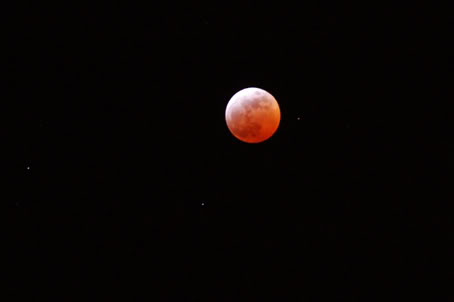
Totality begins…

…at 8.22pm [BST].  That’s tonight’s lunar eclipse and totality will last for 100 minutes – until 10.02pm [BST].  But it’s not, as the Irish Times claims Ireland’s “first lunar eclipse for five years.”  It is special however.  It’s a central total lunar eclipse – the center point of Earth’s shadow will fall on the moon – which explains the unusually long duration. It could be as spectacular as the 2007 total lunar eclipse, which Sammy Morse captured in the featured image above.  Or it …

Read more…

Destination: Vesta!

Nasa’s Dawn spacecraft will arrive at the 530km wide asteroid Vesta on 16 July, where it will spend the next 12 months in orbit.  Then it’s on to the dwarf planet, Ceres [950km wide].  Images Credit: NASA/JPL-Caltech/UCLA/MPS/DLR/IDA. The Hubble Space Telescope has already taken a look at Vesta but, on 1 June, Dawn captured its own views – at a distance of about 480,000km – to assist in the final navigation stage.  And Nasa have released those looped images as a video. From the JPL Nasa press …

Read more…

Tevatron’s false alarm

As the BBC reports, independent checks on a separate experiment at Fermilab’s Tevatron accelerator have found no evidence of “a completely new, unanticipated particle” the BBC had previously reported researchers had said they had found “compelling hints of”.  And, therefore, no signal of “a new fundamental force of nature, and the most radical change in physics for decades.” Which means Jon Butterworth was right to be sceptical [and his money’s safe! – Ed] Indeed.  I did say that BBC report was …

Read more…

Endeavour’s last visit to the International Space Station

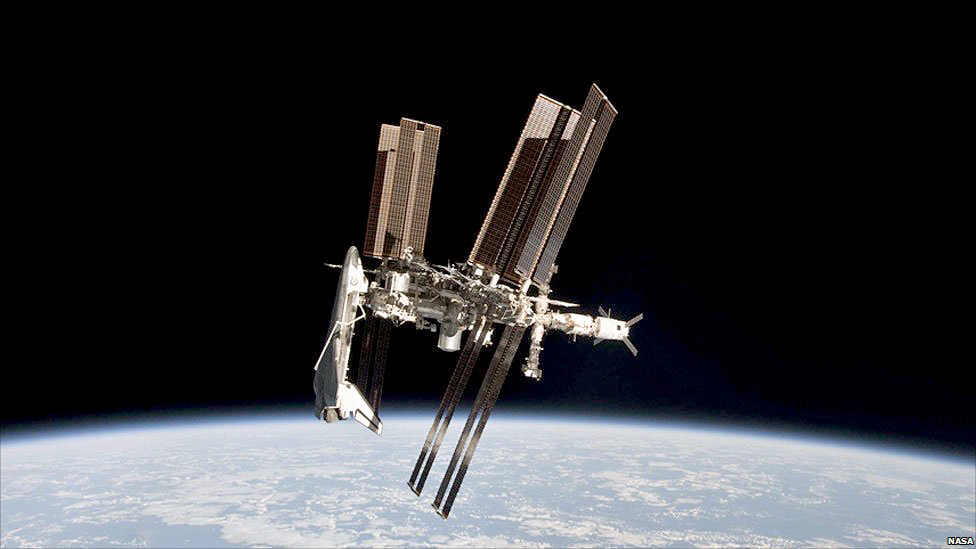
The BBC flagged up the stunning first-ever detailed image of a Space Shuttle docked at the International Space Station – Endeavour’s final voyage.  Now NasaTV have released the video.  The video was shot by European Space Agency astronaut Paolo Nespoli from the Russian Soyuz spacecraft that undocked from the station on May 23. He, Russian cosmonaut Dmitry Kondratyev and NASA astronaut Cady Coleman were departing the station for a return to Earth after five months on the station. Nespoli documented the …

Read more…

Spectacular Solar Eruption

Wondrous images from Nasa’s Solar Dynamics Observatory of the spectacular eruption that accompanied an M-2 (medium-sized) solar flare on June 7.  [Image/video credit: NASA SDO] And, via the Professor, Geeked on Goddard provides further video courtesy Helioviewer.org and a narration by The Sun Today. As LittleSDOHMI notes This Earth-directed CME [Coronal Mass Ejection] is moving at 1400 km/s according to NASA models. Due to its angle, however, effects on Earth should be fairly small. Nevertheless, it may generate space weather effects …

Read more…

Dr Neil Tyson’s “disturbing” thought for the day

The Guardian’s tame particle physicist, Jon Butterworth, is “playing truant” from the LHC at Cern to attend the Boost 2011 meeting at Princeton.  But he’s left a link-tastic post on the results so far.  Meanwhile, the Big G’s GrrlScientist points to director of the Hayden Planetarium, New York, astrophysicist Neil deGrasse Tyson, explaining one of his “disturbing thoughts”. As an aside, the paper, “The Origin of Chemical Elements”, was published in the 1 April 1948 issue of the Physical Review. The …

Read more…

Volcanic ash cloud: “We can’t rule out disruption”

Despite initial confidence that there would be little or no disruption caused by the ash cloud from the ‘significant eruption’ of the Iceland’s Grímsvötn volcano, aviation authorities in the UK and in Ireland seem to be becoming less certain that will be the case.  Video from Russia Today on YouTube. From the Irish Times report The IAA said that while it did not expect any flight disruptions within the next 48 hours the picture could change later in the week. “We don’t …

Read more…

Nasa images Alabama tornado tracks

Nasa has released some stunning satellite images, from the Advanced Spaceborne Thermal Emission and Reflection Radiometer (ASTER), of the ‘footprint’ left by the monster tornado which hit Tuscaloosa, Alabama, on April 27th.  The false-colour images use visible and infra-red data. [Image credit: Science@NASA] From the Science at Nasa report “This is the first time we’ve used the ASTER instrument to track the wake of a super-outbreak of tornadoes,” says NASA meteorologist Gary Jedlovec of the Marshall Space Flight Center in Huntsville, AL. In the …

Read more…

Endeavour’s Final Voyage – Redux

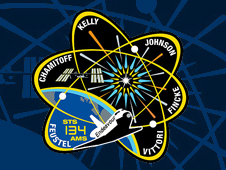
The scheduled April launch was scrubbed due to technical problems, but the final preparations are underway for the 25th and final launch, after 19 years in service, of the Space Shuttle Endeavour on Mission STS-134.  Launch is scheduled for 1.56pm [BST].  Via the NASAKennedy channel And a reminder that Endeavour’s final cargo, for the International Space Station, includes a 7-tonne particle physics experiment – the Alpha Magnetic Spectrometer (AMS).  And the AMS channel provides this informative Nasa overview of the experiment. As usual, there’s the launch blog …

Read more…

NASA images smoke from gorse fires

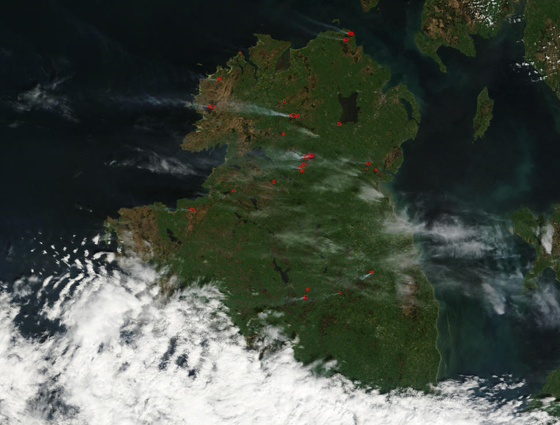
As the Belfast Telegraph notes, smoke from the fires across the UK and Ireland are clearly visible in the stunning satellite images from NASA/GSFC’s MODIS Rapid Response System.  This is a cropped, smaller, version of an image taken at 12.50pm [BST] on 2 May at a resolution of 500 metres.  Red is used to indicate the site of a fire.  (Image credit: NASA/GSFC, MODIS Rapid Response System) And a close-up of the visible smoke plumes.  Note to Belfast Telegraph – See “About Rapid Response Imagery”. …

Read more…

Voyager: Humanity’s Farthest Journey

While waiting for Endeavour’s final voyage, you can catch up, metaphorically, with the ongoing scientific odyssey of those other still-nimble Voyagers as they head towards the vastness of interstellar space.  ( Image credit: NASA/JPL-Caltech) NasaTV has Thursday’s special science presentation on the mission with a panel of the Voyager team – including Ed Stone, who’s been there since 1972, and Ann Druyan, creative director of the group, led by Carl Sagan and Frank Drake, who put together the Golden Record both Voyagers carry. …

Read more…

Endeavour’s Final Voyage

Following the final flight of Discovery, the next Nasa Space Shuttle to be retired, after 19 years of service, will be Endeavour. But first there’s the not insignificant matter of its 25th, and final, flight – Mission STS-134.  Lift-off is scheduled for 1547 local time (1947 GMT; 2047 BST) from the Kennedy Space Centre.  And via the NASAKennedy channel Endeavour’s final cargo, for the International Space Station, includes a 7-tonne particle physics experiment – the Alpha Magnetic Spectrometer (AMS).  And the AMS channel …

Read more…

Chandra finds evidence of Tycho’s origin

Nasa’s Chandra X-ray observatory has been in orbit since 1999 and it’s still producing results.  Like this stunning image of the remnant of the Type Ia supernova first observed by Danish astronomer Tycho Brahe in 1572. The data for the images was collected in 283 hours of observation from 2 pointings between April 29, 2003 and May 3, 2009. (Credit: NASA/CXC/Chinese Academy of Sciences/F. Lu et al) From the text accompanying Chandra’s Tycho photo album This new image of Tycho’s supernova remnant, …

Read more…

Enceladus ‘footprint’ on Saturn

Nasa’s Cassini probe has been exploring Saturn’s system of moons since 2004 – some archived posts here.  Recently it’s watched the weather on Titan and tasted Enceladus’ briny breath.  That briny breath is responsible for the latest observed phenomenon –  Aurora from Saturn moon ‘circuit’.  Image credits: NASA/JPL/University of Colorado/Central Arizona College.  Image details here. From the Cassini mission press release “The footprint discovery at Saturn is one of the most important fields and particle revelations from Cassini and ultimately may help us …

Read more…

First Orbit – 50 years on

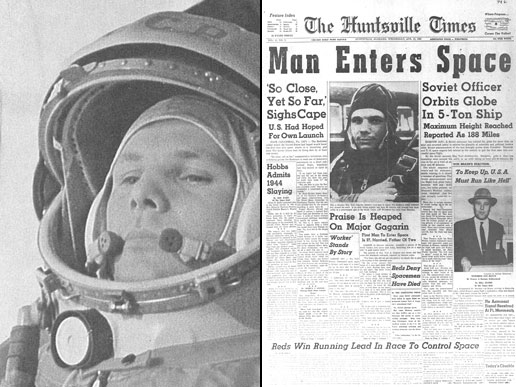
On 12 April 1961, Vostok 1 was launched and cosmonaut Yuri Gagarin became the first man to orbit the planet.  The BBC have a number of articles online as Russia marks the 50th anniversary of that flight – or, as the Guardian’s GrrlScientist calls it, Happy Yuri’s Night!  Nasa have some images, and this short clip of the launch from their archives. And, if you have the time, the Guardian point to this feature length documentary, First Orbit. But remember, compared to the rest of …

Read more…

Tevatron: “My money is on the false alarm at the moment”

A somewhat excited BBC report of potentially ground-breaking interim results from Cern LHC rival accelerator, Tevatron, is undermined by the statistical possibility of a false alarm. The Guardian’s tame particle physicist, at Cern, Jon Butterworth explains. If the histograms and data are exactly right, the paper quotes a one-in-ten-thousand (0.0001) chance that this bump is a fluke. That’s pretty small; although bear in mind that lots of distributions like this get plotted. If you plot 100 different distributions, the chances become about …

Read more…

“you may think it’s a long way down the road to the chemist’s…”

With Cassini exploring Saturn’s moons, and Messenger finally at Mercury, the BBC’s Spaceman, Jonathan Amos, takes an interesting look at the future prospects for interstellar travel.  And he starts with this observation of Voyager’s 33-year-long journey. I’ve been troubled of late by the scale of things, by the vastness of space. It’s been brought into focus by two things, I think. The first is the Voyager 1 probe – the most distant man-made object from Earth. I’ve written a couple of …

Read more…

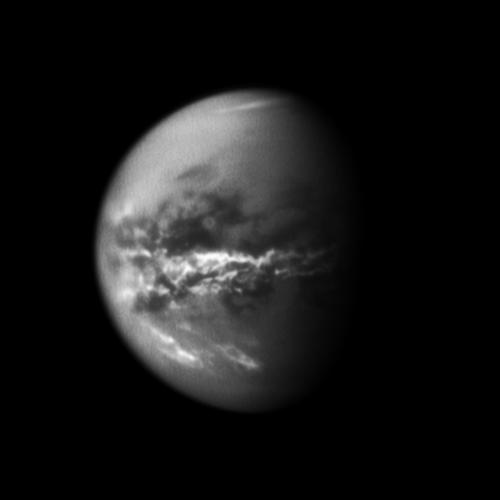
Weather watching… on Titan.

Nasa’s Messenger spacecraft may have finally arrived in orbit around Mercury, but the Cassini probe has been exploring Saturn’s system of moons since 2004 – some archived posts here.  [Image Credit: NASA/JPL/SSI] The latest images show seasonal weather patterns, and apparently associated surface changes.  From the Nasa/JPL press release Extensive rain from large cloud systems, spotted by Cassini’s cameras in late 2010, has apparently darkened the surface of the moon. The best explanation is these areas remained wet after methane rainstorms. …

Read more…

Messenger to Mercury

Tonight at 12.45am [GMT] Nasa’s Messenger spacecraft will begin a 15 minute engine burn timed to take it into orbit around Mercury – the first spacecraft to do so.  (All images credit: NASA/Johns Hopkins University Applied Physics Laboratory/Carnegie Institution of Washington) Launched on 3 August 2004, Messenger’s taken a circuitous route to the innermost planet. It’s second, and final, look at the Earth was in August 2005. Twice past Venus, the second time in June 2007 Before not one, not two fly-bys, but …

Read more…