See beautiful Ontario Lacus!

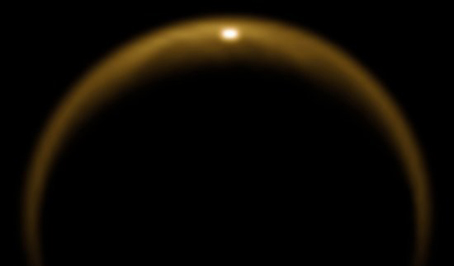
Using radar data from the Cassini spacecraft’s flybys on June 22, 2009, July 8, 2009, and Jan. 12, 2010, Nasa’s Jet Propulsion Laboratory have produced this animated flyover of a potential future holiday destination – the lakes of Titan.  Just don’t forget to pack the thermal underwear…  Video credit: JPL News From the JPL press release Ontario Lacus, the largest lake in the southern hemisphere of Saturn’s moon Titan, turns out to be a perfect exotic vacation spot, provided you can handle the frosty, subzero …
Read more…

World Cups and Solar Eclipses

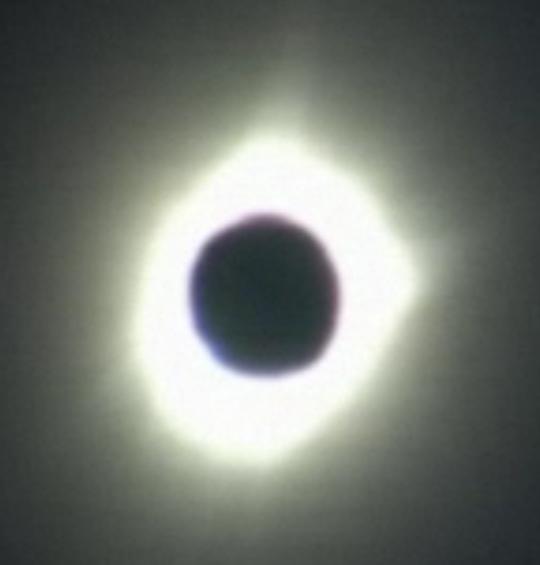
As the crowds gather in Johannesburg for the FIFA World Cup Final between Spain and the Netherlands an estimated 4000 umbraphiles are hoping for clear skies over Easter Island – and no vuvuzelas. They’ve travelled there to be able to observe 4 min 41 secs of the total solar eclipse of July 11, 2010, which is due to occur at the same time that 22 men are chasing after a very round ball on a large patch of grass…  9.11pm BST start for the Easter Island hopefuls. In the New …

Read more…

Asteroids Rock! – redux – Updated

[Updated with images from the fly past]  Japan’s Hayabusa probe looks like it might have successfully returned material from the asteroid Itokawa, if not as much as they had hoped.  Meanwhile Esa’s Rosetta probe, last seen [on Slugger] in 2008, is taking time out from its mission to the comet 67P/Churyumov-Gerasimenko to take a look at the asteroid Lutetia. Artist’s impression of Lutetia. Image credits: ESA – C. Carreau. At 4.44pm [BST] today Rosetta will fly past the 100km wide Lutetia …

Read more…

It’s Science Friday!

Here’s a short interesting video, with stunning images, on the solar weather under investigation with the help of the Solar Dynamics Observatory. Pete Baker

“it’s a thing of beauty”

Launched in May 2009 ESA’s super-cool Planck observatory achieved first light in September.  Now, as the BBC’s Jonathan Amos notes, ESA have released Planck’s first all-sky image. “This is the moment that Planck was conceived for,” says ESA Director of Science and Robotic Exploration, David Southwood. “We’re not giving the answer. We are opening the door to an Eldorado where scientists can seek the nuggets that will lead to deeper understanding of how our Universe came to be and how it …

Read more…

“verdict against Galileo was rational and just…”

Galileo Galilei didn’t invent the telescope.  But he was convicted of heresy by the Catholic Church.  I’ve mentioned his trial before.  And Pope Benedict XVI’s argument that the “verdict against Gaileo was rational and just, and revisionism can be legitimized solely for motives of political opportunism.” [Adds As tierney comments below, I should have noted that Benedict is quoting the philosopher P Feyerabend] Today Will Crawley noted the arguments of a Fr Ernan McMullin On today’s Sunday Sequence, Fr Ernan McMullin, …

Read more…

LRO celebrates one year in orbit

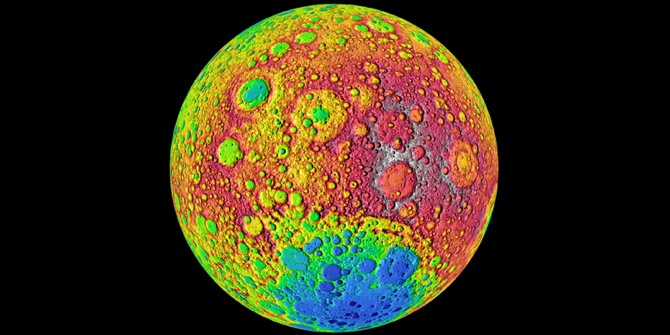
Launched on 18 June 2009, Nasa’s Lunar Reconnaissance Orbiter sent back its first images of the lunar surface shortly afterwards and has just completed its first full year in orbit.  To celebrate Nasa has put together a short video of ten cool things its found – some of which I may have noted at the time. Image credit: Nasa/Goddard/Arizona State University. Video credit: NASA/Goddard. Pete Baker

“Asteroids Rock!”

As the BBC notes, Japanese scientists are confident they have successfully retrieved the first samples ever grabbed from the surface of an asteroid, Itokawa, after recovering a capsule from the Hayabusa spacecraft in the Australian outback. The Japanese space agency (Jaxa) says the capsule looks to be intact. The return was the culmination of a remarkable seven-year adventure, which saw Hayabusa visit asteroid Itokawa in 2005 and attempt to pluck dust from its surface before firing its engines for home. The …

Read more…

More telescopes…

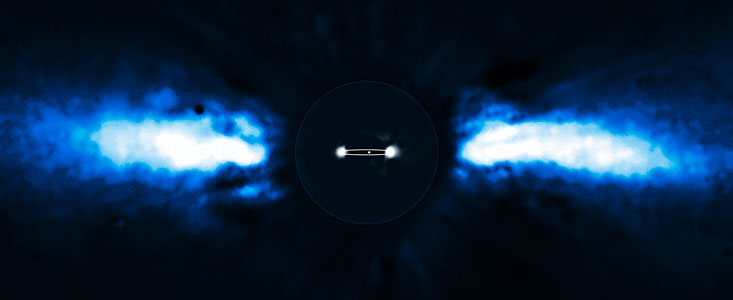
As the BBC notes, for the first time astronomers have directly observed the orbit of an exo-planet – Beta Pictoris b, a gas giant about nine times the mass of Jupiter, some 60 light-years from Earth, in the constellation of Pictar.  The team used the European Southern Observatory’s Very Large Telescope (VLT) in Chile. [Image credit: ESO] Only 12 million years old, or less than three-thousandths of the age of the Sun, Beta Pictoris is 75% more massive than our parent …

Read more…

Interpreting the Giants’ Causeway…

A week or so ago, Will Crawley noted that a fundamentalist campaign group, the Caleb Foundation, were claiming that NI Culture Minister Nelson McCausland’s intervention at the Ulster Museum was as a direct result of their lobbying. On Evening Extra today, a representative of the Foundation [it may have been chairman, Wallace Thompson] confirmed that, encouraged by that ‘success’, they had contacted the NI Tourism Minister, the DUP’s Arlene Foster, seeking a similar ministerial intervention in the consultation over the Giants’ Causeway Interpretive Centre.  They had a lobbying campaign already underway. It’s worth noting that …

Read more…

Fireball on Jupiter!

Via Space Weather.  Amateur astronomer Anthony Wesley was the first to observe the Great Black Spot [of Jupiter].  Now he’s gone one better and recorded an actual impact on the gas giant.  The resulting fireball was independently confirmed by Christopher Go in the Philipines – his video can be viewed here. Here’s the full processed image of the impact, visible in bottom right. Image credit: Anthony Wesley, Broken Hill Australia. And here’s the raw video observation. The impact occurs in the top left in …

Read more…

Venter’s ‘artifical’ life “interesting but not profound”

Controversial scientist Craig Venter grabbed the headlines last week when it was reported that his team of researchers had created “artifical” life. But, as Dick Ahlstrom noted in Saturday’s Irish Times, several scientists [in Ireland] were not as enthusiastic. “I think it has been exaggerated. He has a reputation for showmanship,” Prof Wolfe, professor of genome evolution, said yesterday. “He hasn’t created life, he has mimicked life. It is a technical achievement to synthesise a piece of DNA that size,” he added. “It …

Read more…

The strange case of Ex-Dr Wakefield and the MMR vaccine…

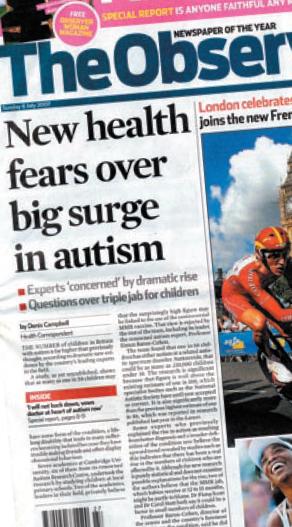
Andrew Wakefield is the ex-doctor, whose scant regard for scientific accuracy or ethics has led to him being struck off the medical register. Yesterday the General Medical Council (GMC) found him guilty of serious professional misconduct, having found him guilty last January of having “showed a callous disregard” for the suffering of children, saying also that he had “abused his position of trust.” Wakefield has caused untold harm to autistic people by leading those falsely describing the condition as vaccination …

Read more…

Atlantis and ISS in solar transit

Via Space Weather. “Yesterday (May 22nd) in Switzerland, Thierry Legault photographed the International Space Station (ISS) and space shuttle Atlantis passing directly in front of the sun.” He’s making a habit of this. The small image here doesn’t do justice to the astounding images he’s taken during the 0.49 second solar transit.  You have to go to his website to see those in full. Equally astounding are the images of a transit 50 minutes before Atlantis docked with the ISS.  …

Read more…

Last Flight of Atlantis

After almost 25 years in service, at 7.20pm [BST] tonight Nasa’s Space Shuttle Atlantis is scheduled to lift-off from Kennedy Space Center on its last ever flight – Mission STS-132.  There’s Nasa’s launch blog and the usual online NasaTV coverage. Only two more missions remain in the Space Shuttle programme. Meanwhile Congress continues to hear from opponents of US President Obama’s new policy for Nasa, including, in a rare public appearance, moonwalker Neil Armstrong. Adds Via NASAtelevision And perhaps I should have said First Last Flight…  …

Read more…

Herschel’s anniversary and Dawn’s destinations

As I mentioned when noting a previous wondrous image, ESA’s cool infrared Herschel observatory sent its first images back in October last year, just after its launch companion, the even cooler Planck observatory achieved first light. Both are twittering away – Planck and Herschel. And ESA have released another stunning image as Herschel nears its first anniversary in orbit. There’s also an ESA video to mark the anniversary The BBC’s Spaceman, Jonathan Amos, has been contemplating Herschel’s images.  He recommends the …

Read more…

SDO Observes Massive Eruption, Scorching Rain

Nasa have followed up the stunning first light images from the Solar Dynamics Observatory [SDO] with equally impressive footage of a magnetic filament erupting on April 19th. Here the Solar Dynamics Observatory zoomed in on a magnetic filament erupting on April 19th. The black “hair-like object” is a speck of dust on the CCD camera. Credit: SDO/AIA. From the Nasa podcast “SDO has just observed a massive eruption on the sun—one of the biggest in years,” says Lika Guhathakurta of NASA headquarters in Washington …

Read more…

Raise a glass to Hubble!

On the 24th April 1990 the Hubble Space Telescope was launched from the Kennedy Space Center and to mark the orbiting observatory’s 20th anniversary they’ve released this suitably stunning image – there’s a Hubblecast video outlining the telescope’s history here. And the BBC have put together a wondrous Hubble 20th anniversary audio-slideshow with Professor Alec Boksenberg. Hubblecast gets in on the act with a tribute to the telescope’s discoveries in those 20 years. And here’s an approximated 3-D view into a giant …

Read more…

Solar Dynamics Observatory First Light

STEREO isn’t the only spacecraft staring at the sun right now. Nasa’s new Solar Dynamics Observatory has successfully achieved first light and they’ve released some stunning videos of recent solar activity as a result. Including this one of an erupting solar prominence on March 30. BBC report here. Also from the SDO YouTube Channel This movie starts with a magnetogram from HMI (Helioseismic and Magnetic Imager) and moves on to 7 different wavebands observed by AIA’s (Atmospheric Imaging Assembly) telescopes. …

Read more…

Hubble images unusually asymmetric Messier 66

If you missed it, a quick reminder of a Northern Star‘s appearance on Beautiful Minds. And, in the meantime, the Hubble Space Telescope has been focussing in on the unusually asymmetric, and supernovae rich, Messier 66 galaxy. Hubblecast credit: Hubble/ESA. Pete Baker