Faster-than-light neutrinos? “Hold on to that ketchup for now”

If you’ve been confused by recent reports of the on again/off again ‘faster-than-light’ neutrinos Professor Matt Strassler explains, in relatively straight-forward terms, why neither the updated OPERA experiment, nor the findings from ICARUS, really changes the situation.  For now. And as theoretical physicist Jim “I will eat my boxer shorts on live TV” Al-Khalili says at Comment is Free The point is that Icarus no more proves Einstein right than Opera proves him wrong. Both results are experimental measurements, not discoveries. A proper test …

Read more…

Chaos on Europa

And that could be a good thing. [Image credit: Nasa/JPL. Image reprocessed by Ted Stryk].  As a BBC report notes, Nasa scientists have published their latest thinking on the chaos terrains of Jovian satellite Europa. [All hail our friend and lord, Jupiter! – Ed] *ahem*.  It suggests that the “chaos terrains form above liquid water lenses perched within the ice shell as shallow as 3 kilometres”.  Here’s a cross-section view through the surface of Europa showing the suspected “Great Lake.”  [Image credit: Britney Schmidt/Dead Pixel …

Read more…

“An aircraft carrier-sized asteroid will make a safe, close flyby of Earth…”

If the calculations are correct, the 400m-wide asteroid 2005 YU55 will make a safe, close flyby of Earth at around half past eleven tonight (11.28pm GMT).  [If?! – Ed]  If not, we’ll have a wondrous new scar to boast about!  Radar image of asteroid 2005 YU55 obtained on Nov. 7, 2011, at 11:45 a.m. PST (2:45 p.m. EST/1945 UTC), when the asteroid was at 3.6 lunar distances, which is about 860,000 miles, or 1.38 million kilometers, from Earth. [Image credit: NASA/JPL-Caltech] And with its …

Read more…

Wow, indeed.

Via Tom Chivers at the Telegraph blog. [Video courtesy of the Image Science & Analysis Laboratory, NASA Johnson Space Center] This video was taken by the crew of Expedition 29 on board the International Space Station. The sequence of shots was taken October 18, 2011 from 07:09:06 to 07:27:42 GMT, on a pass from just south of Alaska to eastern Cuba. The camera used for this imagery was north-facing, so the Aurora Borealis stay visible throughout the video. Lights from …

Read more…

Open access at Royal Society historical archive

From baby steps to giant leaps?  As the Guardian’s GrrlScientist notes, the Royal Society, established on Wednesday 28th November 1660, has blown the doors off their historical archive – papers published more than 70 years ago – all the way back to the first issue of Philosophical Transactions in 1665.  Not for the first time, but this time it’s permanent. The BBC have picked out some strange tales from the archive. And the Big G’s GrrlScientist is “intensely curious to see your …

Read more…

“one of the most important Norse graves ever excavated in Britain”

The discovery of an intact Viking boat burial on the Ardnamurchan Peninsula – by the Ardnamurchan Transitions Project, a team led by experts from the universities of Manchester and Leicester, CFA Archaeology Ltd and Archaeology Scotland – has generated plenty of coverage.  Believed to be from the 10th Century, it’s the first fully intact Viking boat burial site to be excavated on the British mainland.  As the BBC report notes The term “fully-intact”, used to describe the find, means the remains …

Read more…

“humanity’s first overland expedition on another planet..” – redux

[Image credit: NASA/JPL-Caltech/University of Arizona/Texas A&M University.]  Having completed what once “seemed like a crazy idea”, Nasa have released a video documenting the journey of Mars Exploration Rover Opportunity from Victoria crater to Endeavour crater.  A “three-year trek that totaled about 13 miles (21 kilometers) across a Martian plain pocked with smaller craters.”  Opportunity arrived on Mars in January 2004 and completed its three-month prime mission in April that year.  The rest have been bonus, extended missions.   The video is compiled from 309 images taken at …

Read more…

Odyssey Marine’s “Irish project” – redux

Having told the Irish Times previously that they had “been working off the Irish coast, but outside territorial waters”, US company Odyssey Marine Exploration have announced a second silver cargo shipwreck discovery – the SS Mantola with an estimated 600,000 ounces of silver on board, worth approximately £12million at current market values.  Attacked 143 miles west-south-west off Fastnet by German U-boat U-81 on 8 February 1917, the Clydebuilt database account has the Mantola sinking in rough seas on 9 February after an attempt by HMS Laburnum …

Read more…

ALMA opens its eyes

As the BBC report, and see here also, the European Southern Observatory (ESO) have released the first image obtained by their new telescope, the Atacama Large Millimetre/Sub-millimetre Array (ALMA) – even though the array isn’t expected to be completed until 2013.  It’s the focus of the latest ESOcast 36 – ALMA opens its eyes. And here’s that image, of the colliding spiral Antennae Galaxies (also known as NGC 4038 and 4039).  [Image credit: ALMA (ESO/NAOJ/NRAO)] A side-by-side comparison with a Very Large Telescope (VLT) image of …

Read more…

Was Einstein wrong? Probably not.

Ok, this is where my profile picture becomes relevant(-ish) You may have read in the news today that Einstein was wrong. This is due to people drawing conclusions without enough information (it’s not the first time either, see physicists try to destroy Earth with black hole, Higgs boson found, and other such news stories). Luckily though, not everyone out there has jumped on the bandwagon. The result published by CERN today (the paper in question is here) was from an experiment involving …

Read more…

Mind your heads…

I did warn you…  Just about everyone’s now covering the falling UARS satellite – that’s the 5 tonne, 20-year-old UARS satellite.  Nasa has further refined their estimate of when it will come down. As of 10:30 a.m. EDT on Sept. 23, 2011, the orbit of UARS was 100 miles by 105 miles (160 km by 170 km). Re-entry is expected late Friday, Sept. 23, or early Saturday, Sept. 24, Eastern Daylight Time.  Solar activity is no longer the major factor …

Read more…

Aurora Australis, from space

As noted by the BBC, Nasa have released a short video of the Aurora Australis “created from a sequence of still shots taken by astronauts on board the International Space Station. The images were acquired on September 11, 2011 as the ISS orbit pass descended over eastern Australia.”  Wondrous. Pete Baker

Of proto- [and exo-] planets. And falling satellites…

Nasa’s Dawn spacecraft remains in orbit around the 530km-wide proto-planet Vesta – the second most massive object in the main asteroid belt.  And they’ve released this cool video constructed from the images they’ve obtained so far. Via JPLnews Here’s an image of the south pole of Vesta from a distance of about 1,700 miles (2,700 kilometers). [Image credit: NASA/JPL-Caltech/UCLA/MPS/DLR/IDA] And speaking of exo-planets, scientists using the orbiting Kepler observatory have identifed the first circumbinary planet, the first planet known to definitively orbit two …

Read more…

“Currently the number of exoplanets stands at close to 600…”

[Image credit: ESO/M. Kornmesser].  As the BBC reported, astronomers using the HARPS spectrograph on the 3.6-metre telescope at the European Southern Observatory [ESO]’s La Silla Observatory in Chile recently announced the discovery of more than 50 new exoplanets orbiting nearby stars, including sixteen super-Earths.  It’s the subject of ESOcast 35: 50 New Exoplanets. From the ESO science release In the eight years since it started surveying stars like the Sun using the radial velocity technique HARPS has been used to discover more …

Read more…

Royal Observatory Astronomy Photographer of the Year

The Royal Observatory Greenwich has announced the winners of the Astronomy Photographer of the Year 2011 – and they have a free exhibition of the winning shots.  Personally my favourites are among the Deep Space category  [There’s a surprise… – Ed].  All the entries can be viewed on the Flickr Astrophoto group.  And it’s worth taking the time [6min 17sec] to watch the, unfortunately unembeddable, BBC audio slideshow of some of the winning images.  Wondrous. Pete Baker

Now for the science bit…

Quantum field theorist Professor Matt Strassler, whom I mentioned previously and who’s been spending a few days at the Perimeter Institute, takes issue with the science in this BBC science report of “hints” of dark matter in his latest post. Meanwhile, a bit more insight into the CRESST dark matter situation (see yesterday’s post). There  have already been silly press articles.  The BBC article says Researchers at the Cresst experiment in Italy say they have spotted 67 events in their detectors that may be …

Read more…

“We can retrace the astronauts’ steps with greater clarity”

As the BBC’s spaceman, Jonathon Amos, notes, Nasa have released the sharpest ever images ever taken from space of the Apollo 12, 14 and 17 landing sites using a camera on the Lunar Reconnaissance Orbiter.   Here’s the Apollo 17 landing site with the last footprints made by man on the Moon. [All images credit: NASA’s Goddard Space Flight Center/ASU]     Here’s that same image helpfully labelled.   They’re even sharper than the ones released in 2009.  You can do a side-by-side comparison at …

Read more…

“a special perspective of our role and place in the universe…”

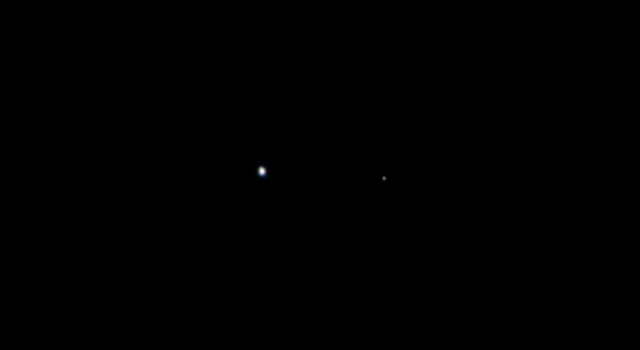
Three weeks into its journey to our friend and lord, Jupiter, Nasa’s Juno spacecraft has taken a look back at its home planet [on the left] and its natural satellite, the Moon.  [Image credit: NASA/JPL-Caltech] From the Nasa press release “This is a remarkable sight people get to see all too rarely,” said Scott Bolton, Juno principal investigator from the Southwest Research Institute in San Antonio. “This view of our planet shows how Earth looks from the outside, illustrating a special …

Read more…

Hurricane Irene: “one scary big storm…”

As Hurricane Irene heads for the North Carolina coast, US President Barack Obama cuts short his family holiday in Martha’s Vineyard, by a day, warning the public that “All indications point to this being a historic hurricane”.  The Guardian report adds that “Obama’s wife and daughters will travel back as planned on Saturday”.  [Image credit: NASA/NOAA GOES Project]   The GOES-13 satellite saw Hurricane Irene moving through the Bahamas on August 25, 2011 at 1402 UTC (10:02 a.m. EDT) and far …

Read more…

The Galactic Centre Revisited

While waiting, hopefully, for the arrival of the James Webb Space Telescope, here’s a short video of what the current space telescopes, particularly Nasa’s Spitzer and ESA’s Herschel, have seen at the centre of our galaxy.  The above image is a three-color composite, showing infrared observations from two of Spitzer instruments. [Image credit: NASA/JPL-Caltech].  Video from SpitzerSpaceCenter. As well as the twisted ring of very dense and cold gas and dust at the galactic centre, there have been other amazing structures observed.  Then there are the “colossal swathes of …

Read more…