Giants’ Causeway Interpretive Centre: “The National Trust fully supports the scientific explanation for the creation of the stones 60 million years ago”

Which is fine, but misses the point.  The National Trust continues to try to defend its decision to give in to the lobbying of the Caleb Foundation and include young-Earth creationist beliefs in the Giants’ Causeway Interpretive Centre.  [Are they after the crank pound? – Ed]  Maybe… and maybe not. Yesterday’s NT press office blog carried this quote A National Trust spokesperson said: “The interpretation in the visitor centre showcases the science of how the stones were formed, the history of …

Read more…

Giants’ Causeway Interpretive Centre: “This is, as far as we are aware, a first for the National Trust anywhere in the UK, and it sets a precedent for others to follow…”

John’s professed concern is misplaced.  As the National Trust press release on the “new state-of-the-art visitor centre” at the Unesco World Heritage Site Giants’ Causeway noted New interactive displays and activities inside the visitor centre include an animation of the legend of Finn McCool and an innovative hand-held audio guide. Such distractions aside, and without access to the material at issue, the quotes in the UTV report from the National Trust raise serious questions. The trust said that the exhibit gives …

Read more…

#GiantsCauseway: Fenians lose out to Bible.

*sigh* According to UTV, the Giant’s Causeway Visitor Centre now includes exhibits that acknowlegde the young-earth Creationist view of how the world-famous stones are formed. Pete has detailed the backstory to this before and others have picked up the creationist lobbying trail around the Ulster Museum. UTV report that The National Trust said it wanted to “reflect and respect” the fact that some people contest the views of mainstream science. With that, the National Trust have now neatly denigrated and rejected centuries …

Read more…

LHC: “we have observed a new particle consistent with a Higgs boson. But which one?”

That’s what they’ll be trying to work out over the next few years.  Matt Strassler’s probably the man to go to for more on the options ahead.  But, for now, the news from Cern is that they have, almost certainly, found “that damned elusive particle“, a Higgs boson.  Earlier this morning one of the six theoreticians who predicted the field/boson, Peter Higgs, instructed his family to start chilling the champagne, and Stephen Hawking has conceded that he has lost his …

Read more…

Voyager: “We are approaching the solar system’s final frontier”

Here’s a short informative video from Science at Nasa on the indications that Voyager 1 is about to enter into the vastness of interstellar space.  (Image credit: NASA/JPL-Caltech) Space, remember, is very very big. And on that note, because I can, here again is some wondrous time-lapse video of the night-sky above the ESO Very Large Telescope array [VLT], in Chile, from NikoBustos. [Video credit: ESO/José Francisco Salgado (josefrancisco.org)] Or even this [Video credit: ESO/S. Guisard (www.eso.org/~sguisard) ESO/José Francisco Salgado (josefrancisco.org)] And, of course, the Milky …

Read more…

Transit of Venus 2012: The Movie

Were your skies not favourable for viewing?  Did you miss the live online coverage of the last transit of Venus until 2117?  Well, there’s a Flickr group.  Or you could take in the stunning views from Nasa’s Solar Dynamics Observatory.  Video from NasaExplorer.  [Credit: Data courtesy of NASA/SDO, HMI, and AIA science teams].  Enjoy! On June 5 2012, SDO collected images of the rarest predictable solar event–the transit of Venus across the face of the sun.  This event happens in …

Read more…

Transit of Venus 2012: “marvel at the solar system in motion”

As I mentioned back in March, tonight one of the rarest predictable astronomical events will occur – a transit of Venus.  [I’m washing my hair! – Ed]  What hair?  ANYhoo… Since the invention of the greatest human innovation, the telescope, at the beginning of the 17th century, not by Galileo, there have been only 7 such transits.  The next time it will happen will be on 11 December 2117.  Nasa’s Sun-Earth Day website will be providing a live web cast during the more than …

Read more…

Aurora Borealis over Europe

Another wondrous view of the Aurora Borealis as captured by the crew of the International Space Station.  This time as a backdrop to the equally wondrous sight of Ireland and the United Kingdom under night-time conditions [0-18s].  Video via NasaCrewEarthObs. This video was taken by the crew of Expedition 30 on board the International Space Station. The sequence of shots was taken April 5, 2012 from 00:44:21 to 00:50:07 GMT, on a pass from the North Atlantic Ocean, west of the Celtic …

Read more…

“Vesta is special”

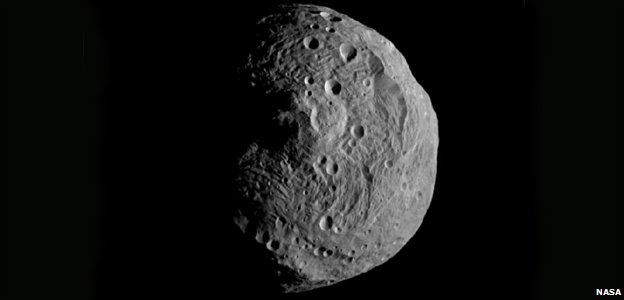
Having arrived at the 530km-wide giant asteroid Vesta in July last year, Nasa’s Dawn Mission scientists have published some of their findings in Science magazine.  As the BBC’s spaceman, Jonathan Amos, notes They confirm that Vesta has a layered interior with a metal-rich core, just as Earth, Mars, Venus and Mercury do. Using information about the shape of the asteroid and its gravity field, scientists can even say something about the likely size of this core. The Dawn team calculates …

Read more…

In praise of… The Antikythera Mechanism

I have noted it before [with videos from Nature], but the Antikythera Mechanism is a pretty wondrous object.  And, as the Guardian’s ‘in praise of’ editorial points out, “A BBC4 programme on Thursday night retold the tale.”  The Antikythera Mechanism Research Project is worth a look too.  Here’s a shorter version of the story And, almost as wondrous, the inevitable Lego version… Pete Baker

SDO: Year 2, approaching solar maximum…

Here’s a short video compilation of some stunning views of the Sun in 2012 – as seen by the Solar Dynamics Observatory (SDO). And Science at Nasa has a, erm, cheerful message as we approach solar maximum – “Enjoy the show!”  [Once more, with feeling… – Ed]  Indeed. Pete Baker

Discovery’s Final Final Flight

Having completed its final mission last February, yesterday the Space Shuttle Discovery took off from the Kenedy Space Centre for the last time on the way to its final destination – the Smithsonian’s National Air and Space Museum Steven F. Udvar-Hazy Center in Chantilly, Virginia.  During the flight, piggy-backing on a modified Boeing 747 (Shuttle Carrier Aircraft NASA 905), Discovery took in the sights at Washington DC at an altitude of about 1,500ft (457m).  The Guardian has a number of images from the US capital …

Read more…

Riding the Boosters

Stunning images, and enhanced sound, in this video from Nasa of the view from the space shuttle’s solid rocket boosters as they push the shuttle up into orbit, and then fall back down to Earth. Enjoy! As the Guardian’s GrrlScientist says The number in the upper right hand corner is airspeed. The glint of light against the backdrop of space at 2:08 and 3:11 is the Space Shuttle going into low Earth orbit. These sounds were cleaned up and made more audible by …

Read more…

LHC: “2012 looks set to be a vintage year for particle physics”

As the BBC reports, the Large Hadron Collider [LHC] at Cern is back with stable beams of protons after its winter break, and at a new record collision energy of 8 trillion electron volts.  From the BBC report Running the LHC at higher energies makes it more likely that Higgs particles, if they exist, will show themselves in the debris of the proton collisions. “The increase in energy is all about maximising the discovery potential of the LHC,” said Cern Research …

Read more…

Titanic: was it all right when it left here?

Not according to metallurgists Tim Foecke and Jennifer Hooper McCarty whose research has suggested that dodgy Harland and Wolff rivets were at fault for allowing the Titanic’s hull to be ripped apart by the pressure of the iceberg impact. With six of the hull’s chambers exposed to the Atlantic waters, the “unsinkable” ship lasted less than three hours, not enough time for rescue boats to reach those (disproportionately poorer) passengers left without access to a lifeboat (the White Star line …

Read more…

“A billion stars revealed”

A stunning image was unveiled last week at the UK-Germany National Astronomy Meeting NAM2012 in Manchester. [All images courtesy of Mike Read (WFAU), UKIDSS/GPS and VVV] The BBC’s Spaceman, Jonathan Amos, helpfully provides this combination image, with a partial zoom-in on the Galactic center. But to really appreciate the scale and detail of the image you need to use the online interactive viewer here. From the University of Edinburgh press release Astronomers have today released a picture containing more than one billion …

Read more…

“awe, curiosity, wonder, joy, amazement”

After a brief scientific explanation of the phenomena, this video from LittleSDOHMI delivers some wondrous recent views (March 3, 4 and 10) of the Aurora Australis from the International Space Station.  With music! [Video credit: NASA ISS/JSC/ Science@NASA] And here are those stunning clips by themselves. [All videos courtesy of the Image Science & Analysis Laboratory, NASA Johnson Space Center (http://eol.jsc.nasa.gov/Videos/CrewEarthObservationsVideos/)] From Kenya to the Aurora Australis This video was taken by the crew of Expedition 30 on board the International …

Read more…

“…and marvel at the solar system in motion”

Here’s a date to mark in your diary [really? – Ed].  On the 5/6 June this year one of the rarest predictable astronomical events will occur – a transit of Venus.  [Can’t wait… – Ed]  Since the invention of the greatest human innovation, the telescope, at the beginning of the 17th century, not by Galileo, there have been only 7 such transits.  And, although the last one was in 2004, the next will not happen until 11 December 2117. [I’ll catch it then! …

Read more…

The Serpent Dust Devil of Mars

  [We’re not in Kansas anymore! – Ed]  Indeed.  Here’s a great little video from JPLNews on the 800m-tall dust devil they spotted on Mars in this wondrous image acquired, on Feb 16 2012, by the High Resolution Imaging Science Experiment (HiRISE) camera on NASA’s Mars Reconnaissance Orbiter. [Image Credit: NASA/JPL-Caltech/Univ. of Arizona] Pete Baker

The Universe at a glance…

Well, several glances actually…  As spotted by the Guardian blog’s Tom McCarthy, NASA has released a new atlas and catalog of the entire infrared sky “showing more than a half billion stars, galaxies and other objects captured by the Wide-field Infrared Survey Explorer (WISE) mission.”  And an impressive view it is. [Image Credit: NASA/JPL-Caltech/UCLA]   From the Nasa press release The sky can be thought of as a sphere that surrounds us in three dimensions. To make a map of …

Read more…