“Good catch, Ron!”

Whilst Earth-bound observers of the annual Perseids meteor shower had to contend with a full moon this year, others had a more privileged view.  Like Nasa astronaut Ron Garan, orbiting on the International Space Station, who captured this stunning image of a fragment of the Swift-Tuttle comet burning up in the Earth’s atmosphere. [Image credit: NASA Image ISS028-E-24847].  Science at Nasa explains in this short video. And you can stay “Up all night” watching the skies, again, courtesy of the camera at Nasa’s Marshall Space …

Read more…

“Strange things happen in the bog.” – Redux

[Image from RTÉ report] Prehistoric human remains found partially buried in a leather bag in a bog near Portlaoise, County Laois, by Bord na Móna workers yesterday are believed to be the over 2,000 year-old body of a sacrificial victim, possibly a young woman.  Here’s a 2007 National Geographic article on Iron Age Europe’s bog bodies.  And from today’s Irish Times report Mr [Eamonn] Kelly [keeper at the National Museum’s Irish antiquities division] said the body would initially have been buried at a considerable depth. …

Read more…

Opportunity at Endeavour

Last seen, on Slugger, at the edge of the football-field sized crater Santa Maria, Nasa’s Mars Exploration Rover Opportunity has arrived at its next destination – the 22km wide crater Endeavour.  3 years and 13 miles from its first destination, Victoria crater. [Image Credit: NASA/JPL-Caltech/Cornell/ASU] A portion of the west rim of Endeavour crater sweeps southward in this color view from NASA’s Mars Exploration Rover Opportunity. This crater — with a diameter of about 14 miles (22 kilometers) — is more …

Read more…

“these could be the first known Martian locations with liquid water”

A BBC report notes the fascinating interpretation being made of some more wondrous images from the HiRISE camera on the Mars Reconnaissance Orbiter.  MRO image gallery here.    From JPLnews Here’s an animated gif showing the features of interest. This series of images shows warm-season features that might be evidence of salty liquid water active on Mars today. Evidence for that possible interpretation is presented in a report by McEwen et al. in the Aug. 5, 2011, edition of Science. These images come …

Read more…

Journey to Jupiter

As the BBC reports, and the Guardian notes, Nasa’s Juno Mission to our friend and lord, Jupiter, is scheduled to launch this afternoon on an Atlas V rocket.  There’s an impressive Juno mission website too.  Lift-off at 15:34 UT [4.34pm BST].  Here’s a short overview of the mission.  Video credit: NASA/JPL-Caltech. And, if you have time, here’s the full science briefing via NasaTV. You can also watch the launch live via NasaTV.  Or, indeed, here! Update2  I’ve replaced the live Ustream video with …

Read more…

Vesta’s dark side [and possibly a colourful one]

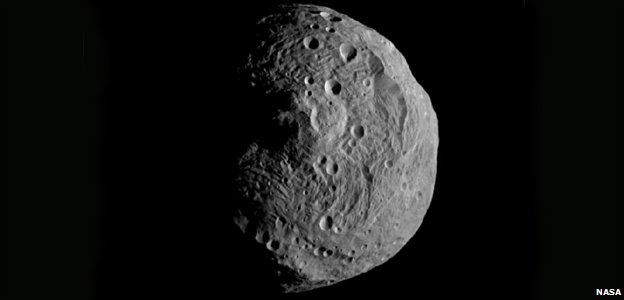
As the BBC spaceman, Jonathon Amos, notes Nasa’s Dawn spacecraft has taken a close look at the 530 km wide giant asteroid Vesta’s northern hemisphere– to add to all those earlier images.  This image was taken on 23 July, at a distance of about 3,200 miles (5,200 kilometers) away from the proto planet Vesta.  Image credit: NASA/JPL-Caltech/UCLA/MPS/DLR/IDA.   And in a short while, 1700 UT [6pm BST], Nasa will be holding a press conference to present the latest findings.  Which may include some colour …

Read more…

Have they found that elusive goddamn particle?

Well, maybe…  As was the case with Tevatron’s false alarm, it’s far too soon to say that the search for “that damned elusive [Higgs] particle” is over.  But there is a difference this time. I thought something was up when I read the Guardian’s tame particle physicist Jon Butterworth’s post on Thursday. I’m writing this on the plane home from CERN. I would have loved to post more about ATLAS preparations for the European Physical Society meeting in Grenoble, but …

Read more…

Space Shuttle Time Lapse

Stunning time lapse footage from orbit with the Space Shuttles Discovery and Atlantis foregrounding a magnificent view.  Via the NasaExplorer channel.   Segment 1: NASA’s Shuttle Discovery (STS131), while docked to the ISS, captured these images on April 12, 2010 as it moved from the night side of the Earth to the daytime. In the process the Aurora Borealis can be seen on the Earth’s limb. A solar panel from the ISS and a docked Soyuz module can be seen in …

Read more…

Hubble spots fourth moon of Pluto

  The Hubble Space Telescope has been looking at the twin dwarf planet system of Pluto and Charon ahead of Nasa’s New Horizons mission expected arrival in the neighbourhood in 2015.  They’ve already mapped the surface of Pluto, to an extent, and now they’ve spotted a fourth moon in the system– if you count the dwarf planet Charon as a moon of Pluto, that is.  The new moon has been designated “S/2011 P1” or “P4” until a permanent name is chosen.  [All …

Read more…

Vesta: “arguably the oldest extant primordial surface in the Solar System”

With Dawn now safely in orbit around the giant asteroid Vesta, Nasa have released the first close-up image of the ancient protoplanet. [Image credit: NASA/JPL-Caltech/UCLA/MPS/DLR/IDA] From the accompanying text July 18, 2011 – PASADENA, Calif. — NASA’s Dawn spacecraft obtained this image with its framing camera on July 17, 2011. It was taken from a distance of about 9,500 miles (15,000 kilometers) away from the protoplanet Vesta. Each pixel in the image corresponds to roughly 0.88 miles (1.4 kilometers). And from the …

Read more…

Dawn: Up close and personal with Vesta

As I may have mentioned, early tomorrow morning, 9am [BST] 16 July, Nasa’s Dawn spacecraft is expected to be captured into orbit by the 530km-wide giant asteroid Vesta.  They won’t know for sure until a scheduled communications pass at 8.30am [BST] on Sunday 17 July.  Here’s the latest image of Vesta taken by Dawn on 9 July at a distance of about 26,000 miles (41,000 km).    NASA’s Dawn spacecraft obtained this image with its framing camera on July 9, …

Read more…

Dawn’s final approach

Next weekend (on 16 July), barring any further unforeseen problems, Nasa’s Dawn spacecraft will enter orbit around the giant asteroid Vesta and begin its year-long observation of the 530km wide proto-planet. [Image credit: NASA/JPL-Caltech/UCLA/MPS/DLR/IDA] From the JPL press release (23 June) After Dawn enters Vesta’s orbit, engineers will need a few days to determine the exact time of capture. Unlike other missions where a dramatic, nail-biting propulsive burn results in orbit insertion around a planet, Dawn has been using its placid ion propulsion …

Read more…

Space Shuttle’s Final Launch

If the weather clears, and currently the weather is a “go”, Nasa’s Space Shuttle Atlantis will launch from the Kennedy Space Centre at 4.26pm [BST].  It’s the end of the Space Shuttle era.  Follow events at Nasa’s launch blog, or via the BBC online, as well as the usual NasaTV coverage. Or, even, here! Broadcasting Live with Ustream Pete Baker

The end of the Space Shuttle era

Atlantis is scheduled to launch on Nasa’s final Space Shuttle mission, STS-135, on Friday at 4.26pm [BST] to bring to an end the 30-year-long Space Shuttle era – weather permitting.  In fact, there’s currently only a 30% chance that the weather will be suitable for launch.  While you’re waiting you can check out Nasa’s Space Shuttle Era website.  Or read the BBC’s Spaceman, Jonathan Amos, on one of the private companies taking over the role played by the Shuttle – Orbital Sciences Corporation.  …

Read more…

Spectacular Solar Eruption Close-up

Nasa have released more stunning footage from the Solar Dynamics Observatory of the spectacular solar eruption on June 7.  As LittleSDOHMI notes – “This video uses the full-resolution 4096 x 4096 pixel images at a one minute time cadence to provide the highest quality, finest detail version possible.”  With music! Pete Baker

Most distant “angry monster” brightest in early Universe

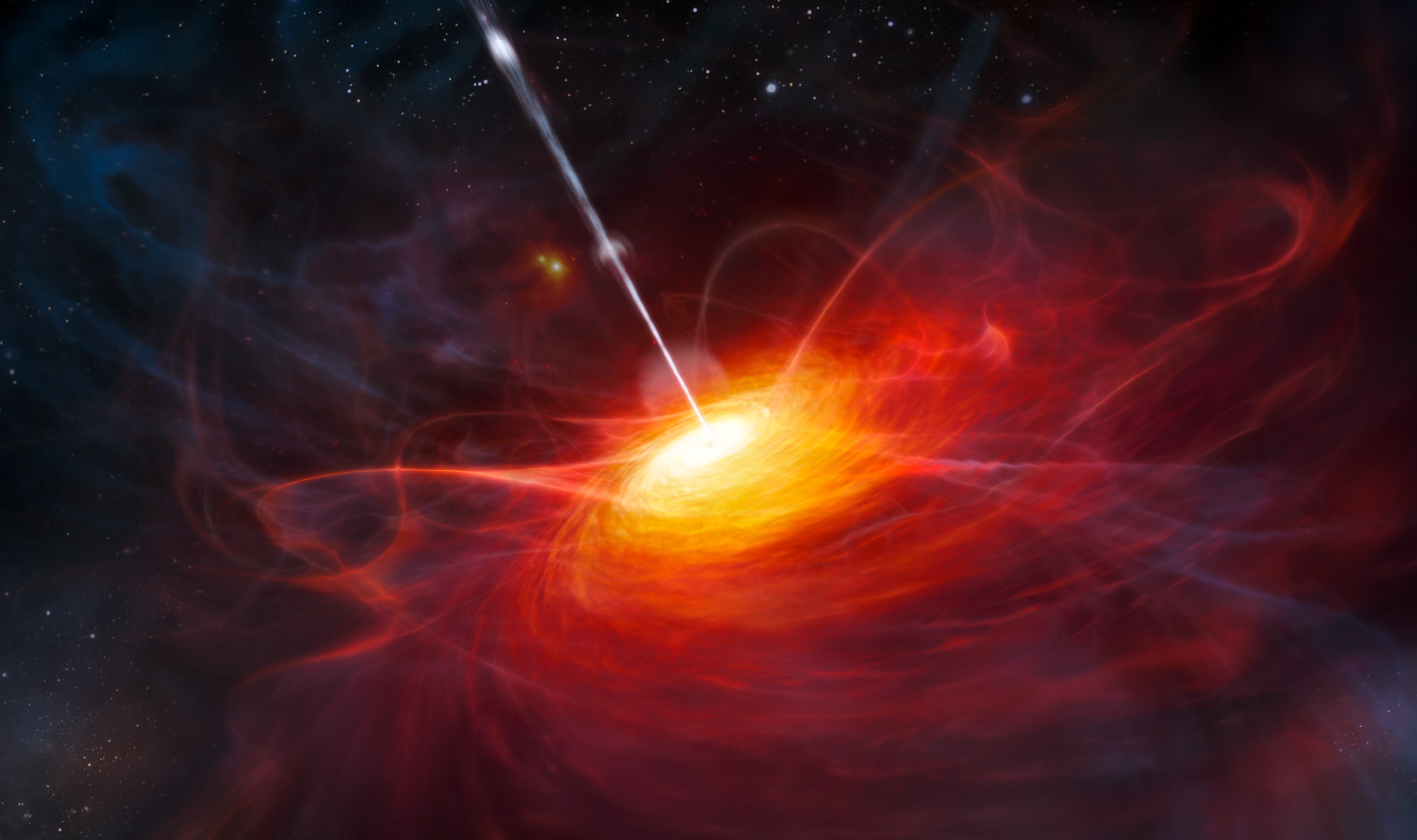
[Image credit: ESO/M. Kornmesser] The BBC reports on the discovery of the most distant quasar yet seen, ULAS J1120+0641.  An “angry monster” 12.9 billion light-years away – a mere 770 million years after the Big Bang.  Before the process of re-ionization was completed.  As the BBC report notes The light from ULAS J1120+0641 displays the characteristic signature of neutral gas, indicating that, at 770 million years after the Big Bang, the process of re-ionization had some way to go before the process was …

Read more…

Voyager: “It’s bubbly out there.”

The Guardian’s GrrlScientist picked up on the 30-something Voyager probes’ latest scientific discovery on humanity’s farthest journey.  New view of the heliosheath. Red and blue spirals are the gracefully curving magnetic field lines of orthodox models. New data from Voyager add a magnetic froth to the mix. Image: NASA Here’s the YouTube version of the ScienceatNasa video posted at the Guardian. And if that explanation was a little too pink and fluffy for you, try this different version of the same …

Read more…

“this is probably the biggest known asteroid to have come this close.”

As spotted by SpaceWeather.  At about 1700 UT (6pm BST) today Asteroid 2011MD will fly past only 12,300 kilometers (7,600 miles) above the Earth’s surface.  [Image credit NASA/JPL] As the diagram shows, that’s close enough to be affected by Earth’s gravity. This small asteroid, only 5-20 meters in diameter, is in a very Earth-like orbit about the Sun, but an orbital analysis indicates there is no chance it will actually strike Earth on Monday. The incoming trajectory leg passes several thousand kilometers …

Read more…

Johannes Kepler “will tumble, disintegrate and burn”

ESA’s second Automated Transfer Vehicle (ATV), Johannes Kepler, the first operational version, was launched on 16 February this year.  At a total mass of 20 tonnes it was Europe’s heaviest spacecraft. As well as delivering its payload to the International Space Station, on 2 April Johannes Kepler successfully manoeuvred the complex to avoid a collision with space debris and, over recent days, boosted the 417-tonne Station to a higher orbit – from around 345 km to its new height of 380 km. …

Read more…