Journey to Jupiter

As the BBC reports, and the Guardian notes, Nasa’s Juno Mission to our friend and lord, Jupiter, is scheduled to launch this afternoon on an Atlas V rocket.  There’s an impressive Juno mission website too.  Lift-off at 15:34 UT [4.34pm BST].  Here’s a short overview of the mission.  Video credit: NASA/JPL-Caltech. And, if you have time, here’s the full science briefing via NasaTV. You can also watch the launch live via NasaTV.  Or, indeed, here! Update2  I’ve replaced the live Ustream video with …

Read more…

Vesta’s dark side [and possibly a colourful one]

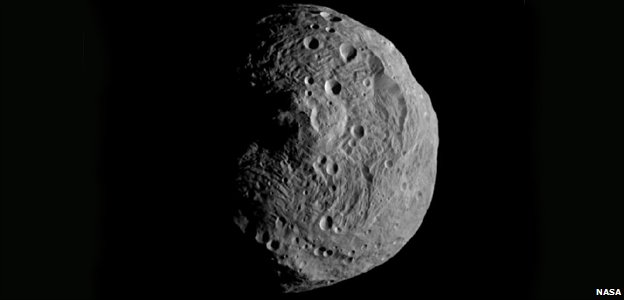
As the BBC spaceman, Jonathon Amos, notes Nasa’s Dawn spacecraft has taken a close look at the 530 km wide giant asteroid Vesta’s northern hemisphere– to add to all those earlier images.  This image was taken on 23 July, at a distance of about 3,200 miles (5,200 kilometers) away from the proto planet Vesta.  Image credit: NASA/JPL-Caltech/UCLA/MPS/DLR/IDA.   And in a short while, 1700 UT [6pm BST], Nasa will be holding a press conference to present the latest findings.  Which may include some colour …

Read more…

Space Shuttle Time Lapse

Stunning time lapse footage from orbit with the Space Shuttles Discovery and Atlantis foregrounding a magnificent view.  Via the NasaExplorer channel.   Segment 1: NASA’s Shuttle Discovery (STS131), while docked to the ISS, captured these images on April 12, 2010 as it moved from the night side of the Earth to the daytime. In the process the Aurora Borealis can be seen on the Earth’s limb. A solar panel from the ISS and a docked Soyuz module can be seen in …

Read more…

Hubble spots fourth moon of Pluto

  The Hubble Space Telescope has been looking at the twin dwarf planet system of Pluto and Charon ahead of Nasa’s New Horizons mission expected arrival in the neighbourhood in 2015.  They’ve already mapped the surface of Pluto, to an extent, and now they’ve spotted a fourth moon in the system– if you count the dwarf planet Charon as a moon of Pluto, that is.  The new moon has been designated “S/2011 P1” or “P4” until a permanent name is chosen.  [All …

Read more…

Vesta: “arguably the oldest extant primordial surface in the Solar System”

With Dawn now safely in orbit around the giant asteroid Vesta, Nasa have released the first close-up image of the ancient protoplanet. [Image credit: NASA/JPL-Caltech/UCLA/MPS/DLR/IDA] From the accompanying text July 18, 2011 – PASADENA, Calif. — NASA’s Dawn spacecraft obtained this image with its framing camera on July 17, 2011. It was taken from a distance of about 9,500 miles (15,000 kilometers) away from the protoplanet Vesta. Each pixel in the image corresponds to roughly 0.88 miles (1.4 kilometers). And from the …

Read more…

Dawn’s final approach

Next weekend (on 16 July), barring any further unforeseen problems, Nasa’s Dawn spacecraft will enter orbit around the giant asteroid Vesta and begin its year-long observation of the 530km wide proto-planet. [Image credit: NASA/JPL-Caltech/UCLA/MPS/DLR/IDA] From the JPL press release (23 June) After Dawn enters Vesta’s orbit, engineers will need a few days to determine the exact time of capture. Unlike other missions where a dramatic, nail-biting propulsive burn results in orbit insertion around a planet, Dawn has been using its placid ion propulsion …

Read more…

Space Shuttle’s Final Launch

If the weather clears, and currently the weather is a “go”, Nasa’s Space Shuttle Atlantis will launch from the Kennedy Space Centre at 4.26pm [BST].  It’s the end of the Space Shuttle era.  Follow events at Nasa’s launch blog, or via the BBC online, as well as the usual NasaTV coverage. Or, even, here! Broadcasting Live with Ustream Pete Baker

The end of the Space Shuttle era

Atlantis is scheduled to launch on Nasa’s final Space Shuttle mission, STS-135, on Friday at 4.26pm [BST] to bring to an end the 30-year-long Space Shuttle era – weather permitting.  In fact, there’s currently only a 30% chance that the weather will be suitable for launch.  While you’re waiting you can check out Nasa’s Space Shuttle Era website.  Or read the BBC’s Spaceman, Jonathan Amos, on one of the private companies taking over the role played by the Shuttle – Orbital Sciences Corporation.  …

Read more…

Most distant “angry monster” brightest in early Universe

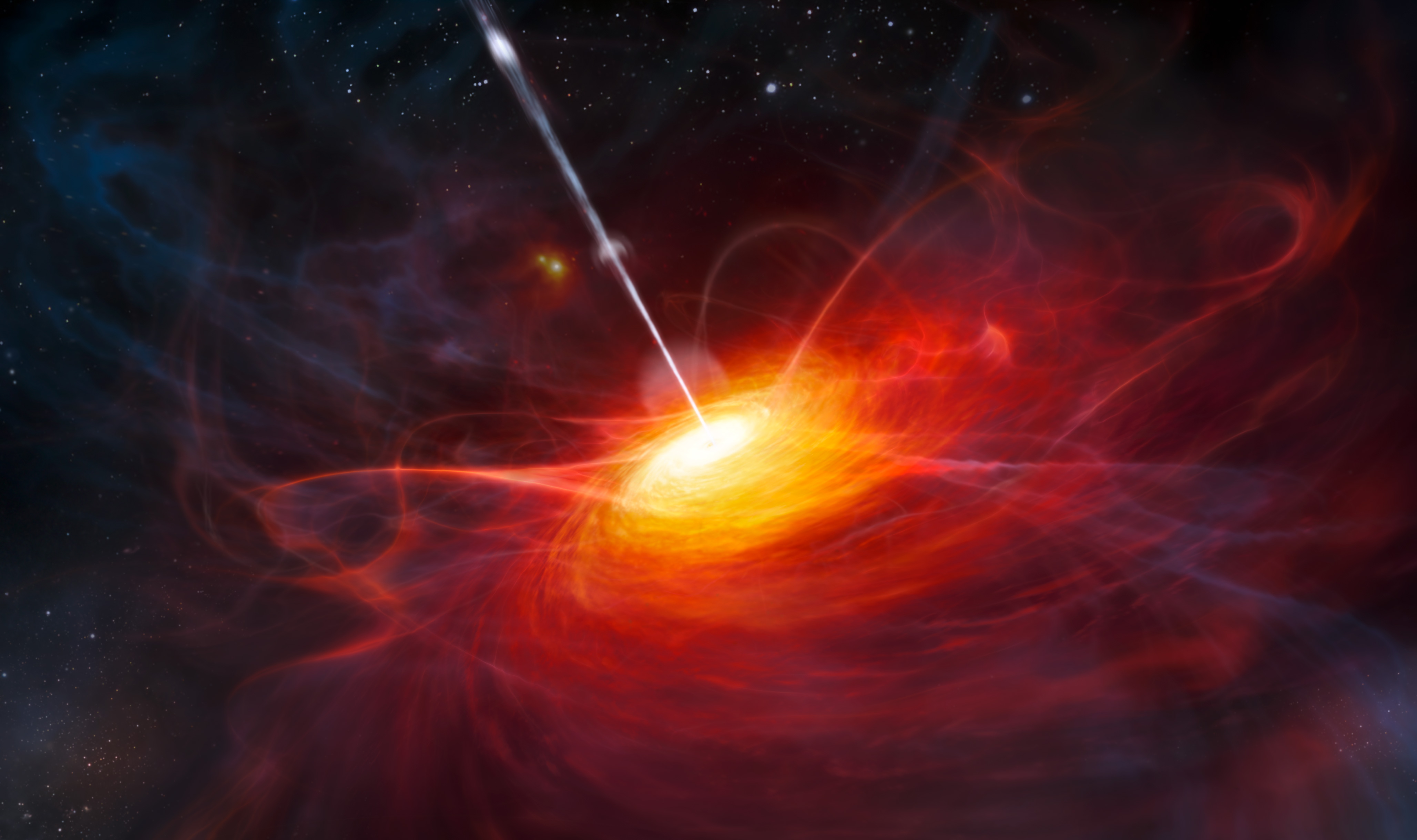
[Image credit: ESO/M. Kornmesser] The BBC reports on the discovery of the most distant quasar yet seen, ULAS J1120+0641.  An “angry monster” 12.9 billion light-years away – a mere 770 million years after the Big Bang.  Before the process of re-ionization was completed.  As the BBC report notes The light from ULAS J1120+0641 displays the characteristic signature of neutral gas, indicating that, at 770 million years after the Big Bang, the process of re-ionization had some way to go before the process was …

Read more…

Voyager: “It’s bubbly out there.”

The Guardian’s GrrlScientist picked up on the 30-something Voyager probes’ latest scientific discovery on humanity’s farthest journey.  New view of the heliosheath. Red and blue spirals are the gracefully curving magnetic field lines of orthodox models. New data from Voyager add a magnetic froth to the mix. Image: NASA Here’s the YouTube version of the ScienceatNasa video posted at the Guardian. And if that explanation was a little too pink and fluffy for you, try this different version of the same …

Read more…

“this is probably the biggest known asteroid to have come this close.”

As spotted by SpaceWeather.  At about 1700 UT (6pm BST) today Asteroid 2011MD will fly past only 12,300 kilometers (7,600 miles) above the Earth’s surface.  [Image credit NASA/JPL] As the diagram shows, that’s close enough to be affected by Earth’s gravity. This small asteroid, only 5-20 meters in diameter, is in a very Earth-like orbit about the Sun, but an orbital analysis indicates there is no chance it will actually strike Earth on Monday. The incoming trajectory leg passes several thousand kilometers …

Read more…

Mercury: “A world in and of its own”

In March this year Nasa’s Messenger probe became the first spacecraft to orbit Mercury.  And, as the BBC reports, a few days ago Nasa released the scientific observations and data collected during the first three months of its scheduled year-long mission.  In the process a number of hypotheses about the innermost planet were consigned to the “dust bin of science”.  Mercury is not like the Moon, nor like the Earth, and it’s not “the burnt-out cinder of the solar system”. [All images …

Read more…

Totality begins…

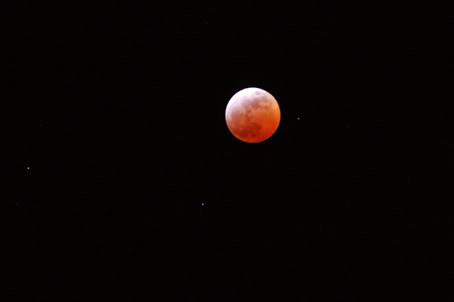
…at 8.22pm [BST].  That’s tonight’s lunar eclipse and totality will last for 100 minutes – until 10.02pm [BST].  But it’s not, as the Irish Times claims Ireland’s “first lunar eclipse for five years.”  It is special however.  It’s a central total lunar eclipse – the center point of Earth’s shadow will fall on the moon – which explains the unusually long duration. It could be as spectacular as the 2007 total lunar eclipse, which Sammy Morse captured in the featured image above.  Or it …

Read more…

Destination: Vesta!

Nasa’s Dawn spacecraft will arrive at the 530km wide asteroid Vesta on 16 July, where it will spend the next 12 months in orbit.  Then it’s on to the dwarf planet, Ceres [950km wide].  Images Credit: NASA/JPL-Caltech/UCLA/MPS/DLR/IDA. The Hubble Space Telescope has already taken a look at Vesta but, on 1 June, Dawn captured its own views – at a distance of about 480,000km – to assist in the final navigation stage.  And Nasa have released those looped images as a video. From the JPL Nasa press …

Read more…

Endeavour’s last visit to the International Space Station

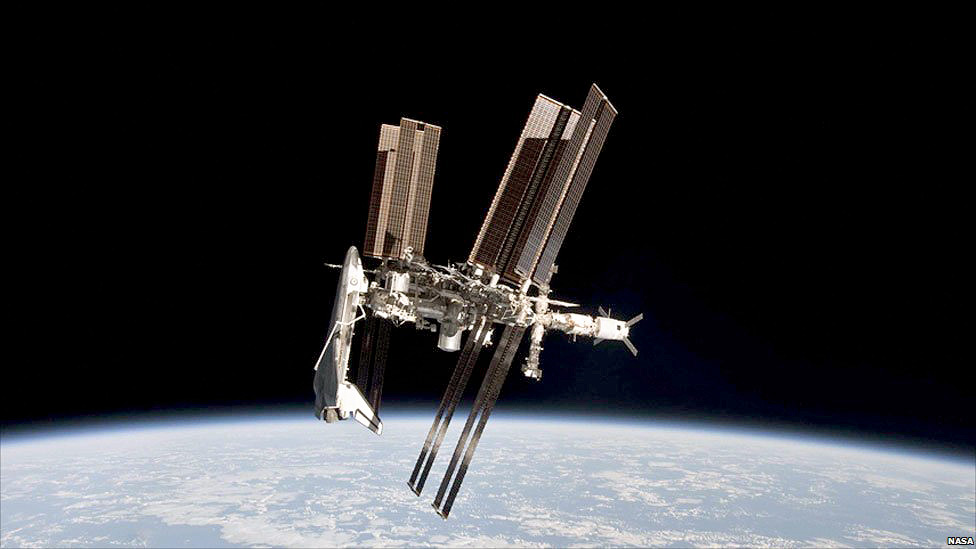
The BBC flagged up the stunning first-ever detailed image of a Space Shuttle docked at the International Space Station – Endeavour’s final voyage.  Now NasaTV have released the video.  The video was shot by European Space Agency astronaut Paolo Nespoli from the Russian Soyuz spacecraft that undocked from the station on May 23. He, Russian cosmonaut Dmitry Kondratyev and NASA astronaut Cady Coleman were departing the station for a return to Earth after five months on the station. Nespoli documented the …

Read more…

Dr Neil Tyson’s “disturbing” thought for the day

The Guardian’s tame particle physicist, Jon Butterworth, is “playing truant” from the LHC at Cern to attend the Boost 2011 meeting at Princeton.  But he’s left a link-tastic post on the results so far.  Meanwhile, the Big G’s GrrlScientist points to director of the Hayden Planetarium, New York, astrophysicist Neil deGrasse Tyson, explaining one of his “disturbing thoughts”. As an aside, the paper, “The Origin of Chemical Elements”, was published in the 1 April 1948 issue of the Physical Review. The …

Read more…

Endeavour’s Final Voyage – Redux

The scheduled April launch was scrubbed due to technical problems, but the final preparations are underway for the 25th and final launch, after 19 years in service, of the Space Shuttle Endeavour on Mission STS-134.  Launch is scheduled for 1.56pm [BST].  Via the NASAKennedy channel And a reminder that Endeavour’s final cargo, for the International Space Station, includes a 7-tonne particle physics experiment – the Alpha Magnetic Spectrometer (AMS).  And the AMS channel provides this informative Nasa overview of the experiment. As usual, there’s the launch blog …

Read more…

Voyager: Humanity’s Farthest Journey

While waiting for Endeavour’s final voyage, you can catch up, metaphorically, with the ongoing scientific odyssey of those other still-nimble Voyagers as they head towards the vastness of interstellar space.  ( Image credit: NASA/JPL-Caltech) NasaTV has Thursday’s special science presentation on the mission with a panel of the Voyager team – including Ed Stone, who’s been there since 1972, and Ann Druyan, creative director of the group, led by Carl Sagan and Frank Drake, who put together the Golden Record both Voyagers carry. …

Read more…

Endeavour’s Final Voyage

Following the final flight of Discovery, the next Nasa Space Shuttle to be retired, after 19 years of service, will be Endeavour. But first there’s the not insignificant matter of its 25th, and final, flight – Mission STS-134.  Lift-off is scheduled for 1547 local time (1947 GMT; 2047 BST) from the Kennedy Space Centre.  And via the NASAKennedy channel Endeavour’s final cargo, for the International Space Station, includes a 7-tonne particle physics experiment – the Alpha Magnetic Spectrometer (AMS).  And the AMS channel …

Read more…

Chandra finds evidence of Tycho’s origin

Nasa’s Chandra X-ray observatory has been in orbit since 1999 and it’s still producing results.  Like this stunning image of the remnant of the Type Ia supernova first observed by Danish astronomer Tycho Brahe in 1572. The data for the images was collected in 283 hours of observation from 2 pointings between April 29, 2003 and May 3, 2009. (Credit: NASA/CXC/Chinese Academy of Sciences/F. Lu et al) From the text accompanying Chandra’s Tycho photo album This new image of Tycho’s supernova remnant, …

Read more…