Solar Dynamics Observatory One Year On

One year on from the Solar Dynamics Observatory (SDO) First Light and Nasa have released a compilation of wondrous clips of its observations of our local star. [Video credit: Nasa SDO] They have selected 12 of the most beautiful, interesting, and mesmerizing events seen by SDO during its first year. In the order they appear in the video the events are: 1. Prominence Eruption from AIA in 304 Angstroms on March 30, 2010 2. Cusp Flow from AIA in 171 Angstroms on …
Read more…

First Orbit – 50 years on

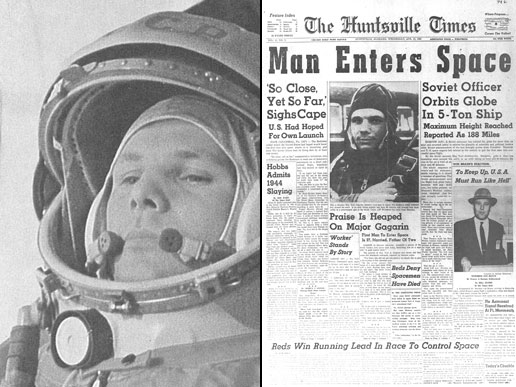
On 12 April 1961, Vostok 1 was launched and cosmonaut Yuri Gagarin became the first man to orbit the planet.  The BBC have a number of articles online as Russia marks the 50th anniversary of that flight – or, as the Guardian’s GrrlScientist calls it, Happy Yuri’s Night!  Nasa have some images, and this short clip of the launch from their archives. And, if you have the time, the Guardian point to this feature length documentary, First Orbit. But remember, compared to the rest of …

Read more…

“you may think it’s a long way down the road to the chemist’s…”

With Cassini exploring Saturn’s moons, and Messenger finally at Mercury, the BBC’s Spaceman, Jonathan Amos, takes an interesting look at the future prospects for interstellar travel.  And he starts with this observation of Voyager’s 33-year-long journey. I’ve been troubled of late by the scale of things, by the vastness of space. It’s been brought into focus by two things, I think. The first is the Voyager 1 probe – the most distant man-made object from Earth. I’ve written a couple of …

Read more…

Weather watching… on Titan.

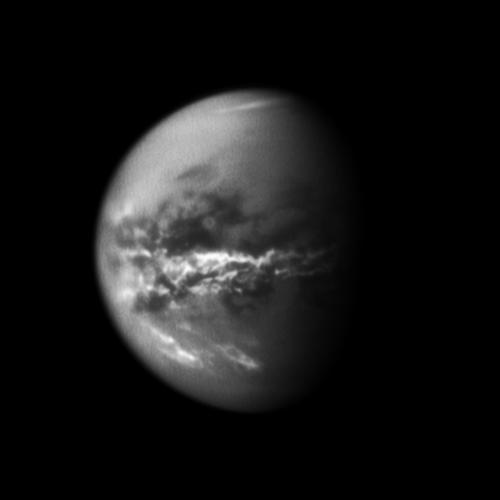
Nasa’s Messenger spacecraft may have finally arrived in orbit around Mercury, but the Cassini probe has been exploring Saturn’s system of moons since 2004 – some archived posts here.  [Image Credit: NASA/JPL/SSI] The latest images show seasonal weather patterns, and apparently associated surface changes.  From the Nasa/JPL press release Extensive rain from large cloud systems, spotted by Cassini’s cameras in late 2010, has apparently darkened the surface of the moon. The best explanation is these areas remained wet after methane rainstorms. …

Read more…

Messenger to Mercury

Tonight at 12.45am [GMT] Nasa’s Messenger spacecraft will begin a 15 minute engine burn timed to take it into orbit around Mercury – the first spacecraft to do so.  (All images credit: NASA/Johns Hopkins University Applied Physics Laboratory/Carnegie Institution of Washington) Launched on 3 August 2004, Messenger’s taken a circuitous route to the innermost planet. It’s second, and final, look at the Earth was in August 2005. Twice past Venus, the second time in June 2007 Before not one, not two fly-bys, but …

Read more…

Gamma-Ray Bursts explained

I have, from time to time, mentioned the potentially lethal, if spectacular, phenomenon known as a Gamma-Ray Burst in my occasional science posts.  By coincidence, the BBC have online digestible clips of past Horizon programmes.  Including this informative clip from 2001 explaining Gamma-Ray Bursts in stellar nurseries, with a suitably ominous narration.  Enjoy!  And, let’s be careful out there… Pete Baker

“It did its grand tour past the planets and it just goes on, on this voyage of discovery.”

The farthest man-made object from Earth, at some 17.4 billion kilometres, Nasa’s Voyager 1 spacecraft is still performing acrobatics 30-odd years after it was launched.  From the BBC report Voyager is executing a series of roll manoeuvres to get one of its instruments into the optimum position to measure particles sweeping away from the Sun. Controllers at the US space agency’s Jet Propulsion Laboratory in Pasadena, California, report a perfect response from the probe. “I liken Voyager to an old car,” …

Read more…

Searching for exoplanets

With the BBC noting a somewhat speculative report on a newly discovered exoplanet, Wasp 12b, here’s a short informative video from ESA Euronews on the ongoing search for planets beyond our solar system. And here are some previous posts on the topic. Pete Baker

Fermi Finds Galactic Gamma-ray-emitting Bubbles

Fascinating discovery by Nasa’s Fermi Gamma-ray Space Telescope, which achieved first light in August 2008.  Image credit: NASA’s Goddard Space Flight Center. From the Nasa press release NASA’s Fermi Gamma-ray Space Telescope has unveiled a previously unseen structure centered in the Milky Way. The feature spans 50,000 light-years and may be the remnant of an eruption from a supersized black hole at the center of our galaxy. “What we see are two gamma-ray-emitting bubbles that extend 25,000 light-years north and …

Read more…

Deep Impact to Flyby Hartley 2

As I mentioned last month, Nasa’s Deep Impact probe was redirected towards comet 103P/Hartley at the start of 2008 as part of the EPOXI mission – see post from the time.  The image top was taken by the EPOXI mission on Nov. 2, 2010 from a distance of 2.3 million kilometers (1.4 million miles). [Image credit: NASA/JPL-Caltech/UMD] And, as the BBC report notes, Deep Impact should be flying within 700km of the comet just about now [1402 GMT].  Live coverage on Nasa TV. …

Read more…

Clearing the cosmic fog

As the BBC noted, astronomers using ESO’s Very Large Telescope [VLT] have confirmed that galaxy UDFy-38135539, one of several candidates identified in the Hubble Ultra Deep Field (UDF) image of the Fornax Constellation acquired with the telescope’s new Wide Field Camera 3 last year, is the most distant galaxy ever detected. [Image credit: NASA, ESA, G. Illingworth (UCO/Lick Observatory and University of California, Santa Cruz) and the HUDF09 Team] Spectroscopic analysis of data collected during a 16 hour observation using the VLT identified a red shift …

Read more…

If all else fails, hit it with a hammer…

Or, as I was tempted to title this post, “Floating in a tin can…”  ANYhoo…  Having eventually fixed the toilet in the US segment, last weekend [31 July] the crew of the International Space Station were forced to reduce power, and suspend scientific experiments, when half their cooling system suddenly shut down. Trouble arose on Saturday night when one of the two ammonia-fed cooling loops shut down, triggering alarms throughout the ISS. The two ammonia lines ensure that all the station’s electronic …

Read more…

Last Flight of Atlantis

After almost 25 years in service, at 7.20pm [BST] tonight Nasa’s Space Shuttle Atlantis is scheduled to lift-off from Kennedy Space Center on its last ever flight – Mission STS-132.  There’s Nasa’s launch blog and the usual online NasaTV coverage. Only two more missions remain in the Space Shuttle programme. Meanwhile Congress continues to hear from opponents of US President Obama’s new policy for Nasa, including, in a rare public appearance, moonwalker Neil Armstrong. Adds Via NASAtelevision And perhaps I should have said First Last Flight…  …

Read more…