I claim no credit for step zero of my life’s journey, which has become a campaign against binary decision-making: my parents were well chosen, one Catholic and British, one Irish and Protestant. (So as far as the Good Friday Agreement is concerned, I am ‘a political bastard.’) Step one was sort of mine: at about the age of six, I decided I wanted to be a sailor; I’m not sure why. So, in 1961, aged 18, I went to Dartmouth, the UK’s nautical ‘sausage factory’ where every Sunday, in uniform, we marched together on parade, and prayed, (separately), for Christian unity. Next, in the waters off Singapore, I served in a submarine where I rose – or sank – to the rank of First Lieutenant.
But what on earth – or sea – was the British navy doing, miles away, in the Pacific? If a Chinese submarine sailed up the English Channel, the whiskers of Whitehall would be bristling with fury! So I resigned, or tried to. Wait for two years, they said. Now as luck would have it – mine, not his – a submariner friend in Bahrain very kindly got malaria, and for my final posting, I was sent to replace him. He lay in hospital, so I gave him a beer – just one, said the nurse – and he survived. I also survived and sailed to Mombasa where, again by chance, I met the headmaster of a school for the poor in Nairobi, who invited me to teach maths and physics, VSO stuff, on £10 a week. Fate was in charge; step two was in Africa.
Three years later, unable to find a job to come home to, I went for a little cycle ride. I’d never been more than 10 km before but… “You should read Dervla Murphy,” I was advised. “Who’s that?” I asked. Four months later, having cycled from Nairobi via Kinshasa, Lagos, Kano and Kinshasa again to Lusaka, Voluntary Service Belfast VSB offered me a job, on £12 a week. Ah, a 20% pay rise! So I cycled back to Nairobi – 10,000 km in all – went to India for a fortnight in Mother Teresa’s Home for the Dying in Kolkata, to mummy for Christmas, and in Jan ’75, step three, to Belfast; ah, this decision was mine, but it was the only job I could find. “Don’t worry mum,” said I, “It’s only for a year.”
Two steps later, to Eurasia, and I’m still here. In summary, my life, with a focus on our binary decision-making, has taken me eastwards, as often as not by bicycle: to Moscow in 1986; next to the war in Bosnia in 1992; to the conflict in Nagorno-Karabakh in ’99; and finally to China, the Middle Kingdom, Zhōngguó, with its ancient wisdoms, amazing varieties of culture, incredible tonal linguistics, and outstanding (not only economic) potential.
____________
So I’ll start this fourth essay in Belfast, in 1975, where this (then) practising Catholic, with what is, actually, chaps, afrightfully posh English accent, ran Cairn Lodge Boys’ Club on the Crumlin Road, and most parents just assumed I was a Prod. I changed its name to a Youth Club, joined a local cross-community summer scheme in the two ‘Protestant’ and ‘Catholic’ Ardoynes, and with two Dutch students, took a bunch of kids cycling, from Belfast to Donegal, a whole week’s holiday with not a drop of rain!
“Are you ‘this’ or ‘that’?” I was often asked. And two old ladies wondered: “Are you washed in the blood of the Saviour?” My response was political: “God knows.”
I had a room in Wheatfield Gardens, where one evening I was introduced to a guest: ha! Dervla Murphy. Another chance coincidence? In Tibet, they say, everything has a reason, everything is connected, each a step in life’s journey. She wrote a foreword for my first book: Inflation? Try a Bicycle, published as a samizdat in ’78; “Dervla out-Murphied,” wrote The Irish Times.
Later, as a community worker in Ardoyne – (an unusual career-move for a retired British officer) – I was talking peace with lots of people about the ‘this’-or-‘that’ stuff. Indeed, what with the other ‘this’-or-‘that’ of the Cold War, it seemed the whole world was divided into conflicting pairs.
Now as we saw in Part III, the 1985 Anglo-Irish Agreement prompted Paisley’s: “Ulster says ‘NO’!” campaign. But what was the question? And why was it binary? Why don’t we ask open or multi-option questions? I thought. Why not a voting procedure in which everyone says ‘yes’ to something, or ‘yes’ in their order of preference to a few other things as well, their compromise options; in essence, a ballot in which NOBODY VOTES ‘NO’?
I was a member of the late Dr. John Robb’s New Ireland Group and in May 1986, in response to Paisley’s ‘never-never’ negativity, we held a People’s Convention: the vibes were good, and as I mentioned in Part II, some 200 people came, from Sinn Féin to the UDA, and many from neither, all but the DUP. They proposed various constitutional settlements, debated these suggestions in workshops… and then, back in plenary, voted, preferentially, saying ‘yes’ to what they loved, liked, or would tolerate.
But yes, nobody voted ‘no’. It worked. The outcome, at best, the option with the highest average preference – “NI to have devolution and power-sharing in a tripartite Belfast-Dublin-London agreement” – was, a sort of mini-GFA, just 12 years ahead of its time. Only later did I discover that this ‘be positive’ voting procedure had been devised in 1770 in France, by Jean-Charles de Borda… and hence, today, my current unpaid employment in the largely unfunded de Borda Institute.
But first – back to yesterday – in the 70’s and early ‘80s, crossing the peace-line in Belfast was easy, especially on a bicycle, for both sides ‘speak very well the English.’ The other ‘peace-line’ was more appropriately named: Iron Curtain. So in 1983, aged 40, I started to learn Russian, and three years later, I cycled across the then two Germanies to study in Moscow. Step four; this one was mine, but fate had made the signposts, like my childhood’s pet cat called Katinka, or one of my mum’s neighbours, a retired brigadier who spoke Russian.
So Moscow it was, where in 1986, perestroika (reconstruction) was underway, under Mikhail Gorbachev. As luck/fate/destiny would have it, I saw a really rare sight for the Soviet capital one day: another cyclist. It was the monolingual Sergei. Come and meet my family, he said. A friendship grew, and in ’89, his trilingual wife Irina and I wrote an article on consensus voting for Moscow News, № 6/89, and another in Russia’s leading literary journal, Novy Mir (New World) № 3/90, where we featured alongside Aleksandr Solzhenitsyn.
Knowing, by this time, that Soviet communism had been a horrible mistake, many Russian journalists were open to new ideas. Lots of western ones, in contrast, were and often are not so objective. What’s more, I argued in one of Moscow’s housing compounds where many foreign journalists lived, a large number of them made a huge mistake when, in 1990-91, instead of Gorbachev, they supported Boris Yeltsin.
The latter had no policies, no principles; he had only ambition (and a love of vodka). He stabbed Gorbachev in the back, politically; he thus became president of Russia, fought the first 1994-6 war in Chechnya, and started the second in ’99 before handing it over to today’s Vladimir Putin who, as we all know, went on to fight in Georgia in 2008 and Ukraine in ’14.
__________
Having mastered the Russian language, something inexorably prompted me (now in my 60s) to study Chinese – what, and why, I know not. This was the beginning of step five, the six-month piece of ecological, bicycle-driven research we saw in Part I. It all indicates that, not only in NI and in Russia, the Balkans and the Caucasus, but also in China and even North Korea, humankind has been, and is still, addicted to binary decision-making: (majority voting is in Article 97 of Pyongyang’s constitution). As in all good research, however, the study has shown the student far more than he had originally envisaged.
First things first, the non-alphabetical language, Chinese, is difficult, while the history I soon learnt is fascinating, no less so for the psephologist! (Ah, my karma was still at work.) Initially, this large and largely undefined landmass was inhabited by umpteen different folks, the Tanguts (Dǎngxiàng) for example, who ran the Xī Xià dynasty from 1038-1227 and now number less than a million, while the Xiōngnú who go back to the third century BCE ruled a huge empire covering large parts of Mongolia and China, have all but disappeared.
56 other minorities, like the Zhuàng (whom we met in Part I), are still recognised today. These different people were all united, by force of course, by the first emperor Qínshǐhuáng in 221 BCE, in the Qîn dynasty. Originally scheduled for 1,000 years, it lasted for only 15, and was succeeded by the Former Hàn dynasty, and inter alia, its ministers used majority voting; this was over 2,000 years ago, and history relates that the emperor usually went along with whatever a majority had voted for. (Wang,Y-C, Studies of Government Institutions in Chinese History, Harvard.) All very civilised, for its time, certainly.
Other peoples, especially the ones to the north, Běijīng regarded as barbarians. So they built The Great Wall to keep them out. It failed, three times! But in some respects, these nomadic folks were actually rather more civilized than their southern neighbours: on the death of a ruler, the Khitans for example, the most easterly group, would hold an assembly of their elders to elect a new leader, the election probably an acclamation. They would then have another assembly three years later, to confirm or replace this new khan. (Franke and Twitchett, Cambridge History of China, Vol VI, p 52.) An example for Putin?
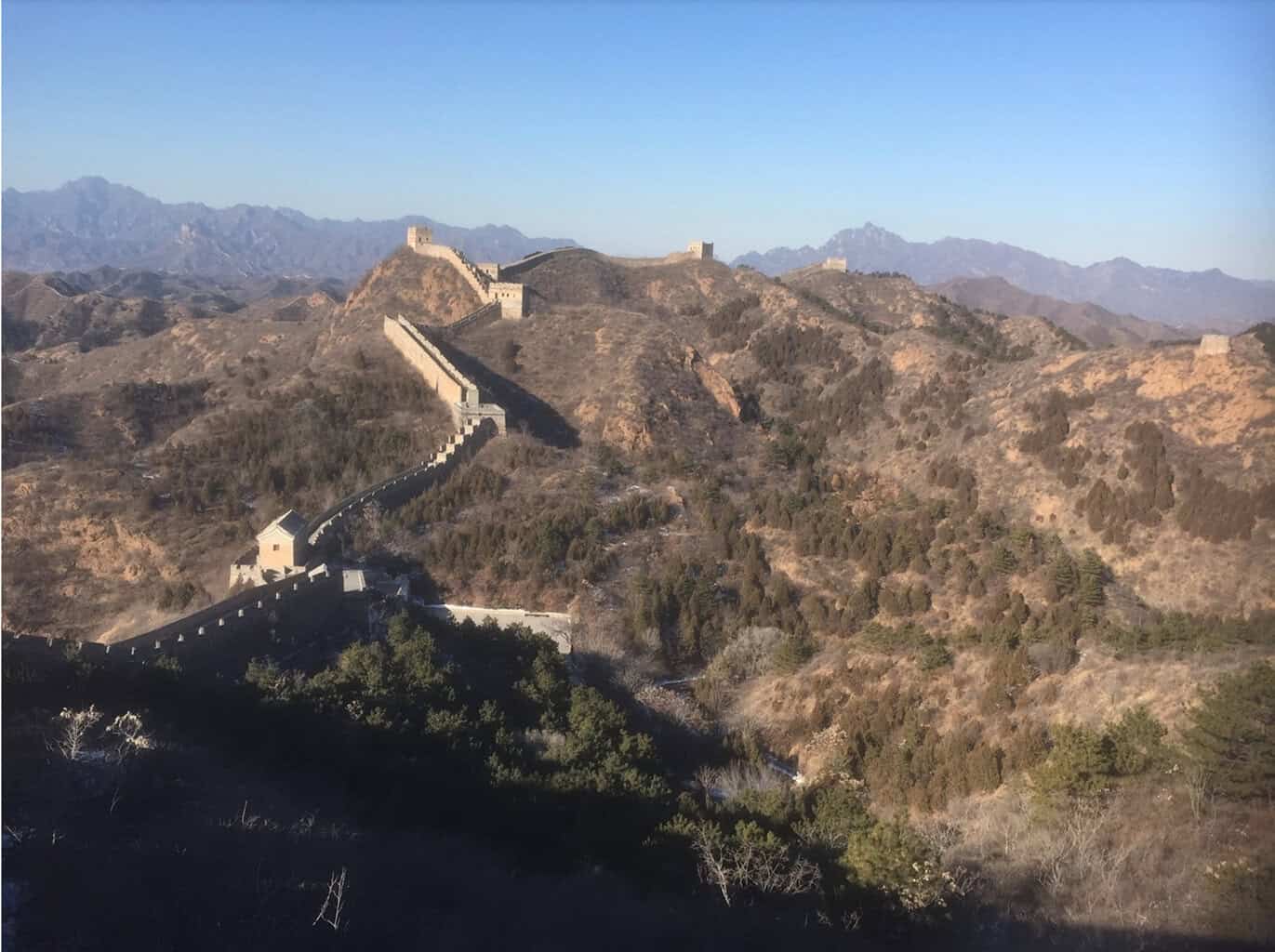
(Now initially, a thousand years or so ago, the eastern Europeans, the Russians, went east, where they met the Khitans; and a little later on, starting with the Portuguese, the western ones headed west. But this explains why the Russian word for China is Kitai, Китай, and I speak Kitaiski, Китайский, well, a little.)
In 916, Běijīng’s fears came true: the Khitans came over the Wall to conquer and then rule a huge part of northern China as the Liáo dynasty. The next set of nomadic ‘barbarians’, the Jurchens, set up the Jīn dynasty in 1115, to rule over an even larger part of China; as we mentioned in Part I, their unique contribution to human history was the world’s first multi-option vote, in 1197. (Ibid, p 266. Britain had a three-option plebiscite in 1948, in Newfoundland; Ireland has yet to even try, despite the call from the 2016 Citizens’ Assembly.)
But back to Asia: in 1206, nine years after China’s first dip into pluralism, the Mongols held their own assembly, a Khuriltai, and elected Chinggis Khan; he marched into China to take over from the Jurchens, and later, in 1279, his grandson Kublai Khan established the Yuán dynasty, to rule over all of China… until the Míng dynasty in 1368, when apparently, heaven decided that China’s ‘son of heaven’ was to be, once more, Chinese.
In days long gone, Běijīng regarded Tibet as yet another land of barbarians. But like many another ancient civilization, the Tibetans too had their wisdoms. In Part III, we said Europe has often tended to look at things in a binary way: land and sea, day and night, yet in most of these pairings, the first is defined by the second. Generally speaking, Asians tend to be more holistic… as we shall now see.
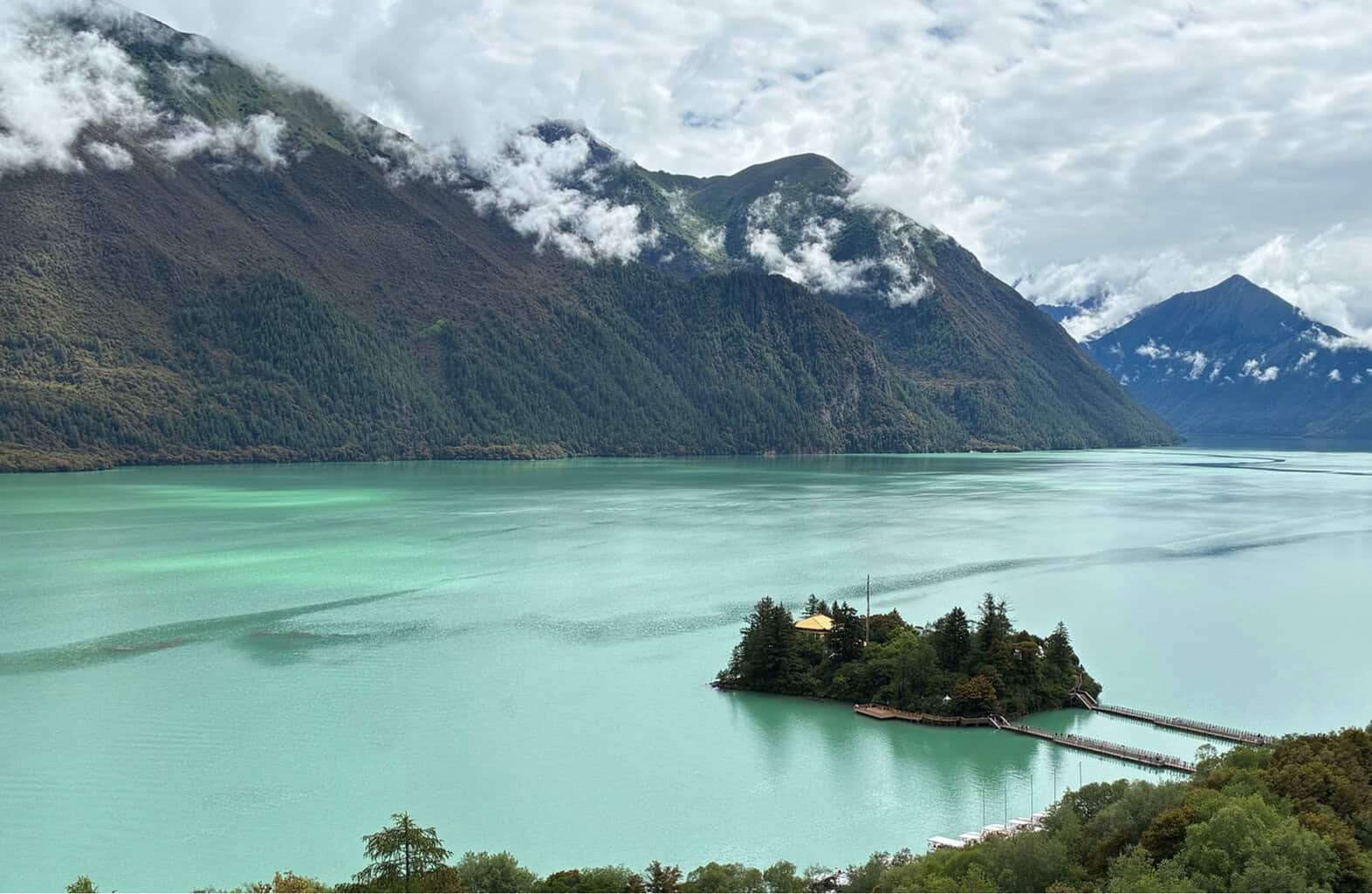
As I mentioned in Part I, getting to Tibet was quite difficult, permit-wise, and once there, I was part of a tourist group. I was allowed to cycle, with a guide, only within Lhasa’s city limits, but that included a nearby village, so my research was complete! But first, as a busload of tourists, we went from Lhasa to Nyingchi, not least to see the ancient Buddhist temple of Tsozong Gongba, on its lovely little island in Lake Pagsum. Like many another monument, it had been attacked during the Cultural Revolution but was now, happily, restored. Fortunately, on the orders of the then Premier, Zhōu Ēnlái, the most famous of all Tibetan monuments, the Potala Palace in Běijīng, was untouched.
Now just as society could be more holistic, so too could democracy. At the moment as we know, our western version is very divisive. It need not be so. And voting procedures could be, and should be, not win-or-lose but win-win, i.e., not majoritarian but more egalitarian. There are literally hundreds of different electoral systems to choose from, sometimes electing more than one winner, sometimes with PR, and it’s all very complicated. In contrast, there are far fewer decision-making systems, only a dozen or so.
Our collective choice of decision-making voting procedure should therefore most definitely not be binary, as in “binary voting, yes or no?” Other multi-option and even preferential methodologies have long since been devised. The most accurate, I think, and certainly the most inclusive, is where the winning candidate(s) and/or option is/are the one(s) with the highest average preference(s)… because an average involves every voter, not just a majority of them.
Asia has often believed in a holistic philosophy, that everything is indeed connected. As we noted in Part III, the Bible slips into a binary mode when it says, “He who is not with Me is against Me” (Matthew 12:30). In contrast, Hinduism’s Bhagavad Gita suggests those who are “free from pairs of opposites [are] easily liberated from bondage” (Śrīmad Bhagavadgītā Chap 5(3) p 78) and a Tibetan Buddhist monk of the 14th century, Longchenpa, spoke of “the non-duality of right and wrong.” (Klieger, C. Tibet – A History Between Dream and Nation State, p 126.) That quotation caused me to google the word. ‘non-duality’ – and goggle at its significance.
Unfortunately, to put it at its mildest, we in the West exported our majoritarianism pretty well everywhere: not only majority voting to an already divided Rwanda, where colonialism had created a Tutsi middle class while the Hutus were the workers; but also majority rule to an even more polarised NI where, as we all know, our problems of antipathy and violence are even more ancient! Accordingly, we should now at least acknowledge that binary ballots are often imperfect.
My visit to Russia, step four, included a critique of binary thinking and ‘majoritarianism’ (the Russian word for which, as we implied in Part III, is ‘bolshevism большевизм’); accordingly, multi-option problems in Crimea and elsewhere should never have been ‘resolved’ in binary ballots of only two options, ‘this’ or ‘that’. If humanity is to have a future, both it and any voting systems shall need to be egalitarian.
And then step five, and China has taught me more than I had ever learnt. I already knew that binary voting can be, not only inaccurate but exclusive and adversarial if not indeed downright dangerous. But, as Naomi Klein has written, “… binary thinking will never get us beyond partitioned selves, or partitioned nations.” (Klein Doppelganger: 303.) In other words, for the human race to survive, we have to use non-binary decision-making and become more holistic. Asia has more to teach us. Maybe, step six, if it’s not posthumous…
“I have an idea,” people sometimes say, as if they themselves had made their idea. No; something else is at work – maybe Teilhard de Chardin’s noosphere, maybe serendipity, maybe je ne sais quoi. It is all very difficult to understand, as was the spiritual experience in the mountains of Tibet of the British army officer, Lt. Col. Younghusband, after he and his troops had occupied the Potala Palace in 1904. He had fought for and won… nothing.

Peter Emerson, the child of an English Catholic mum and Irish Protestant dad, was conceived in Belfast (as far as he recalls) but/and born in England. So – Ne Temere and all that – he was raised a Catholic. First in submarines, he sank to the rank of first lieutenant, but resigned to teach maths and physics in Kenya. Next, Belfast in 1975, he was a community worker in Ardoyne and then an activist in the peace movement and CND. “Are you ’this’ or ’that’?” they asked, in both conflicts, so he learnt Russian and got a job in Moscow.
But first, in 1986, he helped John Robb’s New Ireland Group run an experiment in consensus, with SF, the UDA – all but the DUP – using non-binary voting. It worked. Back in Belfast in ’91, we did another, with a guest from Sarajevo: Bosnia, too, was to suffer a binary conflict. Does everyone use binary voting? He’s just been to China; it seems the answer is yes.
Discover more from Slugger O'Toole
Subscribe to get the latest posts sent to your email.