

“… the reality we want is away in the distance — and we cannot get there unless we move.”
-Seán Lemass, 1926
It’s concerning when a journalist of the calibre of Fintan O’Toole argues as he did last week that “there are only minor differences of emphasis in relation to Northern Ireland” between the two governing parties in the south, Fianna Fáil and Fine Gael and they are largely performative. There is in fact a gulf between the way most parties in the southern state treat Northern Ireland and how Micheál Martin has led the way over these last two terms.
Outside the current coalition and the Greens, most opposition party leaders in the Dail have fallen in behind Sinn Féin’s rather cynical line that only others must change be it trying to force the British government call a border poll or laughing behind the backs what they see as the oddly deluded Orangemen of the North. In fact, as readers will know the delusion is the other way around since there’s little prospect of a border poll, now or in the middle distant future.
If the British government had wanted to disengage from Northern Ireland it would have done so long ago. They’re only there because a solid majority of the population there either want them to stay or acquiesce enough in their lives to not want to express a political preference for constitutional change. It is not, as has been erroneously claimed in recent weeks, an Orange State because it has what is in effect a Sinn Fein Prime Minister.
What O’Toole and too many of the wider liberal cohort in the south have missed is that the peace of the Belfast Agreement is of the type we here on Slugger predicted in our warning to unionists 23 years ago, would be a long one. And one that would take the sort of deep engagement of the very type embodied in the Irish government’s Shared Island Initiative.
At the weekend, Martin argued that… “true republicanism can never be about victory over other groups in the nation. It must be about the victory of an inclusive ideal founded on respect and engagement.” He cited the recently much derided Seamus Mallon who said the Agreement was “a new dispensation” the end of an era and the opening of a new one. “One which falls to all of us to shape”.
This blog essay is an attempt to set the story straight. To argue that the only way to embrace the island’s long future is to shift, north and south towards a better, more plural and less conditional future for all the people of the island, regardless of their cultures and beliefs. To do, in short, what Lemass did more than sixty years ago, and move.
Nationalism’s Copernican problem
It’s sobering (or at least it should be) to think that amid all the giddy talk of an imminent border poll, Irish partition will be 105 years old in December next year. In that time, the two jurisdictions have grown steadily apart. One uses the euro, the other sterling.
One built its prosperity on foreign investment; the other now uniquely trades freely in both UK and EU markets. And while healthcare in the North is free at the point of use, many people in the Republic must pay to see a GP. A century of separation has done more than just draw a line on a map: it has built two quite different states.
There is a rule of thumb in astrophysics, borrowed by statisticians, called the Copernican Principle. It says that unless you have good reason to think otherwise, you should assume you are not observing something at a special moment in its life. Applied to durations, it yields an uncomfortable conclusion: if something has already lasted a hundred years, the odds are that it will last a good while longer. On this formulation, a state of affairs that has run for a century has, with 50% confidence, somewhere between 33 and 300 more years left in it.
Partition is now 105 years old. Nothing about that guarantees it will endure. But it should make anyone who says unity is “just around the corner” pause and ask what, exactly, is special about this moment?
If the honest answer is “probably nothing”, then nationalism faces a question it has spent most of the last century assiduously avoiding: not how to leave Northern Ireland, but how to live its best life within it.
A mirror image of unionism’s problem
When we published the Long Peace report in May 2003, one of our observations was that unionism’s great weakness was its defensive posture. It was far better at saying no than at explaining what it was for. That’s a problem which has persisted to today (see the recent unthought-through re-opening of the long parked Garvaghy Road controversy).
Twenty-three years on, nationalism faces a mirror image of that problem, though with a very different psychological root. Where unionism feared loss, nationalism has tended to treat the northern state as a temporary inconvenience: something to be managed, outlasted or transcended, but never genuinely inhabited.
As a result we have a politically alienated present. Nationalism has said a lot about the destination while neglecting the journey. And the numbers show it. Despite favourable demographics, its share of the vote has barely moved in a generation. It is not winning the argument because it has assumed it was already won. Now the journey is turning out to be a long one, that assumption has started to cost both it and its electorate.
The current strategy has stalled not because the cause is hopeless, but because it still runs on a logic built for a short war rather than a long peace. The habits of sectional mobilisation (count our people, turn them out, win the vote) belong to an era before the Troubles never mind the Belfast Agreement.
This Long Peace demands something else from nationalism: ie, to move on from grievance to governance.
Bogus calls for a border poll
The loudest demand within nationalist politics is for a border poll, now. It is also the least realistic – and the purest expression of the “temporary inconvenience” mindset. This Catechistic belief now includes most of the leaders of parties in the southern state where the fate of Northern Ireland has long since been relinquished to Sinn Féin or, in far fewer cases, to Fianna Fáil.
Yet, under Schedule 1 of the Northern Ireland Act 1998, the Secretary of State is obliged to call a poll only when it appears likely that a majority would vote for a united Ireland. That condition is not currently met, and no serious reading of the either polling or electoral data suggests it is even close.
The demand for a poll is less a strategy so much as a means of avoiding having to have one. It keeps attention on a future vote and away from the unglamorous business of making Northern Ireland (the only place the starting pistol can be fired) work in a favourable direction in the meantime. It may reassures nationalism’s supporters but it offers nothing to anyone else.
Forty per cent and holding
The puzzle nationalists rarely confront head-on is that Catholics now form a plurality of births for a whole generation, and since the 2021 census that also applies to the wider population, yet the combined nationalist vote has rested at roughly 40% for the best part of thirty years.
If demography really were destiny, that number should have climbed steadily. It hasn’t, because it turns out that the nationalist bucket is incredibly leaky (H/T Mainland Ulsterman). A significant cohort of people from Catholic backgrounds no longer identifies as nationalist at all. They’re not becoming unionists but moving into the growing “neither” camp by voting Alliance, Green, or not voting on constitutional lines at all.
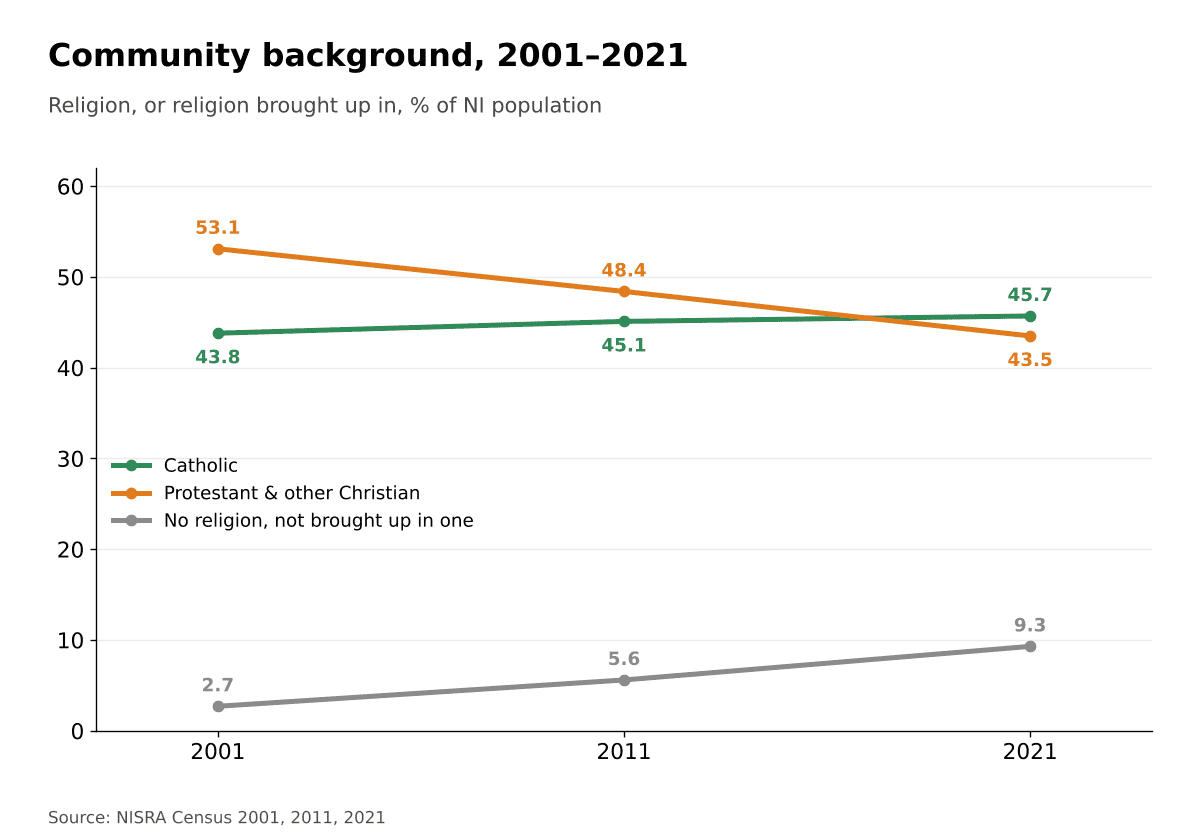
The same is happening on the other side. The precipitous fall in the Protestant population is not an older community dying off as many journalists have been led by the nose to believe. As is evident in the graph most of the change is from former Protestants redesignating as “neither”. This is why unionism now faces sharper competition between its own parties, and from Alliance and the Greens.
It is worth asking what these voters want. By and large, they are the people most interested in the quality of the journey: waiting lists, schools, roads, the cost of living, or whether Stormont is actually sitting. A nationalism that treats the North as a waiting room has very little to say to them. The leaky bucket is, in large part, the price of neglecting governance.
Articles 2 and 3 From claim to consent:
The single most important (and most underused) resource nationalism has is the revised text of Articles 2 and 3 of the Irish Constitution. The old articles were a territorial claim. The new ones, endorsed by 94.4% of voters in the Republic in 1998, are a statement of values and consent. They speak of uniting people, not territory, “in all the diversity of their identities and traditions”, and only with the consent of a majority democratically expressed in both jurisdictions.
This nearly thrity year old change reframes the question of unity entirely. It is no longer the correction of a historical wrong, owed to nationalists by history. It is a political project that has to be won by active democratic persuasion. That is a profound shift, which nationalism has yet to fully internalise. Too much of its rhetoric still treats unity as a territorial entitlement rather than something that has to be won by consent.
Once you accept the new articles on their own terms, the logic is unavoidable. If unity depends on persuading people, then what nationalists do on a Shared Island (how they govern, how they share, how they treat their neighbours) is not a distraction from the goal. It’s their only viable route to what they want.
The 50% plus 1 fallacy
Instead, much nationalist strategy has been quietly (sometimes not so quietly) built around “50% plus one”. Get a Catholic majority, convert it into a nationalist one, win a poll by a whisker and hey presto, job jobbed.
This is a fallacy on two counts. First, as above, a Catholic majority is not a nationalist majority, still less a unity majority, and that is leaving aside the fact the growth in both is now glacial. Second, and more fundamentally, “50% plus one” is a bet on a tipping point: the assumption that a century-old arrangement will give way the moment the numbers edge past halfway.
As Goethe has warned us: if aim too low in your expectations of others you will always fall short of the potential, yours and theirs. And as we have seen above, arrangements that have lasted this long are rarely ended by marginal shifts.
They last precisely because they have absorbed generations of demographic and political change without breaking. Partition has outlived the Troubles, Brexit and the loss of a unionist majority at Stormont; and it is not going to be undone by a single percentage point. What displaces a durable settlement is a broader and deeper consent than the one that sustains it.
The Agreement itself is the best guide to what legitimacy looks like here. It was endorsed by 71.1% of voters in Northern Ireland and 94.4% in the Republic. That is the standard you have to best. Any project that seeks to supersede the GFA should aim for comparable consent, something like 70% and not a simple majority scraped together on a good turnout day.
And you do not get to 70% on grievance. You get there on a record: years of evidence that nationalists can be trusted to govern fairly for everyone, including those who will never share their aspiration.
Three paths
Broadly, nationalism has three options from here:
- One more push. The fringe belief that a final effort will sweep away British influence. It has been tried, repeatedly, and has failed every time.
- Bully for a border poll. The linear fallacy: assume a Catholic majority automatically becomes a unity majority, and demand a vote on that basis. It ignores the leaky bucket problem and would most likely end in defeat.
- Pursue pluralism through governance. Accept the plural nature of the island, inhabit the institutions of the North fully, and build relationships “within and between” its people – aiming not for a bare majority but for the kind of broad consent that produced the Agreement.
The first two are, at bottom, politics of grievance. Only the third is a politics of governance, and only the third leads anywhere durable. And this brings me to the only nationalist party that is currently actively persuing this third option.
Micheál Martin and the Long Peace
Of the current crop of nationalist leaders, the one who seems to understand all this best is Micheál Martin.
What matters is less the sums than the method. Fianna Fáil’s Shared Island rarely talks about constitutional futures. It concentrates on what people across the island have in common – hospitals, universities, transport, the economy – and alongside the concrete it is funding research on how North and South actually compare, from earnings to employment.
At Bodenstown on Sunday, Micheál Martin described it as the largest programme of investment in shared understanding in the state’s history, and argued that its work is accepted as central to prosperity by people “irrespective of where they stand on political and constitutional issues”. Dublin demonstrating through delivery, not declaration, what closer cooperation is worth.
Martin presented Wolfe Tone, a Protestant, as the founder of a tradition that sought “points of unity rather than victory”. Tone’s famous call to replace the labels Protestant, Catholic and Dissenter with “the common name of Irishman” came after a wish to abolish the memory of past dissensions. True republicanism can never be about victory over other groups within the nation.
He was just as direct about the politics of the present. He warned against filtering every discussion “through the lens of one future vote”, and dismissed the idea that a White Paper and a Citizens’ Assembly (my own take is here) would make everything fall into place: that approach, he argued, is unlikely to shift opinion enough to make a vote likely never mind winnable.
Partition, in Martin’s account, has produced more than a century of divergence in social, economic, educational, health and legal life, and engagement between North and South has been thin. Whatever comes next, he said, the basic framework of the Belfast Agreement will remain essential in every reasonable scenario.
That is about as clear a statement of the Long Peace position as any party leader has made. It calls the poll-first/reconciliation-after strategy as a dead end fraud it is, insisting that the relationships within and between these islands have to work whatever the constitutional outcome, and rests its case on evidence and delivery rather than on grievance.
Through the institutions, not in spite of them
If Dublin can treat good governance as a nationalist act, so can nationalists in the North – and with far more direct effect. This is the question any follow-up to the 2003 report should press hardest: what does it mean to pursue unity through the northern institutions rather than despite them?
Legitimising nationalist presence – at Stormont, in the civic life of Northern Ireland, even in its shared cultural fabric, is not a concession to partition. Under the new constitutional dispensation, it is the only coherent path to the goal.
That means treating a functioning Executive as an asset to be protected rather than a lever to be pulled. It means owning Northern Ireland’s problems as nationalist problems, rather than evidence of a failed state to be pointed at. It means turning up, fully and without embarrassment, in the civic spaces that nationalism has historically held at arm’s length.
Nationalism now holds the office of First Minister. That is an opportunity our 2003 report could barely have imagined. The test is whether it is used to demonstrate competence and generosity to the whole community, or merely as an empty symbol of the assumed direction of travel whilst in reality the unity train has barely left the station.
The challenge, put simply, is for nationalists to articulate why good governance in the North is itself a nationalist act.
Beyond sectionalism
If republicanism is to mean anything in the 21st century, it has to represent everyone on the island, not just its own base. Tone’s “Protestant, Catholic and Dissenter” was not a slogan for one community to use against another. Martin in the Irish language section of this speech gave the example of the Fleadh not only as transformative but a vision to be followed by all republicans:
Ní mór dúinn cuimhneamh go bhfuil ár dteanga agus ár gcultúr ag an bpointe is láidre nuaiir a chuirimid deireadh le deighilt chun daoine a nascadh le chéile- nuair a spreagann siad daoine chun teacht le chéile agus comhoibiú le chéile.
Chonaiceamar é sin go soiléir i slí iontach dearfach spleodrach ar shráideanna Bhéal Feirste le linn Fhleadh Cheoil na hÉireann. Tá dualgas orainn gach rud ar féidir linn a dhéanamh chun an fhís iontach, neamhpháirtí polaitiúil, neamhsheicteach d’Éirinn a chur chun cinn.
That also means rethinking the British role. For most of the last century nationalists have cast London as the eternal enemy: the original grievance. But the British government is a co-guarantor of the Agreement, and there is every reason to think it would support any programme that genuinely brings the people of the whole island closer together.
Treating it as a partner rather than an adversary is not a concession; it is a recognition of how lasting change actually happens.
Conclusion
The 2003 report warned unionism that saying no was not a strategy. Nationalism’s equivalent warning is that waiting is not one either. Partition will not end because the right number of babies were born in the right maternity wards, nor because a border poll is called before anyone is ready.
If it ends, it will be because enough people – from every background, including the large and growing number who identify as neither – have been persuaded that a new arrangement would be better for them. And the most persuasive argument nationalists have is the way they govern the place they already share.
That is slow work. It is the work of a long peace, not a short war. It means moving from grievance to governance, and taking the quality of the journey as seriously as its destination. In Lemass’s memorable words, “we cannot get there unless we move”.

Mick is founding editor of Slugger. He has written papers on the impacts of the Internet on politics and the wider media and is a regular guest and speaking events across Ireland, the UK and Europe. Twitter: @MickFealty
Discover more from Slugger O'Toole
Subscribe to get the latest posts sent to your email.


