

In 1969, many people in Northern Ireland thought The Troubles were unique. Eastern Europe changed all that. February 1988 saw the first of many inter-communal clashes between the Armenians and the Azeris in the Caucasus, in Nagorno-Karabakh, and in August, just after my arrival in the Soviet capital, further flare-ups prompted Moscow’s Pravda to carry the following headline: Вот – наш Ольстер (Vot – nash Ol’ster), ‘This is our Northern Ireland.’
It’s probably fair to say that, at the time, hardly anyone from NI knew what or where Nagorno-Karabakh was, including myself. But there too, the problem concerned the co-existence of a majority and a minority. It was soon to be the same in the Balkans, where one Vladimir Grigorov asked, “Why should I be in the minority in your state, when you could be in the minority in mine?” (Woodward, S. 1995, Balkan Tragedy, p 108.)
But I’ll start in Belfast. On my arrival here in 1975, I was asked – inevitably I suppose – was I ‘this’ or ‘that’? Well, as it happens, mum was an English Catholic from Cheshire, and dad, an Irish Protestant from Cork. But the question was binary; so my answer had to be either neither or both. Something was wrong with the question.
1976 saw the peace movement, and I was soon in both the local one and NI’s small part of the wider international anti-nuke movement. The latter was also based on a closed, binary question: “Are you communist or capitalist?”
Next, in 1985, Mikhail Gorbachev took over in Moscow. The (then) Cold War was starting to thaw and, as Peter Brooke was to make clear in 1991, Britain had “no selfish strategic or economic interest” in NI; he spoke retrospectively. But the immediate consequence of the change in the Kremlin, I would argue, came in November ’85: the Anglo-Irish Agreement. To which, of course, at Belfast’s City Hall, Ian Paisley shouted, “Never, never, never,” under the slogan “Ulster says ‘NO’!” In response, one week later, six of us stood there in silence, with a banner, “We have got to say ‘yes’ to something.”
Now what that ‘something’ could be was an open question. But just as I was neither ‘this’ nor ‘that’ but a bit of both, so too, surely, the constitutional status of NI did not have to be either British entirely, or Irish entirely. In theory at least, it could be under a joint authority, administered by the EU or UN, or maybe the best idea was for ‘these islands’ to form a W-I-S-E Wales-Ireland-Scotland-England federation. Accordingly, in practice, we could at least have a multi-option debate, with all possible options ‘on the table’. And if there are lots of them, maybe a citizens’ assembly could formulate a short-list of, say, 4 – 6 options, and the border poll could offer the voters a choice of not only the two stark ‘opposites’, but also a possible compromise or few, on which we the voters could cast our preferences.
___________
So let’s look at decision-making. Admittedly, many problems are binary. And if the question is indeed binary, there are only the two ways of voting: ‘yes’ or ‘no’, A or B. The system is adversarial. In some instances, those involved argue; at worst, they fight.
If, however, the question poses three possible answers – A, B or C? – and if it asks the voters for their 1st-2nd-3rdpreferences, then there are six ways of voting: A-B-C, A-C-B, B-A-C, B-C-A, C-A-B and C-B-A. With four options, 24 nuances and/or opinions may be expressed. And with five, we may relish the diversity of our species.
And let’s be fair: there may not be too much difference between, let’s say, 1st-2nd-3rd-4th-5th preferences of D-B-E-A-Cand those of D-E-A-B-C. In a nutshell, in binary voting, we tend to vote ‘for’ or ‘against’ each other; in contrast, with multi-option, preferential voting, we can vote more ‘with’ each other.
And after all, democracy is for everybody, not just a majority, and definitely not just the majority (of Unionists, or of Russians/ Serbs/Hutus/Jews/Sunnis/Shias etc.). While majority voting is always ‘win-or-lose’, a preferential points system can be ‘win-win’. If those involved cast full, or nearly full ballots, then the option with the most points is also the option with the highest average preference… and an average, of course, involves every voter, not just a majority of them. This particular methodology is inclusive, literally.
It’s called a Borda preferendum or, its technical name, a Modified Borda Count MBC: in a ballot of n options where the voter casts m preferences, (and obviously, m < n), a 1st preference gets m points, a 2nd gets (m-1), and so on. So if you cast only a 1st preference, your favourite gets only one point. If, instead, you cast preferences for all five options, then your 1st preference gets 5 points, your 2nd gets 4, and so on. The difference is always 1 point; the MBC is unbiased. It just encourages all concerned to cast full or nearly full ballots, to recognise their neighbours’ aspirations, to be inclusive.
___________
Binary voting was first used in Greece, some 2,500 years ago, and in China, about four centuries later; there were no political parties anywhere in those days, and majority voting worked fairly well. It came unstuck in Rome in 105 in a murder trial, when there were three options on the jury’s table, and none had majority support. Hence multi-option voting, and in 1433, the first form of preferential voting. The MBC came in 1770, but majority voting remains very popular among both politicians who like majority rule, and business people with majority stakeholdings. I concentrate on its use in politics, where it is ubiquitous even though its use is often iniquitous.
- In the USSR, majority voting was used when the Bolsheviks were founded; indeed, the very word – большевики, bolsheviki – means ‘members of the majority’; it led to countless deaths in the gulags.
- In China, Máo Zédōng’s anti-rightist movement was binary; it led to the Great Leap Forward and the famine, with again multiple casualties.
- In Rwanda, the 1994 genocide was initiated when Hutu extremists rallied round the slogan, “We are the majority,” ‘Rubanda nyamwinshi’.
- In Yugoslavia, “all the wars started with a [majority vote] referendum,” (Oslobodjenje, Sarajevo’s famous newspaper, 7.2.1999); the same is now true of the farcical and unrecognised poll in 2014 in occupied Crimea, which initiated today’s conflict in Ukraine.
- And in the Middle East, a huge part of the problem was and still is Israel’s majority coalition, its most extreme administration ever. Israel is roughly 20% Arab; it’s parliament is about 10%; but the government is 0%! Sadly, majority coalitions are regarded as democratic, even when as in Britain in 2017, a tiny minority called the DUP with 8 seats was thereby able to exercise an influence, while parties far larger in size like Labour with 262 and the SNP with 35, or the Lib-Dems who also had 8, were excluded from power.
Despite this international and appalling history, and despite the existence of a few multi-option voting procedures, many politicians stick to majority voting; why? it’s easier to control. So now, if I may, I’ll add a little maths based on a hypothetical example, to show that majority voting is not only often bad in practice, but also inaccurate in theory.
Imagine a committee of 14 persons debating four options – A, B, C and D – and let’s assume they have 1st-2nd-3rd-4thpreferences as follows:
5 go for A-D-C-B
4 choose B-D-C-A
3 opt for C-B-A-D
and 2 prefer D-C-B-A
In this scenario, their democratic choice depends upon the ‘democratic’ voting procedure:
| Voting procedure | Scores | Winner |
|---|---|---|
| Plurality voting like first-past-the-post |
A-5, B-4, C-3, D-2 | A |
| Two-round system as in French elections |
B-9, A-5 | B |
| STV the Irish system, though a British invention |
C-9, A-5 | C |
| Modified Borda count (MBC) | D-38, C-36, B-34, A-32 | D |
Same voters, same preferences: four procedures, four different winners.So the winner might be A or B or C or D! The outcomes, the social rankings as they’re called, are all democratic, but all different! What’s more, the result with plurality voting – A-B-C-D – is the exact opposite of that produced in an MBC analysis – D-C-B-A. They can’t both be right!
As Jozef Stalin is supposed to have said, “It’s not the people who vote that count, it’s the people who count the votes.” (But he didn’t change the procedure; he just cheated: and doing nothing, i.e., adding a zero, can increase a value by a factor of ten!)
___________
In olden times, many societies had wisdoms different from some of our modern, often western practices. Not slaves but citizens could own what they had made, though land was common; today, alas, it’s nearly all owned. Another example relates to usury; in days now gone, it was a vice, but it has now morphed into the virtue of credit. Thirdly, in Asia, both Hindu and Buddhist traditions have questioned binary thinking.
After all, you cannot have a majority vote on “Yīn or Yáng?” – the two are both part of one and the same, a unity. In 1991, the question in Croatia’s referendums was, in effect, “Are you Serb or Croat?” – yet they are both Slav, Yugo- (or southern-) Slavs; and both are Christian albeit of different denominations, Orthodox and Catholic, (if that mattered, which it did, for it defined their nationalities). Furthermore, that question ignored the many who were in, or adult children of, mixed relationships, as well as those and others who wanted peace, a compromise, a third or other options. That binary vote provoked a war.
Yīn and Yáng are not a duality; Serb and Croat also refer to what is almost a unity; and the 2016 binary vote on Brexit, where there were four options ‘on the table’ – EU, EEA, CU and WTO – was also not a duality but a plurality of options.
Basically, a majority vote may be fair if the two options are indeed a duality, if the second is the only possible alternative to the first, as in the question, “Shall we drive on the ‘left’ or ‘right’?” There are only those two options, the question was fair, and it was posed in 1955 in a referendum in Sweden (where, as it happened, a third option – ‘blank’ – catered for the indifferent).
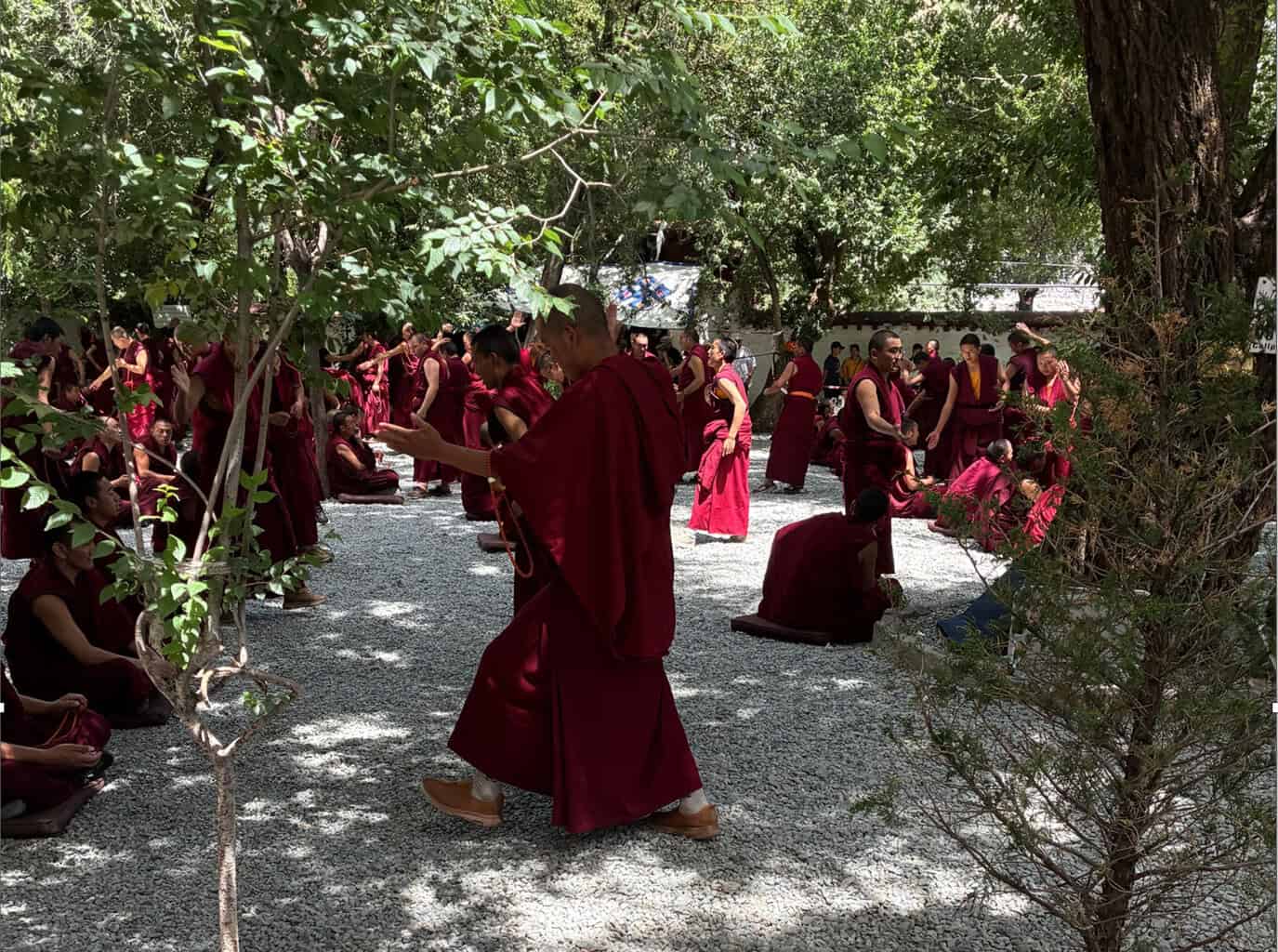
Alas, Christian Europe includes Matthew 12:30, “He who is not with Me is against Me,” and things are often binary, body and soul, heaven and hell, day and night, land and sea… male and female. But these pairs are not opposites; in each twosome, one is defined by the other; furthermore, to take the two genders for example, they can only be (pro)creative when they complement and compliment, ideally when they love, each other.
In like manner, as we said earlier, democracy is not just for a majority, and definitely, not just the majority. A democratic voting procedure should be egalitarian, identifying that option which best represents the common good. So this article concludes with the coming together of two concepts, one European and psephological, the other Asian and philosophical:
THE DE BORDA RULE: Majority voting may be fair if, and only if, its dichotomy is a duality.

Peter Emerson, the child of an English Catholic mum and Irish Protestant dad, was conceived in Belfast (as far as he recalls) but/and born in England. So – Ne Temere and all that – he was raised a Catholic. First in submarines, he sank to the rank of first lieutenant, but resigned to teach maths and physics in Kenya. Next, Belfast in 1975, he was a community worker in Ardoyne and then an activist in the peace movement and CND. “Are you ’this’ or ’that’?” they asked, in both conflicts, so he learnt Russian and got a job in Moscow.
But first, in 1986, he helped John Robb’s New Ireland Group run an experiment in consensus, with SF, the UDA – all but the DUP – using non-binary voting. It worked. Back in Belfast in ’91, we did another, with a guest from Sarajevo: Bosnia, too, was to suffer a binary conflict. Does everyone use binary voting? He’s just been to China; it seems the answer is yes.
Discover more from Slugger O'Toole
Subscribe to get the latest posts sent to your email.


