

In part one of this detailed analysis from Professor Peter Shirlow, Director of the Institute of Irish Studies at the University of Liverpool, captures critical in-time attitudes, revealing a halting decline in the pro-union vote and a stalled pro-unity share. Critically, he examines the rise of non-constitutional parties and voter resistance to collapsing the Assembly.
The data suggests Northern Ireland’s electorate is far from predictable.
Methodology
The current survey is based on a sample of 1534 Northern Ireland electors aged 18+. The survey was conducted using an online panel methodology with the data weighted (i.e. gender, age, SEG, local government district and religion) to be representative of Northern Ireland/North’s population.
The survey has a margin of error of +/- 2.5% at the 95% Confidence Level. Fieldwork was undertaken between 1 and 14 November 2025. The survey was undertaken by Social Market Research.
General Findings and Comments
Surveys are part of the process of measuring change, attitudes and opinions. They capture in-time attitudes that are critical in a place such as Northern Ireland in which the processes related to demographic change, cost of living issues and movement away from traditional identities and voting patterns can be captured.
Much of what forms commentary and political discourse in Northern Ireland/North is wedded to traditional thinking around identity, demography and the inevitability or otherwise of a border poll. This and other Liverpool surveys show that Northern Ireland is not a place of fossilised identities or one without in-depth consideration of policies and issues.
Surveys are an antidote to repetitive stereotyping of communities, the simplicity of sectarian head-counting and the notion that all generations hold the same opinions based on their faith or constitutional position. So first, how would people vote if there was an election tomorrow?
- Since 1998 the pro-union vote has declined but that decline appears to have stopped. Part of that decline is due to the movement of both socially deprived and/or secular and socially liberal pro-union voters to non-constitutional parties combined with levels of alienation and non-voting among those who would vote to remain In the UK.
- Within this survey pro-unity parties have maintained their vote share but have again failed to show signs of growth.
- SF, SDLP and PBP have a predicted vote share of 37.1% that is 2.1% lower than Westminster 2024 due in part to a 3.7% decline in votes for SF.
- The DUP, TUV and UUP have grown their vote share slightly to 41.6% or by 1.5% since last year despite a decline in support for the DUP.
- The non-constitutional Alliance and Greens have increased their vote share from 15.4% to 17.7% due to an impressive rise in the vote share for the Greens.
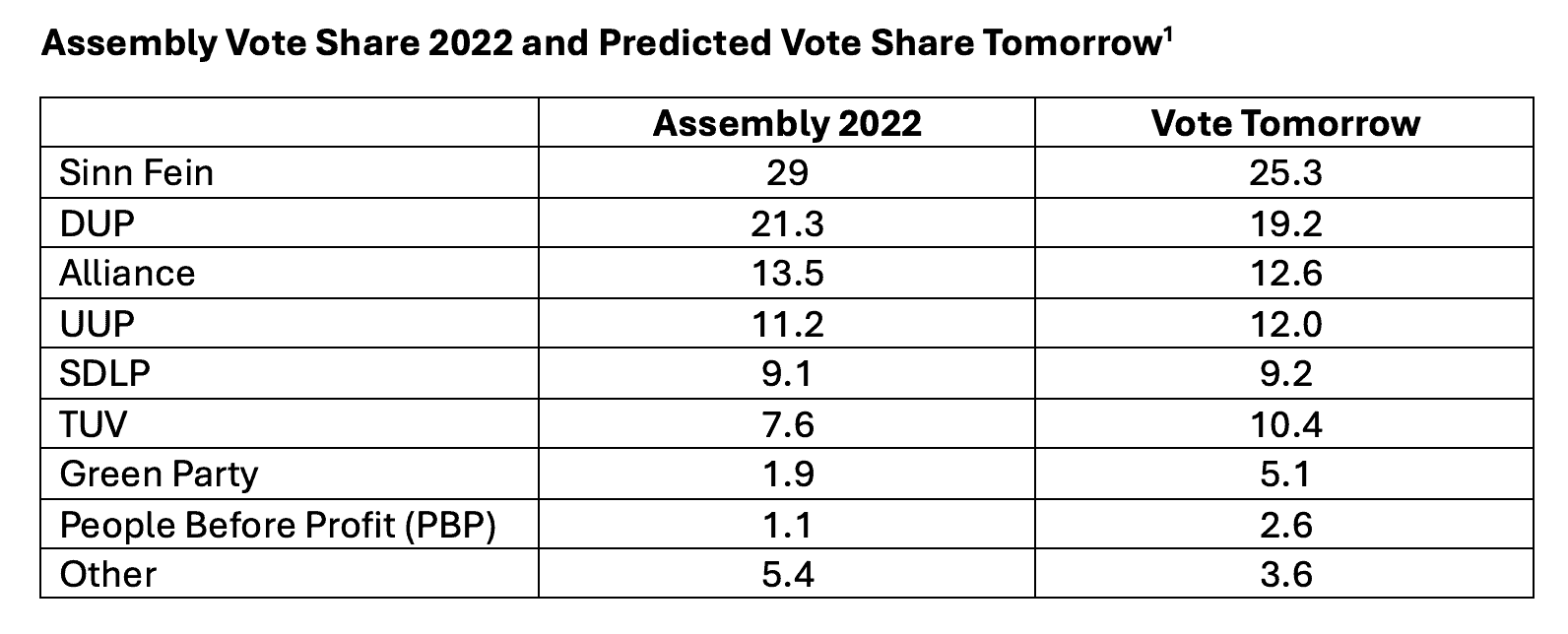
In overall term the two largest parties (SF/DUP) are down on their vote share Assembly 2022. Overall compared to 2022.
- SF is down from 29% to 25.3%.
- The DUP is down from 21.3% to 19.2%.
- Alliance is down marginally from 13.5% to 12.6%.
- The SDLP and UUP remain relatively static.
- The Green Party has gained significantly from 1.9% to 5.1%.
- People Before Profit have also grown from 1.9% to 2.6%.
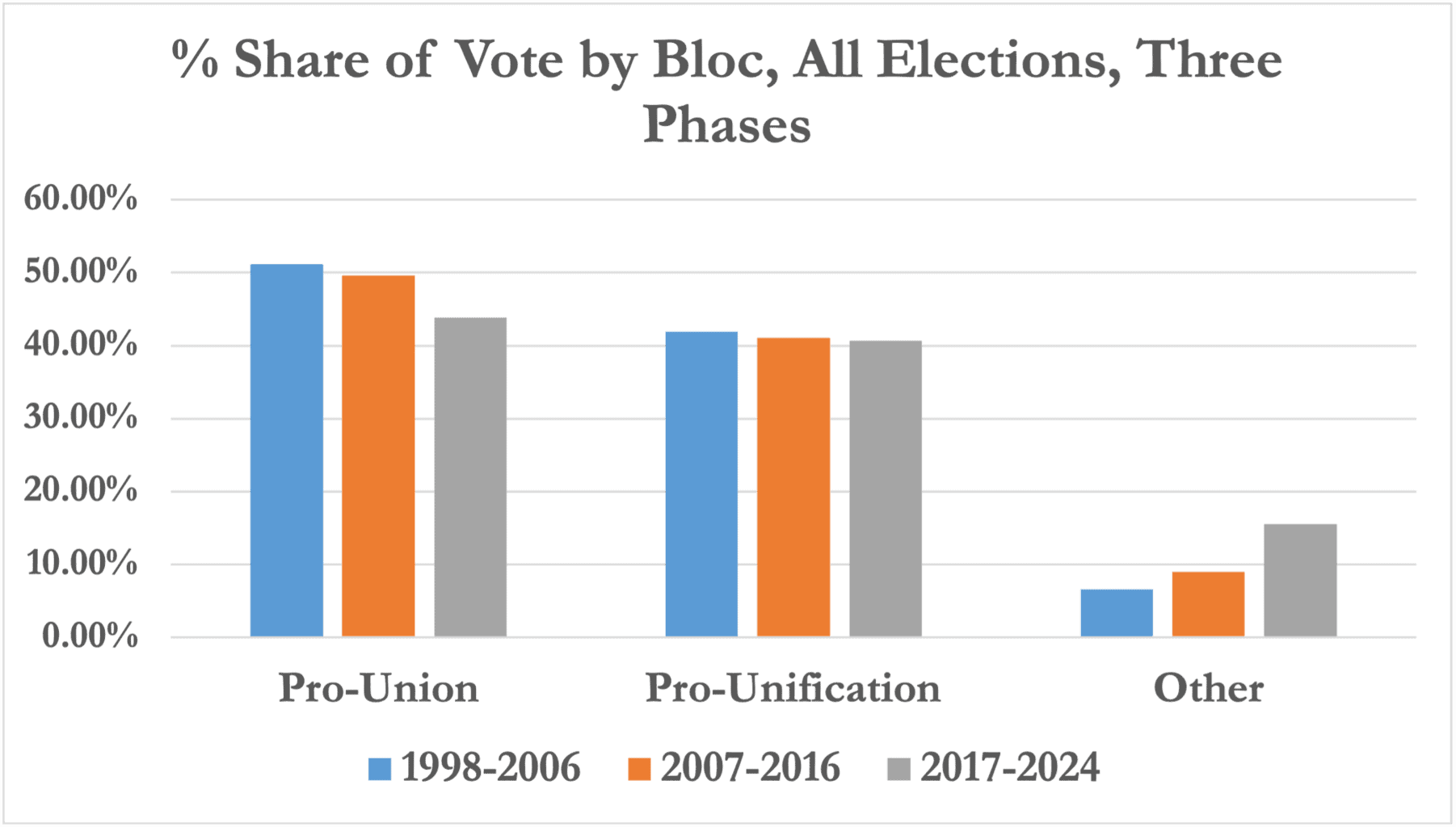
Professor Colin Coulter looked at vote share since 1998 by pro-union, pro-unity and other parties by 3 phases 1998-2006, 2007-2016 and 2017 to 2024. A painstaking task in which he had to find the constitutional loyalties or otherwise of every candidate however great or small.
The demise of unionism is obvious and is paralleled by the shift to the non-constitutional. Much less observed, admitted to or commented upon has been the small but none-the- less reversal in the pro-unity vote share more recently. The Secretary of State’s recent comment that we are not in border poll territory is borne out by electoral results.
With the Secretary of State appearing to state that the vote to trigger a border poll had to hit 50+1 for the pro-unity parties that means in crude terms they would need to achieve around 62% of the constitutional vote if the non-constitutional vote would not factor in future deliberations. Instead, of fuming and raging about a Secretary of State upholding the Good Friday Agreement it may be time for the pro-unity parties and campaigners to reason why since the early 1990s, when Catholics became a plurality of new voters and the overall population, has the pro-unity vote not grown.
As for unionism the lack of capacity to get beyond waiting for those who went elsewhere to return or trying to keep what ‘we hold’ on-board without any vision for electoral growth and a strategy therein is equally puzzling. Both unity and union are failing to capture, as they once did, first time electors, the socially deprived and increasingly the socially comfortable and well-educated.
The survey also asked if you would vote for a party that brought the Assembly down before 2027. Sixty percent agreed that they would not vote for a party that collapsed the Assembly before the election in 2027. A mere 12% stated that they would.
Among party voters 51.9% of SF, 78.4% of SDLP, 55.5% of UUP, 70.5% of Alliance voters and 32.8% of DUP voters stated they would not vote for a party that collapsed the Assembly before the election in 2027. Another piece of evidence that may suggest that SF collapsing the Assembly would not embolden but instead probably undermine the pro-unity vote share.
Their voters who tend, as the survey found, to be those most likely to have difficulty paying at least 1 household bill per year and who are probably more reliant upon the state than other voters is a reminder that voters are reliant upon solid Assembly functioning. In sum, 2027 will not be the last Assembly election.
More tomorrow…

Discover more from Slugger O'Toole
Subscribe to get the latest posts sent to your email.


