
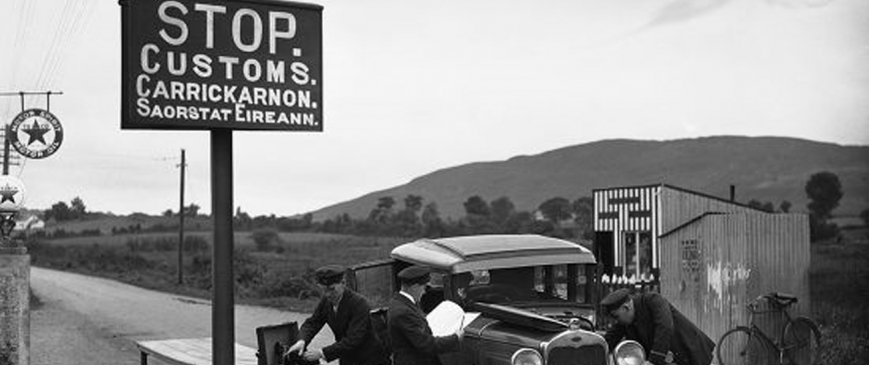
The looming prospect of No Deal is producing all sorts of ferment, with the focus on the clashing red lines over the Border. This was always the case but is now made more acute by trying to extract meaning from Boris Johnson’s smokescreen of bumbling towards victory in the Tory leadership election. Will anything he says bear the force of unbreakable promises to his electorate? The optimistic answer is probably very few, but by its nature it can’t be relied on. So just at the moment the prospects of a crash out have increased, unmitigated by Johnson’s cavalier optimism. The new element is acceptance that some sort of infrastructure around the border is looking unavoidable. This represents a retreat from Theresa May ‘s position. With four months to deadline, the Irish Times runs three pieces today covering the pressure on Dublin’s apparently unwavering support for No Change to the Withdrawal Agreement in response to a wilful No Deal strategy from the British.
Fiach Kelly asks: as a reaction to hard border, should Irish politics start planning under the radar for Unity?
The Government has built its argument on the backstop, the insurance policy to avoid a hard Border, around the Belfast Agreement, insisting its sole concern is protecting the hard-won peace… Should a new British prime minister throw out the existing Brexit withdrawal agreement and pursue no deal it then logically it follows that Dublin believes he will have significantly damaged the 1998 peace accord… Just because senior figures across all parties in Dublin are not talking about what they believe the political consequence of no deal will be doesn’t mean they aren’t thinking about it.
Some in Government suggest the crisis would be so serious that a rickety minority government or a majority coalition comprised of small parties tacked on to either Fianna Fáil and/or Fine Gael would not be strong enough to withstand the pressure, and suggest a national government will be needed.
Others in Leinster House, and not just in Sinn Féin, speak of a white paper on a united Ireland – backed by the full machinery of the civil service – within the lifetime of the next government as agreed policy between all parties in the Dáil, with a unity referendum within a decade.
None of this will be seriously discussed before a potential no-deal Brexit for fear of agitating unionism. But it is these questions, and not just the economic costs of a disorderly Brexit, that could dominate the years ahead.
Cliff Taylor argues that an each way bet on Brexit requires a standstill budget
Nobody really knows what a no-deal Brexit would mean. Even the Department of Finance, normally one to calibrate each forecast down to every last euro, says that in a no-deal Brexit the deficit for next year could be anywhere between €1.75 billion and €5.25 billion
Who knows what he should do? And on a wider scale, the idea that businesses or the Government are “Brexit-ready” is just a meaningless slogan. They aren’t.
We all need to accept that if it is the old-style, few-bob-for-everyone, pre-election nonsense we have seen in the past, we are just asking for trouble.
Without acknowledging that this is also a unionist idea Diarmaid Ferriter asks if Anglo-Irish bilateralism could not help solve the problem of an external border
The Government would, in the event of the worst-case scenario, need to answer two questions: could it accommodate the need for an external EU border with ongoing close cross-Border co-operation in Ireland? And could there be a new era of Anglo-Irish bilateralism as there was during the peace process?
A consistent line from the Government in the three years since the Brexit referendum has been that Ireland’s interests and the EU’s are “indivisible”, but there needs to be realistic planning in case that line becomes compromised and Johnson becomes a prisoner of his own bombast and ignorance.
So much for the commentators. Two of the best reporters in the UK and Ireland describe how a No Deal and a physical border climbed up the agenda. Peter Foster of the Daily Telegraph gives his verdict on the ProsperityUK proposals for “alternative arrangements” to the backstop ventilated at the Policy Exchange seminar earlier this week.
There have always been two Brexits – the big picture political pantomime and the technical, ‘actual’ Brexit of what is available or negotiable. Too often these two worlds have existed in separate orbits, their worlds never colliding.
So while the Tory Party hustings suck up all the media oxygen this week, it is possible to have missed a key coming shift in Government policy which emerges from the self-styled Alternative Arrangements Commission (AAC) report published earlier this week.
The report outlined proposed technical fixes – the same ones Boris Johnson called “abundant” – that Brexiteers believe can deliver a working border in Northern Ireland when the UK leaves the EU single market and customs union.
The idea of ‘MaxFac’ has been around for a while, but the report co-authored by pro-Brexit trade policy expert Shanker Singham makes a huge new leap by conceding that there will need to checks, frictions and intrusions – even if they are away from the border.
In short, all the signs point to the fact that the incoming Johnson administration (Mr Singham is widely expected to be a senior Boris adviser) actually wants to partially resile from Theresa May’s commitment on the border. This was made in the 2017 Joint Report, and pledged to avoid a hard border in Northern Ireland, “including any physical infrastructure or related checks and controls”. And given that Jeremy Hunt’s solution to the border also relies on technology, the same applies if he wins the leadership contest. Do not underestimate what a significant shift this is.
There was a second Brexiteers’ event in London this week that made the demand even more explicit, when Arlene Foster, the DUP leader appeared on a panel for the Policy Exchange think-tank to argue that Brexit could not mean ‘no change’ on the border.
Policy Exchange is the same think-tank that in a previous report in May 2018 argued that some attacks by dissident Republicans were “almost inevitable” but that this would only be a “short-term danger”. This time they glossed over the risk of violence, but in backing a paper by Lord Bew, a former adviser to David Trimble and a contributor to the making of the Good Friday Agreement, repeated that some checks in and around the border should be acceptable.
The Bew paper had a foreword by Sir Graham Brady, the senior Tory backbencher who gave his name to the amendment proposing that the backstop be scrapped in favour of the so-called ‘Alternative Arrangements’. He argues that checks already exist on the border, so it is “The scale and functioning of such checks” that is the real issue.
This might all sound like trifling semantics, but very quickly it takes you deep into the meat of the confrontation that is blocking Brexit.
Lord Bew argues that the “melting away” of a trade border in Northern Ireland began with the Single European Act of 1992, not the Good Friday Agreement and has happened over time. As such the ‘invisible’ border, while “enabled by the peace process”, is “not central to its terms”. This, to put it mildly, is a deeply provocative claim for nationalists. It is also a strange argument that if the Single European Act (that ushered in the EU single market) enabled their freedoms, why would leaving the EU single market not constrain them?
It may also be true that economic and political freedoms on the border have evolved over time but the Alternative Arrangements Commission is openly admitting that those freedoms –economic and personal – will be pared back by Brexit.
No-one is talking about a return to watchtowers or the open violence of the Troubles, but form-filing, mobile customs checks and geo-tracking that MaxFax proponents are suggesting is a material reduction in the day-to-day experience of their lives.
Brexiteers argue that the “world changes, get used to it”, and that the backstop risks equally impinging on the Unionist ‘freedoms’ to enjoy unfettered access to the UK internal market, but no-one should think that the Brexiteer mantra “it’s just a few checks” will cut ice in Dublin or Derry.
It is nothing less than risking a hard-won peace process and reducing the rights and freedoms of the nationalist community in order to deliver an “English” desire to leave the EU and go ‘buccaneering’ outside the EU single market and customs union.
Anyone making bold pronouncements that Leo Varadkar will back down in the face of a ‘no deal’ needs to consider the raw politics the border. Just like Brexiteers might consider choosing ‘no deal’ over ‘no Brexit’ politically rational, so Mr Varardkar might consider it politically rational to choose a ‘no deal’ (where he blames UK disdain for Ireland and the Good Friday Agreement) even it it leads to the return of a border.
The risk of a ‘no deal’ is rising all the time. RTE’s Tony Connelly describes the thinking in Dublin and continental capitals, as the face up to the prospects of No Deal.
The autumn deadline is getting closer, while Boris Johnson is challenging Jeremy Hunt to promise that he’ll take Britain out without a deal. So, in the current down-swing the spotlight is firmly back on the Irish border and what will happen there at the end of October…When the twin extensions were granted, those questions melted away. But now they are back..
“We’ve always had this luxury of the Brits asking for an extension… We’ve never been at the stage where we were looking No Deal in the eye,” says one senior EU source familiar with the negotiations.
This news coincided with both Boris Johnson’s so-called ABC Brexit plan, which included cutting out the backstop from the Withdrawal Agreement, and the launch of the interim report of the Alternative Arrangements Commission (AAC) which proposed a range of technological and administrative solutions to prevent the backstop ever taking effect.. Mr Johnson has described the report as “brilliant”. This cocktail of developments has convinced the EU that the risk of No Deal is rising sharply, and once again an unforgiving tractor beam seems to be swinging in Ireland’s direction.
Were EU member states starting to “gang up” on Ireland and its reticence on what it would do at the border on 31 October?
Some member states are aware of how politically toxic this is for the Irish Government. The moment detailed discussions about what facilitations might mitigate the impact of a hard border on the island of Ireland are made public, then they are likely seized upon by Brexiteers as proof that the backstop is unnecessary.
It seems reasonable to suspect, as one well-placed source concludes, that, for the moment, the discussions between Dublin and Brussels are exclusively at the political level and that technical discussions have not yet taken place.
“In the absence of clear, comprehensive contingency plans for the Irish border right now,” says one source, “drafted by the Commission and Ireland together, then day one of express contingency planning will actually be day one of No Deal.” .. If that assumption is correct, then if No Deal happens on 31 October there will not be much immediate change at the Irish border if at all
The baseline position is that under EU customs rules there is a well-known set of regulatory obligations that member states are required to enforce in managing a border with a third country.
This covers the collection of tariff duties, which goes into the EU’s “own resources” when it comes to the EU’s budget. Some 63 checks and controls in all make up a spectrum of customs, regulatory, fiscal, safety and security checks.
While it is impossible to impose a hierarchy, the most important would probably be within the “sanitary and phyto-sanitary” sphere, or SPS, given the scale of cross-border trade in agri-food. .. In order to preserve food safety and animal health, all member states have signed up to an increasingly strict set of rules. Border Inspection Posts (BIPs) are required because of the very high level of regulatory controls under this rule-book.
These regulations do not leave much room for flexibility or innovation. The rules are relatively clear and well known to customs officials, and BIPs require infrastructure and planning.
The Union Customs Code, the body of law covering the cross-border movement of goods and services, is not entirely specific about where BIPs need to be placed in terms of metres and kilometres from a border.
Member states simply have to demonstrate they are managing the border effectively. In some cases, these checks are done inland, typically if the border is straddled by a waterway. In other situations, BIPs are located dozens of kilometres away from the border because the livestock or animal products are being transported by train, which is a closed and controlled environment.
How quickly might a border regime be established in a No Deal situation?
The Irish Government will first and foremost find itself in the horns of a dilemma. Part of the political negotiations between Dublin and the Commission will no doubt focus on messaging and on managing the highly unpredictable fallout on the island.
The whole point about the backstop, from Ireland and the EU’s point of view, is to avoid a physical border in the first place (in other words, preventing what Ireland views as the achievements of the peace process from going into reverse).
It is impossible – perhaps pointless – to predict what condition Britain’s politics or economy will be in if No Deal hits hard. But an extremely acrimonious climate, wherein both sides will struggle to find some kind of modus operandi, is a safe bet.
Irish customs officials, meanwhile, will have to work out the border slice by slice.
Sources in Brussels say some things could be done relatively quickly through ad hoc measures… However, establishing a long-term border, if that is what destiny has in store, could take years.
The EU may agree to phase in some obligations in order to mitigate the effect. However, contemplating these obligations – which is what Dublin regards them as – in advance is one thing. What if there is a sudden surge in demonstrations and protests when the time comes? EU officials may shake their heads in dread. In the meantime, trying to divine the intentions of Boris Johnson and Jeremy Hunt is enough to keep everyone occupied.
His upfront plan to “disaggregate” the Withdrawal Agreement by selecting the parts he likes will not go anywhere. Furthermore, declaring that the Irish border issue should be pushed into the far end of the free trade talks that he confidently predicts will begin after No Deal is an echo of Britain’s opening gambit when the negotiations began, and which was at the time flatly rejected by the EU.
On Monday the Alternative Arrangements Commissions (AAC) published its 200-page interim report on preventing the backstop through the use of existing technology and exemptions. The EU, and Dublin, have declined to respond publicly to the report as it is not an official UK government paper.
However, officials from member states meeting in Brussels on Thursday gave it a cool reception when briefed on its contents by the European Commission. One diplomat present said it made for “interesting reading” but that overall its recommendation of multiple borders, exemptions and derogations rendered the ideas unfeasibly complicated and expensive for traders.
In particular, the proposal of a single animal health and food safety “area” comprising the island of Ireland and island of Great Britain was dismissed as a non-starter, since it would mean Ireland having to exit parts of the single market.
In a foretaste of the challenges facing either Boris Johnson or Jeremy Hunt, when they come to Brussels seeking “a better deal”, the European Commission has set five tests that alternative arrangements will have to meet, whether the freelance options by the AAC or the UK government’s own official ideas, which can only be worked up jointly with the Commission once the Withdrawal Agreement is ratified.
These are that they must ensure no hard border; they must comply with both the Union Customs Code and WTO rules; they must treat all member states equally (ie, Ireland cannot become a semi-detached member through some joint SPS-zone with the UK); and finally, they must comply with the objectives of the all-island economy.
These set the bar high. Seen against the backdrop of the Tory leadership race, the mood in capitals is downbeat.
“If it’s just a race to the bottom in the sense of the most undeliverable promises,” says one diplomat, “then the blow will be hard in the end. October is going to be a real rough ride.”
Rough ride perhaps but is it really impossible solve when for instance SPS regulations are uniform throughout the British Isles ? This does not dispose of all regulatory issues of the entire single market of course but neither does it dispose of the entire concept of max fac. Bruno Waterfield of the Time’s report covered in Slugger identified the EU’s hope( for) some sort of deal — tweaking, disaggregating backstop dates to create a timetable in a new legally binding protocol, a “joint interpretive instrument” and rewriting the Brexit political declaration on the future relationship — is Mr Johnson’s objective.

Former BBC journalist and manager in Belfast, Manchester and London, Editor Spolight; Political Editor BBC NI; Current Affairs Commissioning editor BBC Radio 4; Editor Political and Parliamentary Programmes, BBC Westminster; former London Editor Belfast Telegraph. Hon Senior Research Fellow, The Constitution Unit, Univ Coll. London
Discover more from Slugger O'Toole
Subscribe to get the latest posts sent to your email.


