
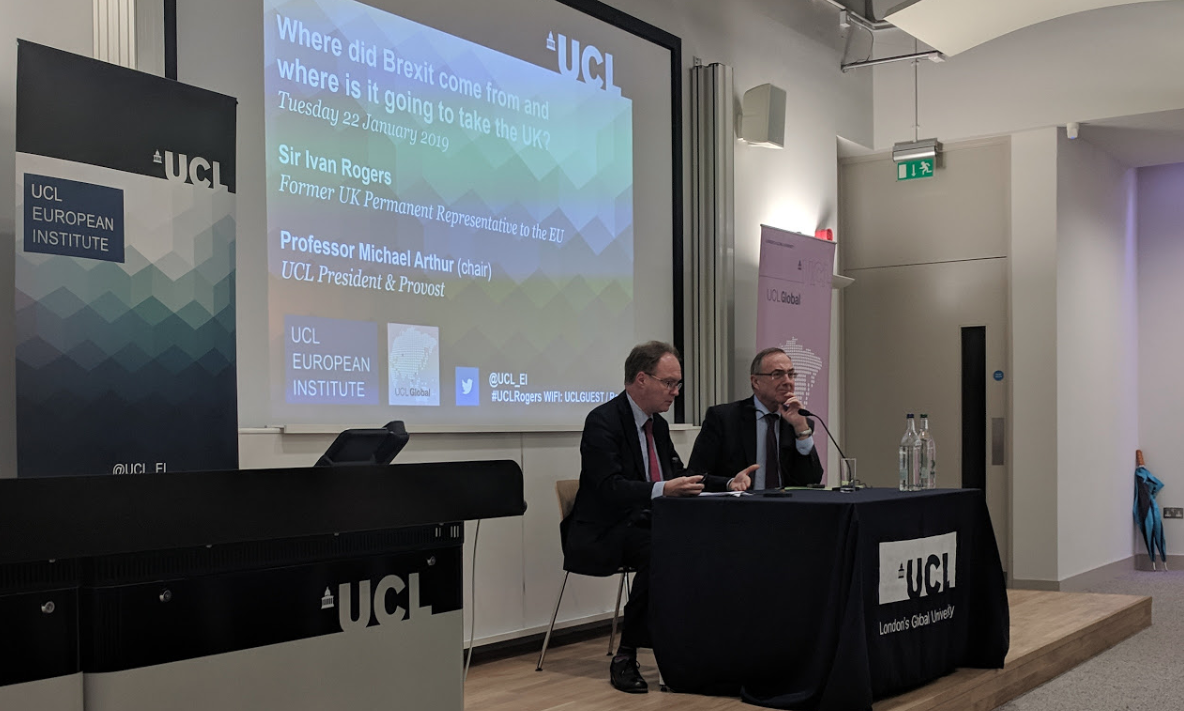
Last night I managed to survive the Ivan Rogers Experience, ( YouTube) a remorseless dissection of the entire Brexit debate which was as depressing as it was impressive. With good reason, Rogers is known as the Eeyore among Brexit experts. He was the UK ambassador to the EU who quit in disgust six months into Theresa May’s premiership. Remorselessly he spelled out the defects of every option now facing the UK, including remaining or re-applying. He laid about him with hard- to- answer criticism of all sides, but most of all the “fantasy” of negotiating on WTO rules.
As one astute commentator ( full text), who voted leave, put it rather superbly this weekend, it is the “I have no solutions and can’t be arsed to think” option.
So I will make one extremely confident prediction for the post Brexit trade talks ahead, regardless of which Prime Minister we have and whether they espouse what is in the current Political Declaration or whether they profess to want a Canadian style deal. When we get into them, we will discover, at a granular level, just how bad it is to start from a tabula rasa third country baseline on services. And we shall then spend a lot of negotiating capital and use a lot of concessions on other issues – and the free movement of people question is, as we have seen, intimately linked to services provision – to try and lever up our level of market access into what used to be our home market to something nearer Single Market levels. What is dismal about our political debate is the inability to start that debate until it is upon us.
Rogers had four lessons for the immediate future. First, the existential question should be asked: is it really possible to quit the EU at all?
…countries do hvave to be able to exit the EU, if that is their democratic choice. If the U.K. cannot manage it, and we are the size of the smallest 2/3 of Member States put together, there really is a huge problem. BUT… it only really works if the exiting country has worked out where it is exiting to. And is very clear sighted and basically united about what it wants to gain and what it is prepared to lose. Neither applies in the UK.
Second, we have to understand how the EU works and negotiates, because we shall, like it or not, not ever be floating free of ties and responsibilities in the mid-Atlantic. We shall, like an outsized Switzerland, be negotiating on everything – from fish to financial services, from food and farming to fundamental rights, and that is just the “fs” – for as long as both UK and EU exist.
He did identify limitations to the EU approach and culture.
The EU is a difficult negotiating partner… and the EU style of negotiating is inflexible. And in this negotiation, technocratic overreach in the departure of a major Member State may still end badly. The EU side too, at leader level, has to think harder about why, and about where it is going with the UK in the longer term. Repeatedly saying “we never get anything coherent from you in London”,, even if very often true, is not really enough.
Third, baselines – where you start from – matter in negotiations. We started on this one in a way calculated to land us up where we have duly ended. I have explained on the impending trade negotiations, assuming we get there, why I would profoundly not want to start out from a WTO-only baseline. And why the current Withdrawal Agreement already tilts the playing field nicely in the EU’s direction for the talks to come. No one is going to sign off on what they know the UK most urgently wants, till they have also banked a lot of what it doesn’t want. I am sorry if that sounds rough. But others do have interests and politics too. And if we end up seeking to get a quick and dirty trade deal done at all costs before the election and escape the vassaldom of transition, the EU will use the pressure of the ticking clock in the next phase just as effectively as they have in this, to extract concessions.
Fourth and finally, one cannot rule out an extension of Article 50, whether a technical, short one, because we are too short of time to get the legislation through in good order. Or a longer one because it remains such a total mess and both sides at top political level conclude that a disorderly and bitter “no deal” at this point is better avoided.
And just a hint of hope for the dream of the Brexiteers, – a last minute shift of position from the EU leaders, but against the odds.
One can see that on such an issue, leaders might well be in a different place from technocrats. Although, by and large, at every stage so far, leaders have been inclined to be less flexible than the Brussels apparatchiks.
We can see Rogers’ warnings in action in the Brexit panic surfacing in Dublin, after an example of “ technocratic overreach by the European Commission’s chief spokesman Margaritis Schinas, in saying the previously unsayable.
“ If you’d like… to push me and speculate on what might happen in a no-deal scenario in Ireland, I think it’s pretty obvious – you will have a hard border.
Which drew a stumblIng contradiction from Simon Coveney acknowledging that avoiding a hard border – which would require customs checks at the border with Northern Ireland – would be “very difficult”and the blunt admission from Leo Varadkar that a no-deal outcome would place Ireland in “a real dilemma.. The UK and Ireland would have to negotiate an agreement on customs and regulations that would mean full alignment so there would be no hard border.”
London for the first time in ages is offering Dublin “ immediate talks.” Now I wonder what they could about?
Despite Dublin nervousness, Michel Barnier has not backtracked on the commission’s position. He even added a warning largely unnoticed by No Deal Brexiteers.
Without ratification there will be neither a withdrawal agreement nor a transition period, nor will there be the mutual trust that we need, in order to construct the future relationship on a sound basis.
There will be checks in case of a no-deal-Brexit. We will do everything possible to enforce them unobtrusively. However, that will not be possible with everything. How should we control animals crossing the border? There will have to be checks. Again, the problem arose from Brexit and we expect the UK to take responsibility.
We’re cooperating with the British government. Things could start moving rapidly. This depends on the future relationship, like I already said. We are ready to be more ambitious if the British decide to shift their red lines, for example by remaining in a customs union, or participating in the single market. I believe there is a readiness in London for that.
If Britain asks for an extension, it has to be approved by EU leaders. They will only agree if three questions are answered: first and second, why and how long? And third, will not that be a problem for holding the EU elections in May? I have no clear legal answer to the third question yet. It is important that the EU’s democratic processes are not disturbed by this, however.
It needs a stable majority in London for all laws related to Brexit that need to be adopted. This will need time.
This is the kind of pressure that hard line Brexiteers like E International Trade secretary Liam Fox and cabinet ministers of like mind will resist when they oppose applying for an extension to Article 50.
Inside the Westminster bubble, there’s a lot of fuss about Rees -Mogg narrowing his objections to the May deal to the backstop. Outside it doesn’t come close to the reality Barnier’s is insisting upon and is overshadowed anyway by his daft idea of suspending Parliament . A sign of desperation or what? Rees- Mogg’s concessions are puny beside Barnier’s implacablity.
Tiny footnote
This is rather interesting… Arlene Foster and Nigel Dodds and their spouses had dinner with the Mays and stayed at Chequers last Friday

Former BBC journalist and manager in Belfast, Manchester and London, Editor Spolight; Political Editor BBC NI; Current Affairs Commissioning editor BBC Radio 4; Editor Political and Parliamentary Programmes, BBC Westminster; former London Editor Belfast Telegraph. Hon Senior Research Fellow, The Constitution Unit, Univ Coll. London
Discover more from Slugger O'Toole
Subscribe to get the latest posts sent to your email.


