
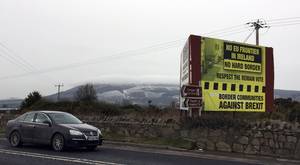
In a brave attempt to discuss a border poll dispassionately, Newton Emerson is tentatively suggesting that it might be a good idea to hold a sort of test poll outside the terms of the GFA “to clear the air.” Unfortunately his analysis is better than his prescription, as a poll of any sort under official sponsorship, even one declared in some way not to count, would inevitably still stimulate the seven year itch among nationalists he rightly identifies , to create a countdown to a united Ireland.
Newton notes the persistent disparity between the political attitude results in the Life and Times surveys and increasingly regular opinion polling. The first thing to do now surely is to convene a study of experts to try to account for this. Explanations are to hand: “ shy nationalists” and sampling which fails to take adequate account of a communally divided demographic or makes questionable assumptions about the non-voting public. Then there is also the example of the poor predictive record of snapshot polls, whether on line or by telephone, in the UK and US in volatile political circumstances. As things stand, a border poll is kept prominently on the agenda by anyone who has the inclination and funding to commission a public opinion poll. That can’t be right.
What can’t be denied is that any future result will be closer to the Scottish experience, much more marginal therefore than in the old days of a stable unionist majority. As all recognise, even the muted DUP, this is due to changing demographics in the North and the transformational character of the southern state and its relations with Britain.
The relevant section of the GFA reads to me as if they threw a border poll into the mix as a remote contingency, almost if not quite as unlikely as the UK leaving the EU. Leaving the judgement to hold a poll to the secretary of state under the vaguest of criteria ( Bertie Ahern claims credit), kept the issue away from the Assembly, in case the existential issue jeopardised the smooth operation of power sharing.
Twenty years on, these criteria should be re-examined.
As the political system institutionalises the communal division, should not the criteria for a border poll do likewise in the form of either a requirement for separate unionist and nationalist majorities or an overall weighted majority ? Almost certainly not. Interestingly so far there has been no serious agitation for this from unionists and it would certainly cause nationalist uproar. I believe when it comes to it, we are left with the general precedent of 50% +1.
“ When it comes to it.” There’s the rub. What is the context for a border poll? All sides are floundering in the Brexit atmosphere, but they would do so even without it. Brexit provides cover for a general reluctance to grip the issue.
How far does “ reconciliation” have to proceed before a border poll is held and how do we recognise it if and when it happens? Is “reconciliation” compatible with a border poll or a stalling strategy for unionists?
The Unionist parties are unlikely to engage in scenario planning for a border poll and more fundamentally on terms and conditions for accepting unity, for fear of encouraging the very developments they do not wish to see come about. The main Dail parties of government are generally reluctant to engage for fear of jeopardising reconciliation, although they are not above a little constructive ambiguity on the point .
One definitive act that could cut through the thickets of doubt and uncertainty would be to call on the northern political parties to declare their position in their manifestoes on a border poll during the lifetime of the next Assembly if there is one, and pledge to vote on it in the Assembly. Anything over a 40% voter turnout in favour and 40% in the Assembly might be held to be persuasive. But would not the very proposal be so divisive that it would blight whatever chances there may be after Brexit for reconvening the Assembly? Or would all parties accept the challenge?

Former BBC journalist and manager in Belfast, Manchester and London, Editor Spolight; Political Editor BBC NI; Current Affairs Commissioning editor BBC Radio 4; Editor Political and Parliamentary Programmes, BBC Westminster; former London Editor Belfast Telegraph. Hon Senior Research Fellow, The Constitution Unit, Univ Coll. London
Discover more from Slugger O'Toole
Subscribe to get the latest posts sent to your email.


