

If a picture’s worth a thousand words, there here are three charts to help your eyes unpack some of the shifts in voter behaviour at Thursday’s General Election!
Turnout across Northern Ireland’s 18 constituencies was low. Very low.
The final NI figure of 57.45% dipped below the 2010 slump (57.99%) and – correct me if I’m wrong – is the lowest turnout for any General Election in the last 50 years. (Note that turnout at by-elections can be much lower: for example, only 36.46% of the eligible electorate cast their vote in the 2011 Belfast West by-election.)
While turnout fell in all 18 constituencies from the last Westminster election in 2019, the fall was anything but uniform. (I’m not re-estimating turnout based on the boundary changes.)
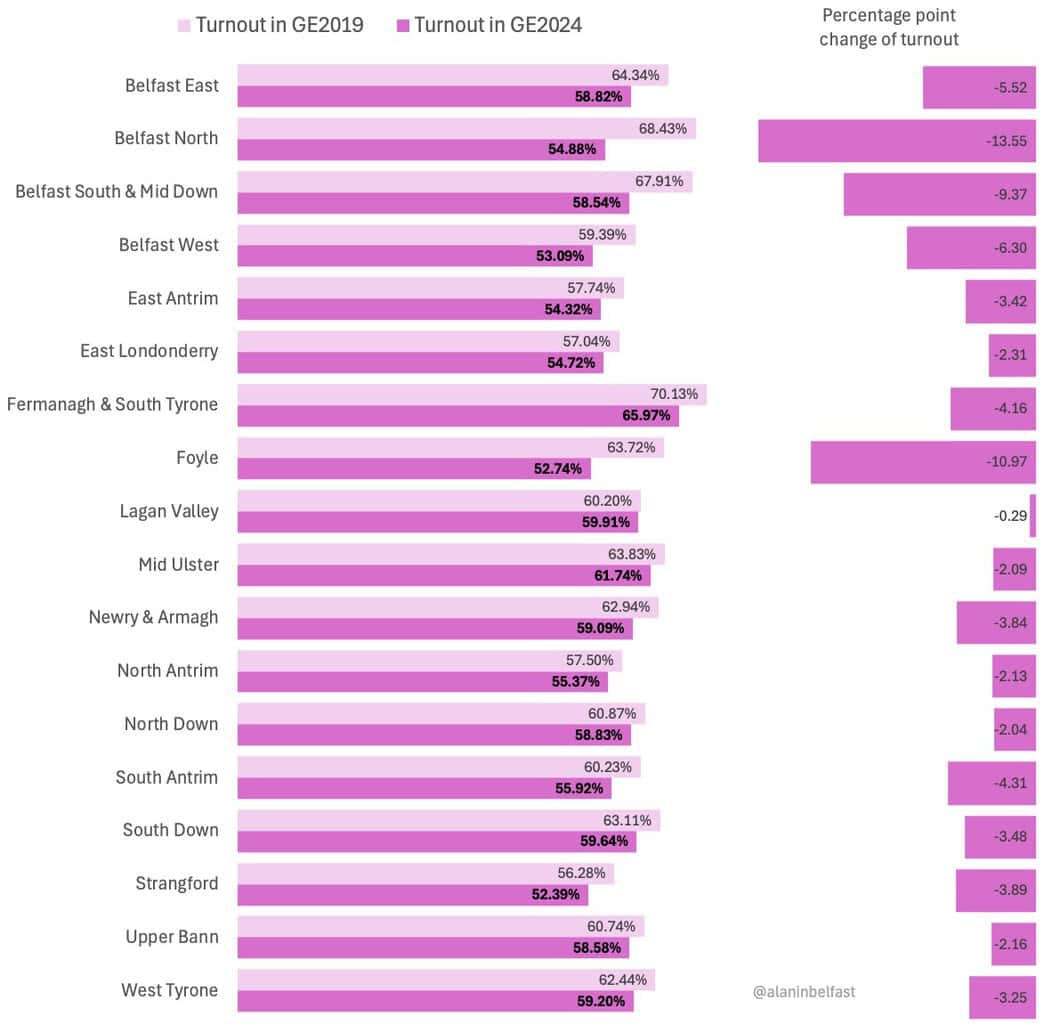
Fermanagh & South Tyrone remained the constituency with the highest turnout (65.97%, a drop of 4.16 percentage points) and Strangford was once again the lowest (52.39%, a drop of 3.89 percentage points).
The smallest drop was in in Lagan Valley – just down 0.29 percentage points in this competitive race – in sharp contrast to the largest dropoffs in turnout in Belfast North (13.55 percentage points), Foyle (10.97), Belfast South & Mid Down (9.37), Belfast West (6.30) and Belfast East (5.52) … several of which would be considered relatively competitive too.
Party support tells a different story.
Note that the charts use grey to indicate when parties didn’t field a candidate at the previous election (for increases in support) or didn’t field a candidate at this election (to explain decreases in support). So the TUV’s gains are all grey as they had zero candidates in 2019. And, for example, the Sinn Fein’s drop in support in Lagan Valley is grey because they didn’t field a candidate in 2024. Clicking on the pictures should bring up larger images if you’re struggling to squint at the figures!
In all but one constituency in which they ran, the overall number of votes polled for the DUP was down. The party’s vote share dropped in all but three constituencies (Upper Bann, South Down, and – marginally – Foyle). There’s a considerable mirroring between the TUV gains – they didn’t contest any seats in 2019 – and the DUP losses.

Paddling against decreases in turnout, Sinn Féin increased their vote in every constituency in which they ran except Belfast North. Their vote share only dropped in Belfast North (3.4 percentage points – almost matched by the SDLP vote upon reentering the field – and Belfast West). Sinn Féin had a very good election in terms of consolidating their vote.Alliance made gains in terms of votes cast in Lagan Valley and Belfast South & Mid Down … and let’s not forget the single extra vote gained in Foyle. And while the party doubled their vote share in 12 constituencies in the 2019 election, Alliance’s vote share slipped back in 13 constituencies in 2024.
The UUP managed to put on votes and vote share in more constituencies than the SDLP.
People Before Profit will be disappointed that they lost vote share in Belfast West (which corresponds with the SDLP candidate’s gain, but we can’t be certain that was where they all went).

If you’re trying to piece together the North Down story, independent Alex Easton – whose 2024 performance is not covered on the charts above as I didn’t include independents – pulled in 5,523 extra votes on top of his haul for the DUP back in 2019 (now totalling 20,913), and gained 10.44 percentage points of vote share (now standing at 48.30%).

Alan Meban. Tweets as @alaninbelfast. Blogs about cinema and theatre over at Alan in Belfast. A freelancer who writes about, reports from, live-tweets and live-streams civic, academic and political events and conferences. He delivers social media training/coaching; produces podcasts and radio programmes; is a FactCheckNI director; a member of Ofcom’s Advisory Committee for Northern Ireland; and a member of the Corrymeela Community.
Discover more from Slugger O'Toole
Subscribe to get the latest posts sent to your email.



