
Ann Watt is the Director of Pivotal
We are used to hearing about Northern Ireland’s political difficulties. We hear much less about the public policy challenges that affect people’s everyday lives. That has to change.
Key pillars of public policy face significant and pressing challenges. The health service is in crisis. The schools system has areas of excellence but suffers from major inequalities. The economy is unbalanced and performs poorly compared with the rest of the UK. A quarter of children here live in poverty, community division remains a significant issue, and Northern Ireland has simply not taken a seat at the table when it comes to tackling climate change.
All these things need our attention, and all require urgent reform.
Last week’s Westminster election had a clear result, the new government will look to reach a Brexit resolution quickly and, while it is almost three years since the Northern Ireland Executive collapsed leaving the Assembly in limbo, talks are set to resume this week on reigniting Stormont with a election early in 2020 possible if these efforts fail.
This might not be the end of the political uncertainty of recent years but, regardless, now is the time for greater focus on what affects local people day and daily.
The election result did not change the problems we face. Neither will whatever happens at Stormont in the next few weeks and months. Northern Ireland’s core issues remain the same, they are matters of policy and they need to be addressed as such. Of course, politics and policy are tied together but the fact is that, whether or not an Executive is in place, whoever is in a position to make decisions about policy matters in Northern Ireland has to drive change, and do so quickly. It would be much better if these decisions were made by a government at Stormont made up of Northern Ireland parties.
Pivotal is a new organisation, and is Northern Ireland’s only independent think tank. Our first report, Moving forward – putting Northern Ireland on track for the future, was published on 19 November. It takes a look at Northern Ireland as it is now, shining a light on six major policy areas that face great challenges. None of these issues are new, and some have been the focus of sustained government investment. Nevertheless our problems remain, and urgent policy change is needed if we are to get on track for the future.
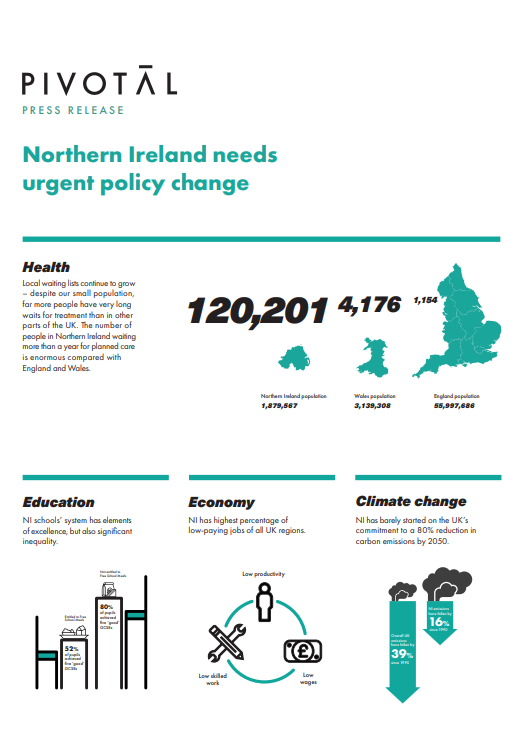
The economy – Northern Ireland has the highest percentage of low-paying jobs of any UK region, and is one of only three regions with more jobs paying poorly rather than well. Our rate of economic inactivity is the highest in the UK, at 25.8% – meaning over a quarter of all adults are neither in work nor looking for work – and the gap between our public spending and the tax revenue we raise is £4,939 per year, per person.
Health and social care – demographic change means rising demand for health and social care. However, little has been done to make the structural changes needed to provide for these changes in demand. Today, the signs of crisis are clearly showing.
In March this year, there were 1,154 people who had been waiting over a year for planned care in England. In Wales that number was 4,176. In Northern Ireland, it was 120,201.
Only 5% of health spending goes on mental health provision, half the proportion spent in England – despite estimates showing instances of mental ill health are 25% higher in Northern Ireland.
Social care is stretched to breaking point, while demand continues to increase. Between 2018 and 2043, the numbers of people in NI aged over 65 and over 85 are projected to rise by 56% and 106% respectively. Over the same period, the overall population will rise by only 6%.
Education – our segregated education system has elements of excellence but suffers from major inequality:
• The proportion of students getting ‘good’ GCSEs – at least five A*-C, including English and maths – is 94% in grammar schools but only 52% in secondary schools.
• 52% of pupils entitled to Free School Meals got five ‘good’ GCSEs compared to 80% of pupils who are not entitled to Free School Meals.
• 78% of pupils entitled to Free School Meals attend secondary schools, and only 22% attend grammar schools.
Our education system is expensive, and finances are stretched. There are just over 1,000 schools in Northern Ireland and this year 451 of them went over budget, with a total funding shortfall of £62.6m.
Poverty – children here are more likely to live in poverty than adults (one in four, vs one in five). Failures in the education and training systems contribute to persistent poverty across generations.
Northern Ireland has the highest percentage of children living in long-term workless households out of all UK regions – 13.6% of children, compared with the UK average of 8.2%. Children growing up in workless households are much more likely to have lower educational attainment, be unemployed, and live in poverty later in life.
Climate change – the world is in a state of climate emergency and there is a growing global movement for change involving governments, businesses and societies. Northern Ireland has yet to take a seat at the table.
A decade after the UK Climate Change Act, Northern Ireland has set no emissions targets – unlike Scotland and Wales, both of which set their own targets in addition to those for the UK as a whole – and enacted no legislation. Since the Act came into force, emissions here have fallen by just 9% compared with 27% across the UK in general.
Community relations – social division cuts across all policy and debate here. Key public services like education and social housing remain largely divided along lines of perceived culture and community.
However, division along sectarian lines is not the only issue we face. There is a racially motivated hate crime an average of three times a day, despite the relatively small number of people here from ethnic minorities or from other countries.
The case for change is clear, and Pivotal hopes to be of some help. Our core aim is to help improve public policy in Northern Ireland, for the benefit of all the people who live here. We are an independent organisation, we have no political alignment and are open minded about policy solutions. We want to work with all those who are ambitious for change in Northern Ireland.
We are also positive. Northern Ireland faces great challenges and there is no point pretending otherwise. However, these challenges are not insurmountable. We can change. We can create a better future.
Think tanks can play an important role in both highlighting and framing policy discussions. Our work will focus on evidence and analysis. Our Moving Forward report is just the start – hopefully it can provide a significant nudge towards great policy debate and better policy choices in Northern Ireland.
Find out more at Pivotalppf.org or follow us on Twitter @pivotalppf

This is a guest slot to give a platform for new writers either as a one off, or a prelude to becoming part of the regular Slugger team.
Discover more from Slugger O'Toole
Subscribe to get the latest posts sent to your email.


