I was travelling yesterday, so I didn’t see the LucidTalk poll on the European elections until late on. Bill White has asked people to ante up with both first and second preferences, and the results are fascinating in what they suggest about the likely transfer patterns (of which more later).
LucidTalk relies on a similar model to YouGov, in that Bell has been developing an online panel of about 10,000. Clearly the bigger the panel gets the better the success rate should be. It also has another advantage in that Northern Ireland elections are more predictable than most.
This uniformity of pattern lies in a number of fixed factors, the largest of them being the constitutional question. But in this election Brexit superimposes a small but significant uncertainty factor, which in fact does not cut straight down communal lines.
In a polity which voted by a very small majority in favour of remaining, the real scrap is going to be whether that third seat goes Remain or Leave. Communal identity will blur this matter at the edges, but it could be a key pivot point for enough voters to make a difference.
 In an interview with Frank Mitchell, Bill admitted that the poll might be underestimating Jim Allister’s vote (which combined with UKIP took a 100k last time), down from 12.1%* last time out, but this time is on 8.5%. Given that the DUP appears to be holding this could be also be a squeeze on the core Brexit vote (UKIP is also down).
Extreme Brexiteer-ism is not as strong in Northern Ireland as it is England. Over the last year and a half the economic vulnerabilities of Northern Ireland have made it clear there is a strong appetite for compromises (there’s just no agreement on what they should comprise).
The candidate who suffers most from any Remain v Leave squeeze could be the Ulster Unionist Danny Kennedy. His party probably accounts for the largest single group of Remain voting Unionists. However, at 11.8% he’s still within range of what Jim Nicholson got back in 2014. They are struggling with signaling.
But he has two things favour. He’s younger than Jim Nicholson and should benefit from the much stricter vote for the unionist line being adopted by both Diane Dodds and Jim Allister. If the Allister vote comes in bigger numbers than predicted, staying in the following pack could get him over the line.
On the nationalist side, 42% of Sinn Fein second preferences say they will go straight out of nationalism and to Naomi. Despite the fact that SF is not above asking the SDLP to step aside to allow a single nationalist candidate, its own strategy appears to be the obliteration the SDLP.
Nevertheless, according Lucid talk, of the three likely winners of the third seat it is Colum Eastwood who currently sits fractionally ahead of both Danny and Naomi. Bill has described this race as the PR election closest to aFPTP in that generally the top three finishers take the top three slots.
Of course this is only a poll, and Eastwood is very far from guaranteed of taking third place, but the transfer patterns (which favour Naomi) suggests that his best chance is to focus on bringing in as many first preferences as he possibly can before having to enter the count process where the advantage may slowly switch towards Kennedy and/or Long.
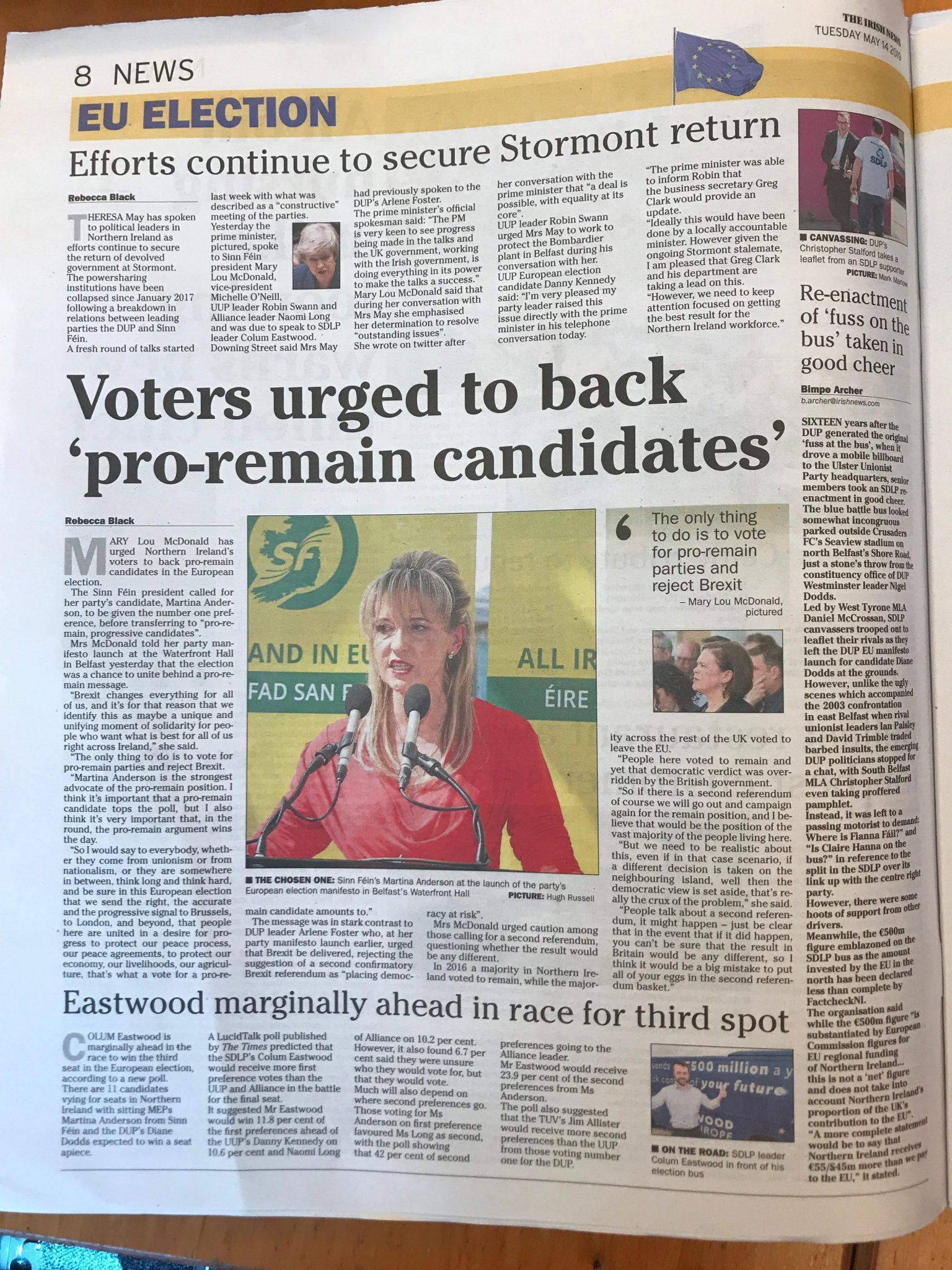
In trying to do so, Colum will have little help from the mainstream press. The Irish News this morning relegated news of the EP elections to just two pages inside. They also relegated his strong showing to page 8 with a lower billing than Sinn Féin’s call for voters to vote for Remain.
On the other hand the transfer patterns mapped by LucidTalk means that even if she’s not in third place, Naomi’s chances should improve with each succeeding count, with the largest single number likely to come from those who plan to give the SDLP first preferences (71.8%).
On Northern Slant James McMordie writes:
Green voters are even more likely to transfer to Alliance, with 71.3% indicating that Naomi Long would receive their second preference. By way of comparison, Danny Kennedy would only receive 0.3% of Sinn Féin transfers and 2.8% of Green transfers, whilst Colum Eastwood would only receive 23.9% and 5.6% respectively.
Much will depend on turnout. A rise could mean a late surge of pro Brexit unionists. But there is also that large, mysterious pile of voters who have decided they will vote, but not yet who they will vote for (6.7%). Bill says that they are predominantly in the predominantly unionist East.
They remain an unknown and unknowable quantity, which is just as well because there is always a danger with polling in place like Northern Ireland that the voters might just forget it is their duty to prove the pollsters right or wrong.
*All party figures are based on excluding don’t knows as per the lower chart above.
Photo by geralt is licensed under CC BY-NC-SA

Mick is founding editor of Slugger. He has written papers on the impacts of the Internet on politics and the wider media and is a regular guest and speaking events across Ireland, the UK and Europe. Twitter: @MickFealty
Discover more from Slugger O'Toole
Subscribe to get the latest posts sent to your email.