
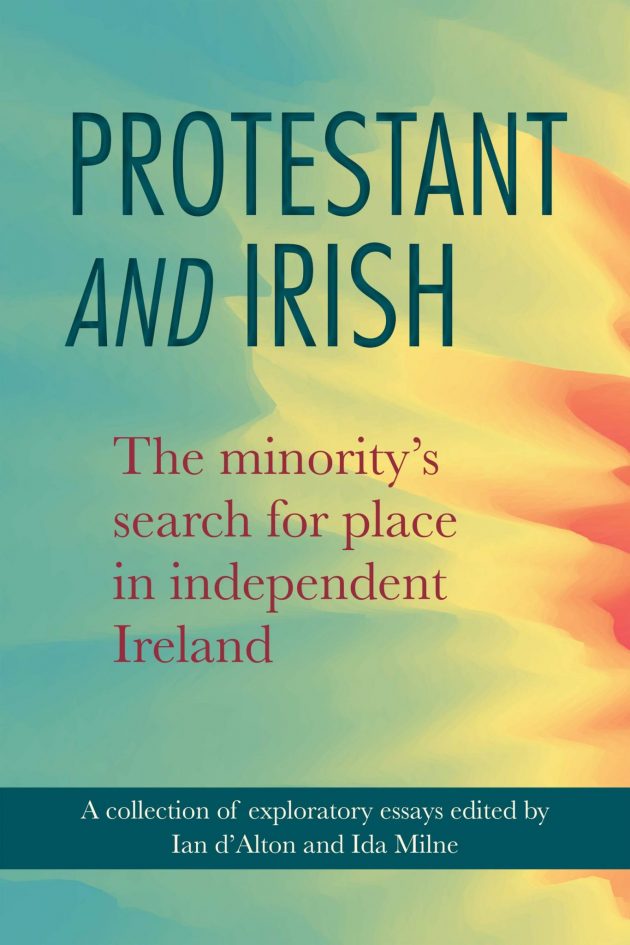
 Protestant and Irish: The Minority’s search for place in independent Ireland is a collection of exploratory essays edited by Ian d’Alton and Ida Milne. It is published by Cork University Press 2019 ISBN 978-1-78205-298-2.
It is hard to credit today but when I left Belfast for Galway in 1974 there was a sense of entering the faraway and unknown. Belfast Protestants were pretty thin on the ground there so far as I could tell; indeed, the only other fellow Northerner I was aware of at UCG (now NUIG) when I got my bearings was James Fairley, the botanist.
Having a pint in the wonderful Tavern bar in Eyre Square – alas, long gone – one of the younger members of staff at the College raised a few eyebrows when he remarked somewhat theatrically that ‘I had brought the Troubles with me’. Difficult as it is to recall those days of the early 1970s it’s even harder to believe that British Army officers were still to be seen locally for a year or so ‘on leave’.
Religion rarely raised its head because so much of the landscape – by which I mean everything from school and hospital, college and public buildings – was suffused with the ethos and symbols of the Catholic Church. And there was also of course the sound as well of the Angelus, along with the religious ceremonies which were still marked then such as Corpus Christi with public parades through the inner city of Galway where I lived in a tiny network of high but narrow streets skirting the Corrib River, the canal ways and bridges.
I was not too put out by all of this, being, as Glenn Patterson has called it, ‘a lapsed Protestant’. Galway could have been Genoa as far as I was concerned. In fact, there was a tidy wee bar by that very name only a few steps away from the flat in which I had pitched-up.
But as the decade developed and I started to realise that this was going to be my home for some time to come I did notice how one could be offended by the unconscious assumption that being from Belfast, and having ‘Gerald’ as your first name, meant that you had to be, of course, Catholic.
If and when this misunderstanding was clarified, nothing more was said. There was never a hint of spitefulness. Not a sectarian word – not among those who became my friends and eventually family. Not a bit of it. Sometimes a jest; occasionally a curious enquiry (‘I always thought Protestants…’) but that was it. I spent many hours in the famous Castle Hotel in Abbeygate Street discussing politics, as Aran men and women swept in and out, or in The Cellar Bar and Taaffe’s, another haunt for Sunday night revels, when traditional music flowed.
After I published a couple of books of poetry with what were considered at the time ‘political’ connotations – The Lundys Letter (1985) and Sunday School (1991) – and started to write critically about Protestantism and Irish culture – for instance, in Across a Roaring Hill: Essays on the Protestant Imagination (co-edited in 1985 with Edna Longley) – things changed a little, though not, on the personal or local front.
It really is a long time ago. But some of the difficulties, the misconceptions and the strains resurfaced reading this wonderful and highly recommended collection of essays, Protestant and Irish, edited with diligent care by Ian d’Alton and Ida Milne, both of whom contribute valuable essays as well as setting the book in motion with a sensible introduction, ‘Content and Context’, which in turn, follows Roy Foster’s Preface ‘The Protestant Accent’, more on which anon.
The collection gives such rich and enveloping insight into the ways and manners by which southern Irish Protestantism adjusted to Irish independence from the 1920s to, roughly, the 1960s. If I had one reservation it is that the northern part of the story could well have complemented the narratives included here by which I mean, the experience of those from the north who experienced life as Protestants in the ‘Free State’ (and eventual Republic) during the same time-frame.
That might have produced an interesting perspective. The sense of a partitioned history should not really feature though, understandably, the pedagogies and practicalities of publishing have very much their own priorities.
This one minor caveat aside Protestant and Irish is a necessary and timely volume. So much lived experience is contained within the book that it’s difficult to know where to start in responding to the range and fascinating detail of the witness given by so many ordinary ‘Prods’ to what it was like growing up in different parts of the twenty-six counties.
Many of the essays are based around oral histories, of interviews some of which disclosed ‘a reticence…indicative of a legacy of hurt and resentment’ (235) particularly regarding the transgressive nature of ‘mixed marriages’ leading in some painful cases to the ostracising of family members.
There are also some smart readings of southern based cartoonists whose work included satirical portraits of upper-class Protestant society in Freeman’s Journal in the 1920s and Dublin Opinion in the 1930s. As Caleb Richardson remarks in his consideration of the humourist and journalist, Patrick Campbell, ‘humour played an important role in [Protestant]adaptation to life in independent Ireland, although not quite in the ways that one might think’ (269).
From Protestants involved with the GAA, recounted by Ida Milne, to those throughout the countryside engaged with local and national politics – as Tony Varley describes, sometimes against the current such as Robert Malachy Burke’s standing for the Labour Party in Galway during the 1930s and ‘40s, facing a campaign of ‘whispering and vilification’ against him (113) to the Protestant republicans involved in revolutionary movements for independence and after, described in great detail by Martin Maguire. The dramatis personae of Protestant involvement produces all manner of individuals, each one worthy of attention. Indeed, the fictional and dramatic possibilities which Protestant and Irish offer are manifold.
But how was this community within a community viewed? According to the editors the Irish ‘government was relatively sensitive to its minority, more or less leaving it to its own devices. But the corollary was a subterranean exclusion’ (3). Clearly class background and locale were important in determining the wider Catholic society’s understanding of those from a different religious background.
None more so than in Dublin’s ‘Pockets of the Protestant working class’ (the world out of which Sean O’Casey emerged) and ‘the coterie of domestic servants in the south city, county and township areas and beyond or the skilled working-class Protestants in the suburb of Inchicore, with its railway works’ (13).
It is suggested that throughout the immediate period after the establishment of the Free State (1922) and as late as the 1950s the protocol for dealing with religious and cultural differences was simple: ‘deliberate amnesia on both sides…it was neither necessary, nor important to remember….
Nevertheless, there is still within some elements of the Protestant community homage to a sensitivity to a presumed memory of murder, persecution and flight; whether real or imagined is beside the point’ (15). Other researchers such as Robin Bury, Buried Lives: The Protestants of Southern Ireland (2017) paint a different, gloomier story of decline, detachment and depression, tones which have attracted several important Irish writers to the fate of the minority as a narrative of emblematic status for modern societies, post-conflict and crisis.
Trinity College Dublin features throughout Protestant and Irish as its identification with the British imperial state and cosmopolitan culture comes increasingly under strain in the new emerging state. ‘Change was certainly underway and was making an impact on the younger generation’ Miriam Moffitt declares in a fascinating re-run of ‘Protestant Identity and the “State Prayers” Controversy, 1948-9’: ‘Trinity College, a bastion of unionism, was initially suspicious of the new state but moved towards an accommodation over time, which intensified after it negotiated a much-needed government grant in 1947.
Some students realised as early as the 1920s that they were not bound by their parents’ attitudes and that their Protestantism was not necessarily synonymous with loyalism, so the average student in the mid-1940s adopted a form of moderate nationalism: Ireland first and then the Commonwealth’ (72).
This accords fairly closely with my own experience of several much older scholars and Fellows I met in the College in the 1980s, many of whom would have been young academics in the late 1940s and 50s and who eventually faded away as a younger generation pushed through important interior changes of both heart and mind in the 1960s and 70s when TCD became an Irish college yet drawing upon its four hundred-year plus history.
Which brings me back to Roy Foster’s preface ‘The Protestant Accent’ and his conclusion that while it ‘may have vanished, independent Ireland was characterised by a Protestant intonation, and was all the richer for it’ (xxiv). It may well be that the ‘accent’ will alter somewhat over the next generation and that a northern influence of independent thought plays an increasingly more progressive role in the mentalité of the Republic, post-Brexit. (Who can tell but unquestionably at the present the north seems to be lying well behind the Republic in terms of civic rights.)
As the editors’ remark: ‘There is another volume to be written about southern Protestantism in the turbulent years shaped by the Northern Irish conflict, economic boom-and-bust and the Weberian ‘protestantisation’ of Irish Catholic society’ (6).
Notwithstanding the assumption that ‘strongly held conceptions of identity can neither be discarded nor disregarded’ (79) what Protestant and Irish proves is that the legacy of cultural Protestantism is only now, in the 70th anniversary year of the declaration of an Irish republic, finding its level in cultural discourse which does not presume (as it once did) that to discuss such things is itself sectarian.
How all this will impact upon the situation of Northern Ireland is another story altogether. It might be instructive to meditate upon how Irish society treated one of its largest minorities as a template for how in today’s Ireland other minorities will be facilitated in a post-Brexit Ireland, north and south.
In his Afterword ‘Ireland’s Mysterious Minority – a French-Irish Comparison’ Joseph Ruane, looking at how the French Revolution ‘put in place a new citizenship-based understanding of the French nation, undoing the ancien régime’s equivalence of Catholicity and Frenchness’ suggests that with the notion of reunification – which ‘could happen a long time from now, or it could come quicker than anyone imagines’ – ‘a historic opportunity to once again play a role in the politics of the island’ awaits the Protestant minority, although ‘Doing so would mean breaking with their low-key approach and asserting themselves in public debate’.

Gerald Dawe is a Belfast-born poet. He was professor of English and fellow of Trinity College Dublin until his retirement in 2017. He has published twenty collections of poetry and literary criticism, including most recently, The Last Peacock and The Sound of the Shuttle: Essays on Cultural Belonging & Protestantism in Northern Ireland.
Discover more from Slugger O'Toole
Subscribe to get the latest posts sent to your email.


