
 Walking the dog through the silent streets and avenues of an unusually deserted south Belfast, the scene reminded me fleetingly of Sunday mornings during the industrial, asthma-inducing nineteen fifties when there wasn’t a soul about. Everyone then would have been indoors in semi-darkness, putting down fires and making fries before the call of whichever church service they adhered to or simply ‘turning over’.
Not so here and now. It was a bright morning, the air clear as a bell. Shop fronts were locked-up, this being Christmas-time, and the little trees in the front rooms were sparkling away. Soon I’d be in front of the television watching the endless re-runs of World War Two films.
Sure as shooting what pops up but ‘A Bridge Too Far’ as Anthony Hopkins – the pukka Horse-and-Hound horn-tooting Lieutenant Colonel ‘Johnny’ Frost – lies amongst the rubble of Arnhem when the immaculate Maximilian Snell (Lieutenant General Bittrich) offers him a bar of chocolate; ‘English’. ‘English’, Hopkins replies, with that undefeated twinkle in his brave eyes.
The fact is that the failure at Arnhem during the endgame of World War Two, the tragic failure which led to such unnecessary loss of life, was as a direct result of inefficient planning and lack of supplies for the frontline soldiers (thus the chocolate, dropped behind enemy lines). It’s all intensely etched in Sean Connery’s closing scene (as Major General Urquhart) with an immaculate Dirk Bogarde (Lieutenant General Browning and real-life husband of Daphne du Maurier) before a surviving Dutch family, in Mother Courage-style, drawing their belongings behind them in a handcart, is silhouetted against the sky.
The fact that it’s Liv Ullman and Lawrence Olivier makes the final shot all the more telling for the audience of the time. The Richard Attenborough directed film was released in 1977 and, bearing in mind that 2019 marks the 80th anniversary of the beginning of the 1939-45 war, we’re likely to be seeing a lot of Churchill’s ‘Lions’ in one shape or another in the year ahead, marking self-serving ‘Brexitland’ comparisons with wartime England. Oh, lordy…
But back to the chocolate.
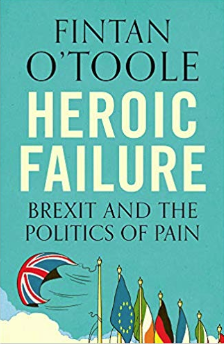
This is Fintan O’Toole’s ‘take’ on the matter of the English, Brexit and food in his riveting new book, Heroic Failure: Brexit and the Politics of Pain (Head of Zeus) a book which if there is any justice should be distributed to each and every member of the current Westminster parliament for homework as they return to their follies.
‘Another of the architects of Brexit, Michael Gove’ writes O’Toole ‘says poorer people eat fatty food because it gives them “comfort, solace and pleasure”. Solace for what? For the destruction of their lives by neoliberalism? The thickening of the English body is the market’s compensation for the thinning of English working class hopes. If England cannot fatten itself on the riches of its colonies, its poor must fatten themselves on unregulated junk.’ [116]
Not since G.B. Shaw took off has an Irish writer been so animated by the foibles of England and Englishness as Fintan O’Toole is in Heroic Failure. It is in many ways a love token to a familiar and challenging society which has lost its way and, in so doing, threatens (from an immediate point of view) to undermine the collaborative achievements and progressive developments in Britain and Ireland over the past twenty years or so.
It is hard to credit that leading elements within the Conservative Party have allowed this situation to deteriorate since the referendum in 2016 as failed politicians from Iain Duncan Smith and Boris Johnson gambol from television studio to radio station being taken seriously by slightly happy-chappy correspondents.
It all seems far from reality and yet as O’Toole’s assiduous study points out, many of these ‘leaders’ have form. Underlying the High Table badinage there is a stealthy hard-nosed class politics at play, masked somewhat by the rasping corporals like Nicholas Farage and his bankrolling pals, offspring of the Thatcher generation’s rallying-cry Loadsamoney.
‘It is not accidental that the far-right Faragist side of the Brexit movement chose to paint itself as a political wing of the Sex Pistols. Its supplier of dark money, Arron Banks, called his hastily cobbled-together book The Bad Boys of Brexit: Tales of Mischief, Mayhem & Guerrilla Warfare in the EU Referendum Campaign.’ [126]
It’s abundantly clear from reading Heroic Failure that the failures spread across the political aisle and that while the Eurosceptics within the Labour Party didn’t quite show their hand during the referendum, they did enough to stunt any effective and level-headed discussion out and about among the fifty-five million people who make up English society, to say nothing of the thirty-three-plus million who decided to vote.
One thing which is so striking (and depressing) about the truths which O’Toole’s eloquent study brings to the table, is just how prejudiced and ill-informed the public actually were and of how the subtextual politics – asset-stripping of the NHS, casting away the onerous yet necessary business of sustaining the welfare system, to say nothing about the under-resourcing of the universities, the dysfunctional railway and water networks – the referendum was, in fact, a quiet revolution.
It probably has –ultimately- little to do with Europe and much more to do with the right-wing takeover attempts of the Conservative Party by the likes of Rees-Mogg and his fellow-travellers. Their desire to see themselves as ‘nation’ builders might be politically backward but they have convinced the majority that it will work economically and are willing to run the risk, though others in society will pay if it all goes belly-up. It’s a re-run of the Boom time.
But ‘Brexit means Brexit’ and in O’Toole’s account, it will surely end badly: England ‘emerges as a divided thing, bitterly split, not just between Leavers and Remainers but between the England of the big multi-cultural cities on the one side and the England of the villages and towns on the other. And so Brexit must inevitably exit on its on condition, into mythological time. And it must acknowledge the true gods: the gods of international capital.’ [154]
It may well be that for those such as the blundering Pritti Patel, ill-placed Dominic Raab or leading contender for May’s job, Jeremy Hunt (‘In my office there’s a bust of Churchill’, he has breathlessly enthused, ‘Just think for a moment about the international order that he created’) are simply out of their depth.
Little educated in the ways of their own, never mind Irish history, they certainly seem uninterested in learning about the cross-currents of intellectual, political and cultural realities between ‘these islands’ while the immediate and local fall-out post Brexit simply doesn’t matter. Which is a pity because as O’Toole sees it there is an important issue of English nationalism that needs to be ventilated in Westminster and where and how it can best be expressed in a positive shape in the future rather than in the delusions of Brexitland.
‘Ireland’ didn’t feature in the lead-up to the referendum nor does it, to be fair, generally feature much in English self-consciousness, notwithstanding the familial bonds which characterise so many ordinary lives on both sides of the Irish sea. There seems to be a kind of indulgent pride in not knowing what ‘one’ is talking about as if argument and clarity of discourse was for the lower orders to bother with, not the visionaries!
Certainly, some of the accents and postures being adopted even look like versions of an upper-class England parodied ‘one thought’ to extinction by the likes of John Cleese and the Monty Python set. But not so in this resurgent Brexitland where, regardless of class and origin, Tories are falling over each other to sound like real ‘toffs’: wicked on the repartee, sparkling wit and killer punchline.
Alas, this all might go down well in the Tory heartlands and marginal seats but the rest of the world looks on either in embarrassed silence or aghast at the display of a Johnson, now removed from the one and only serious national position he held as UK Foreign Minister.
What seems increasingly clear to those on the outside looking in, is that England does not have, at this critical moment in its history, the diplomatic experience and skills to affect a rethink but will more than likely ‘carry on’, with a sense of daily pragmatism and faith in the size of its economy and the sheer weight of numbers to take it through.
The wealthy will continue to live their lives in a parallel universe, expecting the same kind of standards of health provision and education available elsewhere in a Europe many of their children will be educated in, detached from the hardships and everyday challenges facing the ordinary punters who voted for Leave and for whom something is bound to turn up, like that chocolate bar proffered amidst the ruins.
Heroic Failure, a defining book of this moment in time, made me think of another great work of cultural reflection, Neal Ascherson’s Games with Shadows (1988). Strange, is it not, that it takes, thirty years apart, a Scottish and an Irish writer to provide such critical insight into England and the state of its ongoing crisis of identity.
——————————
Belfast-born poet, Gerald Dawe’s most recent publications include In The Corpus Clock: Five Poems and The Wrong Country: Essays on Modern Irish Writing (both 2018).

Gerald Dawe is a Belfast-born poet. He was professor of English and fellow of Trinity College Dublin until his retirement in 2017. He has published twenty collections of poetry and literary criticism, including most recently, The Last Peacock and The Sound of the Shuttle: Essays on Cultural Belonging & Protestantism in Northern Ireland.
Discover more from Slugger O'Toole
Subscribe to get the latest posts sent to your email.


