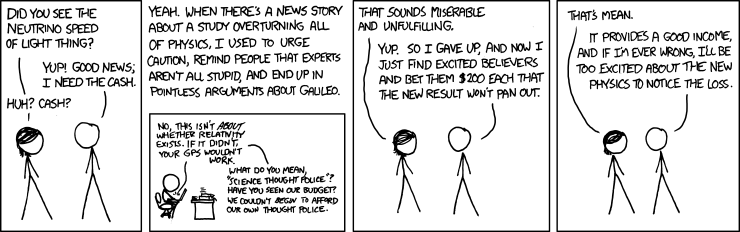
Jim “I will eat my boxer shorts on live TV” Al-Khalili can probably put the ketchup down now.
The somewhat excitable BBC science report notes that the Icarus group at the Gran Sasso underground laboratory in Italy have published the results of a new experiment testing the speed of neutrinos. And guess what? They’re not faster-than-light. [They never were! – Ed] Indeed. From the BBC science report
The Icarus experiment uses 600 tonnes – 430,000 litres – of liquid argon to detect the arrival of neutrinos sent through 730km of rock from the Cern laboratory in Switzerland.
Since their November result, the Icarus team have adjusted their experiment to do a speed measurement.
What was missing was information from Cern about the departure time of the neutrinos, which the team recently received to complete their analysis.
The result: they find that the neutrinos do travel at the same speed as light, within a small error range.
“We are completely compatible with the speed of light that we learn at school,” said Sandro Centro, co-spokesman for the Icarus collaboration.
Dr Centro said that he was not surprised by the result.
“In fact I was a little sceptical since the beginning,” he told BBC News. “Now we are 100% sure that the speed of light is the speed of neutrinos.”
Glen Mark Martin has a neat graph – “Read it and weep”. And theoretical physicist Matt Strassler spells it out
This is the way it works in science all the time. A first experiment makes a claim that they see a striking and surprising effect. A second experiment tries to verify the effect and instead shows no sign of it. It’s commonplace. Research at the forefront of knowledge is much more difficult than people often realize, and mistakes and flukes happen on a regular basis. When something like this happens, physicists shrug and move on, unruffled and unsurprised.
The only thing that makes this story unusual is that this particular (non-)effect was at the heart of one of the most famous statements of twentieth century physics — the universal speed limit suggested in Einstein’s historic 1905 paper — and so it hit the headlines in a big way. Otherwise, it was just like many other examples I’ve seen in my career.

Discover more from Slugger O'Toole
Subscribe to get the latest posts sent to your email.