“It was a meteor strike–the most powerful since the Tunguska event of 1908”

ScienceAtNasa has a sobering video on the latest information about the visitation by the god Ogdy unexpected meteor strike in the Chelyabinsk region of Russia on 15 February.  Video credit: ScienceAtNasa. From the accompanying ScienceAtNasa press release The Russian meteor’s infrasound signal was was the strongest ever detected by the CTBTO network. The furthest station to record the sub-audible sound was 15,000km away in Antarctica. Western Ontario Professor of Physics Peter Brown analyzed the data: “The asteroid was about 17 meters in diameter and weighed approximately …

Read more…

“President Vladimir Putin said he thanked God no big fragments had fallen in populated areas.”

As I mentioned previously, asteroid 2012 DA14 is due to make its close encounter with Earth later this evening.  Meanwhile, earlier today several hundred people in the Chelyabinsk region of Russia were injured during a visitation by the god Ogdy by debris caused by the unexpected appearance of a relatively large meteor.  It’s reported that a crater 6m (20ft) wide has been found on the shore of a lake 1km outside Chebarkul, a town in the region – created by a fragment of the meteor.  …

Read more…

“Will Comet ISON fizzle … or sizzle?”

Science at Nasa has a great assessment of the potential for Comet C/2012 S1 (ISON) to become the ‘Comet of the Century’.  Worth watching. Just remember – “comets are like cats: they have tails, and do whatever they want to do.” But as the Science at Nasa assessment notes “Comet ISON is probably at least twice as big as Comet Lovejoy and will pass a bit farther from the sun’s surface” notes Knight. “This would seem to favor Comet ISON surviving and …

Read more…

“comets are like cats: they have tails, and do whatever they want to do”

In the BBC’s science news preview of 2013, reporter Jason Palmer highlights a couple of astronomical events worth keeping an eye out for. In mid-February we will get another reminder we live in a (potentially) violent cosmos – asteroid 2012 DA14 will make a harmless but attention-grabbing pass near the Earth, at a distance just a tenth that of the Moon. Exactly what happens then will determine how near the asteroid’s next pass will be, in 2026. (Don’t worry, signs are pretty …

Read more…

Further Up Yonder

Stunning views of the Earth accompany this seasonal message from the crew of the International Space Station. Pete Baker

“In Saturn’s Shadow” – redux

Saturn doesn’t get the love some of our other gas giants do.  [All hail our friend and lord, Jupiter!  Keeping Ogdy at bay… – Ed]  Indeed.  But, with the help of Cassini, Saturn does provide some wondrous images.  [Image Credit: NASA/JPL-Caltech/Space Science Institute].  From the image’s associated text NASA’s Cassini spacecraft has delivered a glorious view of Saturn, taken while the spacecraft was in Saturn’s shadow. The cameras were turned toward Saturn and the sun so that the planet and rings are backlit. …

Read more…

Titan’s Nile River Valley

Fascinating image from Nasa’s Cassini probe at Saturn, where we’ve previously watched the weather on Titan.  [Image credit: NASA/JPL-Caltech/ASI.]  North is to the right in this view. From the JPLnews press release “Titan is the only place we’ve found besides Earth that has a liquid in continuous movement on its surface,” said Steve Wall, the radar deputy team lead, based at NASA’s Jet Propulsion Laboratory, Pasadena, Calif. “This picture gives us a snapshot of a world in motion. Rain falls, …

Read more…

Jupiter swallows an asteroid – redux

As Space Weather notes Around the world, amateur astronomers have been scanning the cloudtops of Jupiter for signs of debris from an explosion witnessed by Dan Peterson and George Hall on Sept. 10th. So far the cloud layer is blank. “Several observers have now obtained excellent images on the second and third rotations after the fireball, and there is nothing new nor distinctive at the impact site,” reports John H. Rogers, director of the Jupiter Section of the British Astronomical …

Read more…

“Thrust is engaged, and we are now climbing away from Vesta atop a blue-green pillar of xenon ions”

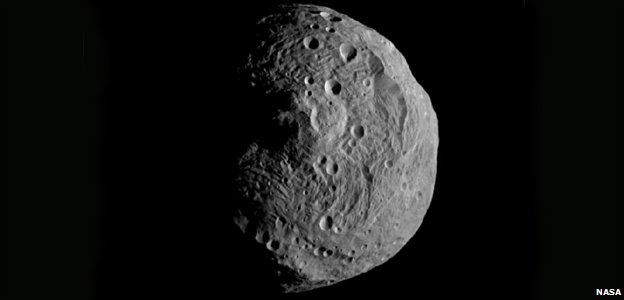
Having arrived at the 530km-wide giant asteroid Vesta in July 2011, in May this year Nasa’s Dawn Mission scientists published some of their findings.  Now Dawn’s ready to head out on the next leg of its journey – Destination [the even larger protoplanet (dwarf planet)] Ceres, ETA 2015. From the JPL press release “Thrust is engaged, and we are now climbing away from Vesta atop a blue-green pillar of xenon ions,” said Marc Rayman, Dawn’s chief engineer and mission director, at NASA’s Jet Propulsion Laboratory, …

Read more…

“This is an area on Mount Sharp where Curiosity will go”

More wondrous images from Nasa’s mobile Mars Science Laboratory (MSL), the 900kg rover Curiosity, now safely on the Martian surface in Gale Crater.  And it’s only warming up its instruments.  Here’s a panaroma of the landing site and the prime mission target, Mount Sharp. Focusing in on Mount Sharp… [Image credit: NASA/JPL-Caltech/MSSS] But the images that have attracted attention are from the telephoto lens [Image credit: NASA/JPL-Caltech/MSSS] As the Nasa press release notes The telephoto images beamed back to Earth show a …

Read more…

“the next time you walk outside on a clear night and see the moon smiling down at you, think of Neil Armstrong and give him a wink”

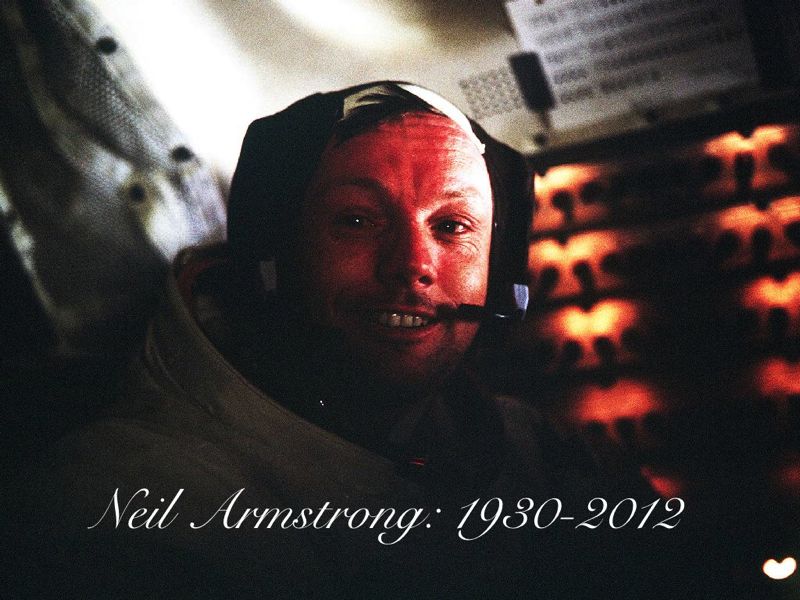
Private family man, engineer, US Navy fighter pilot, war veteran, civilian test pilot, astronaut, academic, businessman, reluctant hero, and the first man to walk on the moon, Neil Armstrong has died at the age of 82.  Reg Turnill, who was the BBC’s aerospace correspondent at the time of the first moon landing, gives his thoughts.  Nasa’s tribute is available here. And, via the Professor, Rand Simberg has a detailed biography that’s worth a read. For the 40th Anniversary of the launch of …

Read more…

Curiosity drops in on Mars – in Hi-res

Nasa’s mobile Mars Science Laboratory (MSL), the 900kg rover Curiosity, may have started roving on the surface of Mars, but there’s still room for more stunning video of its descent. In high-resolution.  Audio from mission control can also be heard, counting down the critical events.  Video from JPL News This movie from NASA’s Curiosity rover shows most of the high-resolution frames acquired by the Mars Descent Imager between the jettison of the heat shield and touchdown. Pete Baker

“Curiosity will soon have a different patch of ground beneath it.”

Nasa’s mobile Mars Science Laboratory (MSL), the 900kg rover Curiosity, may have damaged one of two sets of wind sensors in its Rover Environmental Monitoring Station (REMS) during its dramatic landing on Mars, but it will still be providing daily weather reports from the Red Planet. And, as a JPL/Nasa press release noted yesterday – with moving images Curiosity will soon have a different patch of ground beneath it. Today, the six-wheeled rover wiggled its four corner wheels side to side for the …

Read more…

Curiosity: “This is a very low-resolution panorama”

Having survived the seven minutes of terror, and landed successfully at Gale Crater, earlier this week Nasa’s mobile Mars Science Laboratory (MSL), the 900kg rover Curiosity, lifted its 2m high camera mast.  And took a look at itself.  [Image credit: NASA/JPL-Caltech] Then it took a look at its new surroundings.  In colour. [Image credit: NASA/JPL-Caltech/MSSS] JPL have helpfully put together a video of the panoramic view. As the BBC spaceman, Jonathan Amos, notes The low-resolution vista shows at centre the big mountain …

Read more…

“Guess you could consider us the closest thing to paparazzi on Mars”

Another wondrous image from Nasa’s Mars Reconnaissance Orbiter (MRO).  This time the High Resolution Imaging Science Experiment (HiRISE) camera onboard snapped the Red Planet’s “newest celebrity” – the Curiosity rover and its 51-foot-wide (almost 16 metre) parachute descending towards Gale Crater. [Image Credit: NASA/JPL-Caltech/Univ. of Arizona] From the Nasa/JPL press release “If HiRISE took the image one second before or one second after, we probably would be looking at an empty Martian landscape,” said Sarah Milkovich, HiRISE investigation scientist at NASA’s Jet Propulsion …

Read more…

Curiosity: “I’m safely on the surface of Mars”

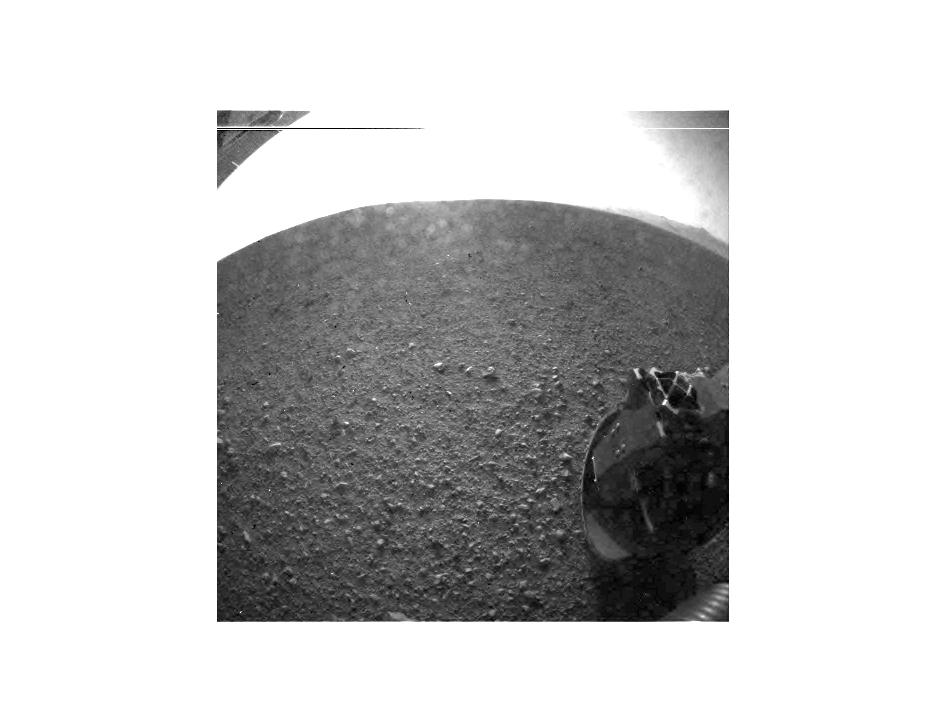
If you didn’t manage to catch those ‘seven minutes of terror’ earlier this morning for Nasa’s mobile Mars Science Laboratory (MSL), the massive 900kg rover Curiosity, here’s how it worked out. From NasaTelevision As the Curiosity Rover said on Twitter I’m safely on the surface of Mars. GALE CRATER I AM IN YOU!!! #MSL — Curiosity Rover (@MarsCuriosity) August 6, 2012 Heh.  And the first image from the landing site at Gale Crater. [Images credit: NASA/JPL-Caltech] Another with Curiosity’s shadow visible. …

Read more…

Curiosity: “It’s like the Olympics for nerds!”

Just a quick reminder that, if everything goes to plan, Nasa’s mobile Mars Science Laboratory (MSL), the massive 900kg rover Curiosity, is scheduled to land on the red planet at 6.30am [BST] tomorrow morning.  As the Curiosity Rover says itself It’s landing day & I’m hours from Mars! Watch my final @nasa prelanding briefing, Aug 5 9:30am PT (1630 UT) ustream.tv/nasajpl — Curiosity Rover (@MarsCuriosity) August 5, 2012 And from the Guardian’s Pass Notes No 3,223 Is it all going …

Read more…

Curiosity: “We’re doing something completely novel, hanging it way out there”

Launched back in November 2011, Nasa’s mobile Mars Science Laboratory (MSL), the massive 900kg rover Curiosity, is scheduled to land on the red planet at 6.30am [BST] on Monday 6 August. [Image Credit: NASA/JPL-Caltech/ESA/DLR/FU Berlin/MSSS] They’ve successfully repositioned the orbiting Mars Odyssey spacecraft to keep in touch with Curiosity as it descends into Gale Crater [pictured above] in a novel way. To achieve the precision needed for landing safely inside Gale Crater, the spacecraft will fly like a wing in the upper …

Read more…

Dwarf Planet Gains Fifth Moon…

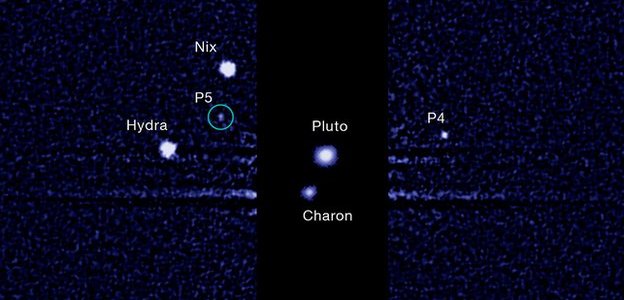
Not that it didn’t already have five moons.  At least.  ANYhoo…  As I was saying this time last year, when Hubble spotted a fourth moon orbiting Pluto.  The Hubble Space Telescope has been looking at the twin dwarf planet system of Pluto and Charon ahead of Nasa’s New Horizons mission expected arrival in the neighbourhood in 2015.  [Image credit: NASA, ESA, and M. Showalter (SETI Institute)] They’ve already mapped the surface of Pluto, to an extent, and now they’ve spotted a …

Read more…

Voyager: “We are approaching the solar system’s final frontier”

Here’s a short informative video from Science at Nasa on the indications that Voyager 1 is about to enter into the vastness of interstellar space.  (Image credit: NASA/JPL-Caltech) Space, remember, is very very big. And on that note, because I can, here again is some wondrous time-lapse video of the night-sky above the ESO Very Large Telescope array [VLT], in Chile, from NikoBustos. [Video credit: ESO/José Francisco Salgado (josefrancisco.org)] Or even this [Video credit: ESO/S. Guisard (www.eso.org/~sguisard) ESO/José Francisco Salgado (josefrancisco.org)] And, of course, the Milky …

Read more…