Hubble spots fourth moon of Pluto

  The Hubble Space Telescope has been looking at the twin dwarf planet system of Pluto and Charon ahead of Nasa’s New Horizons mission expected arrival in the neighbourhood in 2015.  They’ve already mapped the surface of Pluto, to an extent, and now they’ve spotted a fourth moon in the system– if you count the dwarf planet Charon as a moon of Pluto, that is.  The new moon has been designated “S/2011 P1” or “P4” until a permanent name is chosen.  [All …
Read more…

Vesta: “arguably the oldest extant primordial surface in the Solar System”

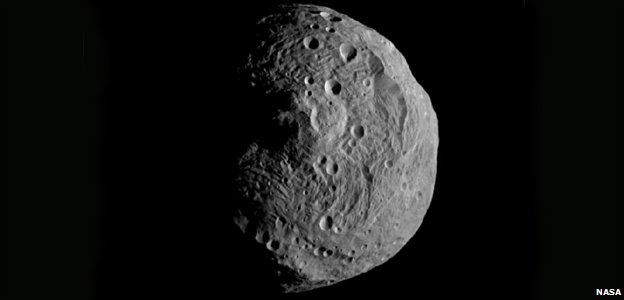
With Dawn now safely in orbit around the giant asteroid Vesta, Nasa have released the first close-up image of the ancient protoplanet. [Image credit: NASA/JPL-Caltech/UCLA/MPS/DLR/IDA] From the accompanying text July 18, 2011 – PASADENA, Calif. — NASA’s Dawn spacecraft obtained this image with its framing camera on July 17, 2011. It was taken from a distance of about 9,500 miles (15,000 kilometers) away from the protoplanet Vesta. Each pixel in the image corresponds to roughly 0.88 miles (1.4 kilometers). And from the …

Read more…

Dawn: Up close and personal with Vesta

As I may have mentioned, early tomorrow morning, 9am [BST] 16 July, Nasa’s Dawn spacecraft is expected to be captured into orbit by the 530km-wide giant asteroid Vesta.  They won’t know for sure until a scheduled communications pass at 8.30am [BST] on Sunday 17 July.  Here’s the latest image of Vesta taken by Dawn on 9 July at a distance of about 26,000 miles (41,000 km).    NASA’s Dawn spacecraft obtained this image with its framing camera on July 9, …

Read more…

Dawn’s final approach

Next weekend (on 16 July), barring any further unforeseen problems, Nasa’s Dawn spacecraft will enter orbit around the giant asteroid Vesta and begin its year-long observation of the 530km wide proto-planet. [Image credit: NASA/JPL-Caltech/UCLA/MPS/DLR/IDA] From the JPL press release (23 June) After Dawn enters Vesta’s orbit, engineers will need a few days to determine the exact time of capture. Unlike other missions where a dramatic, nail-biting propulsive burn results in orbit insertion around a planet, Dawn has been using its placid ion propulsion …

Read more…

Space Shuttle’s Final Launch

If the weather clears, and currently the weather is a “go”, Nasa’s Space Shuttle Atlantis will launch from the Kennedy Space Centre at 4.26pm [BST].  It’s the end of the Space Shuttle era.  Follow events at Nasa’s launch blog, or via the BBC online, as well as the usual NasaTV coverage. Or, even, here! Broadcasting Live with Ustream Pete Baker

The end of the Space Shuttle era

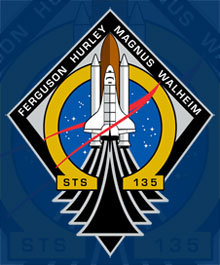
Atlantis is scheduled to launch on Nasa’s final Space Shuttle mission, STS-135, on Friday at 4.26pm [BST] to bring to an end the 30-year-long Space Shuttle era – weather permitting.  In fact, there’s currently only a 30% chance that the weather will be suitable for launch.  While you’re waiting you can check out Nasa’s Space Shuttle Era website.  Or read the BBC’s Spaceman, Jonathan Amos, on one of the private companies taking over the role played by the Shuttle – Orbital Sciences Corporation.  …

Read more…

Spectacular Solar Eruption Close-up

Nasa have released more stunning footage from the Solar Dynamics Observatory of the spectacular solar eruption on June 7.  As LittleSDOHMI notes – “This video uses the full-resolution 4096 x 4096 pixel images at a one minute time cadence to provide the highest quality, finest detail version possible.”  With music! Pete Baker

Voyager: “It’s bubbly out there.”

The Guardian’s GrrlScientist picked up on the 30-something Voyager probes’ latest scientific discovery on humanity’s farthest journey.  New view of the heliosheath. Red and blue spirals are the gracefully curving magnetic field lines of orthodox models. New data from Voyager add a magnetic froth to the mix. Image: NASA Here’s the YouTube version of the ScienceatNasa video posted at the Guardian. And if that explanation was a little too pink and fluffy for you, try this different version of the same …

Read more…

“this is probably the biggest known asteroid to have come this close.”

As spotted by SpaceWeather.  At about 1700 UT (6pm BST) today Asteroid 2011MD will fly past only 12,300 kilometers (7,600 miles) above the Earth’s surface.  [Image credit NASA/JPL] As the diagram shows, that’s close enough to be affected by Earth’s gravity. This small asteroid, only 5-20 meters in diameter, is in a very Earth-like orbit about the Sun, but an orbital analysis indicates there is no chance it will actually strike Earth on Monday. The incoming trajectory leg passes several thousand kilometers …

Read more…

Mercury: “A world in and of its own”

In March this year Nasa’s Messenger probe became the first spacecraft to orbit Mercury.  And, as the BBC reports, a few days ago Nasa released the scientific observations and data collected during the first three months of its scheduled year-long mission.  In the process a number of hypotheses about the innermost planet were consigned to the “dust bin of science”.  Mercury is not like the Moon, nor like the Earth, and it’s not “the burnt-out cinder of the solar system”. [All images …

Read more…

Destination: Vesta!

Nasa’s Dawn spacecraft will arrive at the 530km wide asteroid Vesta on 16 July, where it will spend the next 12 months in orbit.  Then it’s on to the dwarf planet, Ceres [950km wide].  Images Credit: NASA/JPL-Caltech/UCLA/MPS/DLR/IDA. The Hubble Space Telescope has already taken a look at Vesta but, on 1 June, Dawn captured its own views – at a distance of about 480,000km – to assist in the final navigation stage.  And Nasa have released those looped images as a video. From the JPL Nasa press …

Read more…

Endeavour’s last visit to the International Space Station

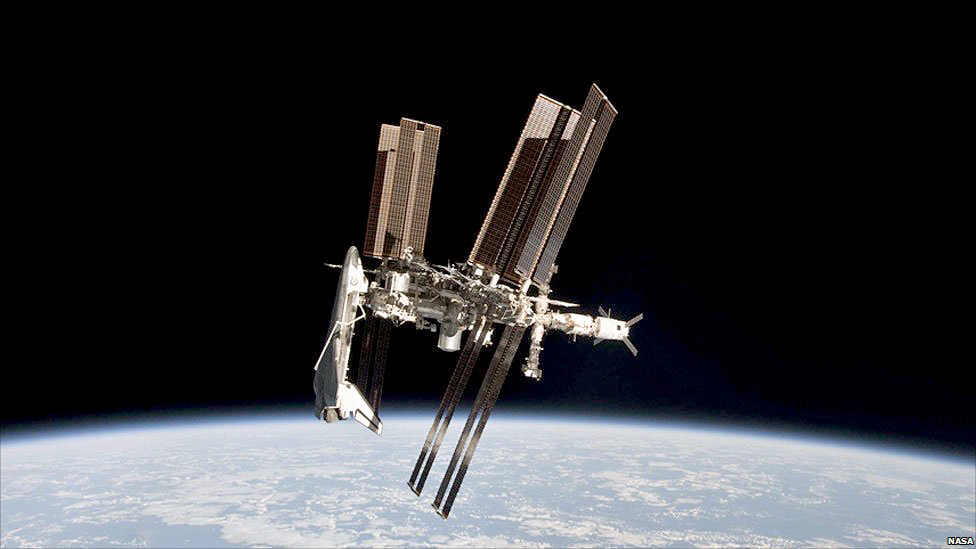
The BBC flagged up the stunning first-ever detailed image of a Space Shuttle docked at the International Space Station – Endeavour’s final voyage.  Now NasaTV have released the video.  The video was shot by European Space Agency astronaut Paolo Nespoli from the Russian Soyuz spacecraft that undocked from the station on May 23. He, Russian cosmonaut Dmitry Kondratyev and NASA astronaut Cady Coleman were departing the station for a return to Earth after five months on the station. Nespoli documented the …

Read more…

Spectacular Solar Eruption

Wondrous images from Nasa’s Solar Dynamics Observatory of the spectacular eruption that accompanied an M-2 (medium-sized) solar flare on June 7.  [Image/video credit: NASA SDO] And, via the Professor, Geeked on Goddard provides further video courtesy Helioviewer.org and a narration by The Sun Today. As LittleSDOHMI notes This Earth-directed CME [Coronal Mass Ejection] is moving at 1400 km/s according to NASA models. Due to its angle, however, effects on Earth should be fairly small. Nevertheless, it may generate space weather effects …

Read more…

Nasa images Alabama tornado tracks

Nasa has released some stunning satellite images, from the Advanced Spaceborne Thermal Emission and Reflection Radiometer (ASTER), of the ‘footprint’ left by the monster tornado which hit Tuscaloosa, Alabama, on April 27th.  The false-colour images use visible and infra-red data. [Image credit: Science@NASA] From the Science at Nasa report “This is the first time we’ve used the ASTER instrument to track the wake of a super-outbreak of tornadoes,” says NASA meteorologist Gary Jedlovec of the Marshall Space Flight Center in Huntsville, AL. In the …

Read more…

Endeavour’s Final Voyage – Redux

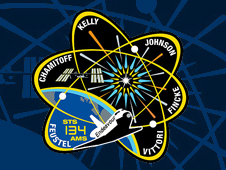
The scheduled April launch was scrubbed due to technical problems, but the final preparations are underway for the 25th and final launch, after 19 years in service, of the Space Shuttle Endeavour on Mission STS-134.  Launch is scheduled for 1.56pm [BST].  Via the NASAKennedy channel And a reminder that Endeavour’s final cargo, for the International Space Station, includes a 7-tonne particle physics experiment – the Alpha Magnetic Spectrometer (AMS).  And the AMS channel provides this informative Nasa overview of the experiment. As usual, there’s the launch blog …

Read more…

NASA images smoke from gorse fires

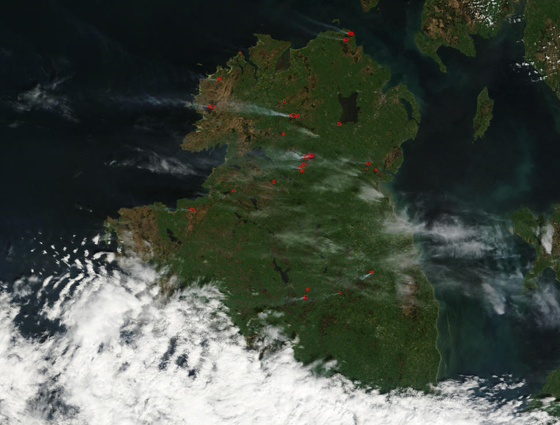
As the Belfast Telegraph notes, smoke from the fires across the UK and Ireland are clearly visible in the stunning satellite images from NASA/GSFC’s MODIS Rapid Response System.  This is a cropped, smaller, version of an image taken at 12.50pm [BST] on 2 May at a resolution of 500 metres.  Red is used to indicate the site of a fire.  (Image credit: NASA/GSFC, MODIS Rapid Response System) And a close-up of the visible smoke plumes.  Note to Belfast Telegraph – See “About Rapid Response Imagery”. …

Read more…

Voyager: Humanity’s Farthest Journey

While waiting for Endeavour’s final voyage, you can catch up, metaphorically, with the ongoing scientific odyssey of those other still-nimble Voyagers as they head towards the vastness of interstellar space.  ( Image credit: NASA/JPL-Caltech) NasaTV has Thursday’s special science presentation on the mission with a panel of the Voyager team – including Ed Stone, who’s been there since 1972, and Ann Druyan, creative director of the group, led by Carl Sagan and Frank Drake, who put together the Golden Record both Voyagers carry. …

Read more…

Endeavour’s Final Voyage

Following the final flight of Discovery, the next Nasa Space Shuttle to be retired, after 19 years of service, will be Endeavour. But first there’s the not insignificant matter of its 25th, and final, flight – Mission STS-134.  Lift-off is scheduled for 1547 local time (1947 GMT; 2047 BST) from the Kennedy Space Centre.  And via the NASAKennedy channel Endeavour’s final cargo, for the International Space Station, includes a 7-tonne particle physics experiment – the Alpha Magnetic Spectrometer (AMS).  And the AMS channel …

Read more…

Chandra finds evidence of Tycho’s origin

Nasa’s Chandra X-ray observatory has been in orbit since 1999 and it’s still producing results.  Like this stunning image of the remnant of the Type Ia supernova first observed by Danish astronomer Tycho Brahe in 1572. The data for the images was collected in 283 hours of observation from 2 pointings between April 29, 2003 and May 3, 2009. (Credit: NASA/CXC/Chinese Academy of Sciences/F. Lu et al) From the text accompanying Chandra’s Tycho photo album This new image of Tycho’s supernova remnant, …

Read more…

Enceladus ‘footprint’ on Saturn

Nasa’s Cassini probe has been exploring Saturn’s system of moons since 2004 – some archived posts here.  Recently it’s watched the weather on Titan and tasted Enceladus’ briny breath.  That briny breath is responsible for the latest observed phenomenon –  Aurora from Saturn moon ‘circuit’.  Image credits: NASA/JPL/University of Colorado/Central Arizona College.  Image details here. From the Cassini mission press release “The footprint discovery at Saturn is one of the most important fields and particle revelations from Cassini and ultimately may help us …

Read more…