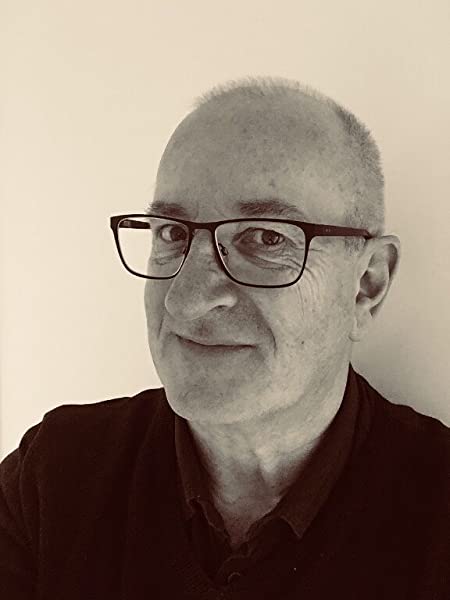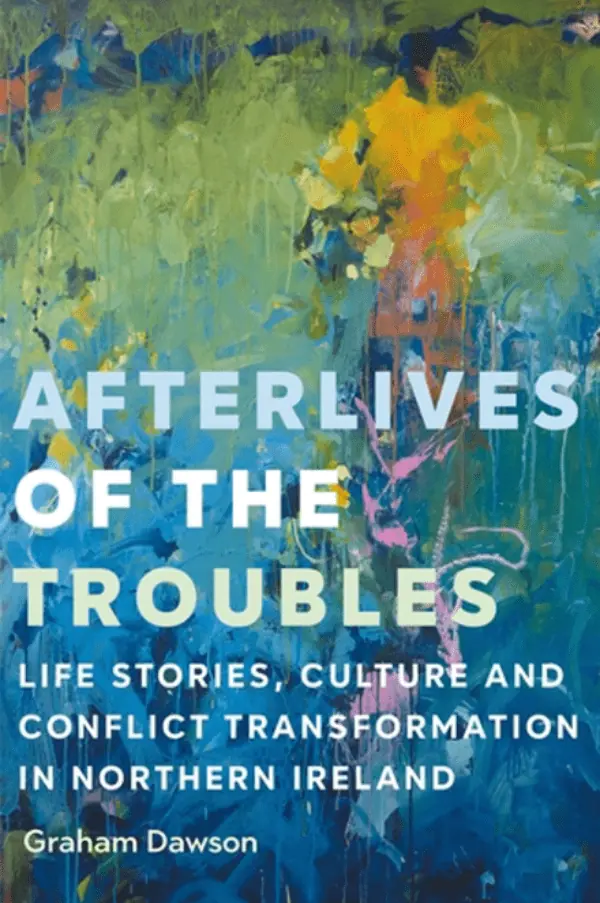
The Memories, Narratives and Histories Research Collective (MNHRC) gathered online to launch Afterlives of the Troubles: Life Stories, Culture and Conflict Transformation in Northern Ireland, by Professor Graham Dawson. Fifteen years in the making, the book draws on oral history, cultural analysis, and lived experience to challenge the assumption that Northern Ireland’s conflict can be neatly divided into “the Troubles” and a settled post-conflict present. Three scholars joined Dawson in conversation: Róisín Higgins (Professor of History at Maynooth University); Claire Hackett (Director of the Dúchas Oral History Archive at Falls Community Council); and Anne Rigney (Emeritus Professor of Comparative Literature at Utrecht University).
Four arguments
Dawson, a visiting professor at Ulster University’s International Conflict Research Institute and a founding member of the MNHRC, opened by laying out four arguments at the heart of the book.
The first challenges the idea that societies simply “move on” after a conflict — that the Troubles ended, and Northern Ireland stepped out the other side into something called post-conflict. That framing, he argued, is a political convenience, not a description of how people actually live.
The second argument gives the book its title; borrowing the concept of the “afterlife” from historian Marek Tamm, Dawson describes how the past continues to inhabit the present. It does not recede; it resurfaces, often when least expected, in the texture of everyday life.
Third, rather than focusing on trauma as a clinical or psychiatric category, Dawson attends to feelings: how emotions persist, return, and interrupt the stories people try to tell about their own lives. A memory does not arrive in sequence, it breaks in. He calls this “associative diffraction”, the way feeling cuts across the flow of a narrative.
His fourth point follows directly: policymakers and legislators, working to electoral timetables and political deadlines, consistently underestimate how long this process takes. Memory does not move at the speed of a peace agreement or a legacy review. The book argues that failing to understand this has real consequences for how societies attempt to deal with the past.
Róisín Higgins: Permission and attentiveness
Professor Róisín Higgins opened the panel by reflecting on what the book had given her permission to do. Growing up working-class and Catholic during the Troubles, she had found it difficult to bring her own experience into academic work. Dawson’s method — taking people’s stories seriously, attending to ambivalence and contradiction — showed that healing through heritage and storytelling is more complicated than it might appear, and that this complication is the point. She recalled Thomas Hardy’s poem “Afterwards”, with its image of someone who notices what matters to others. For Higgins, that attentiveness defines Dawson’s scholarship.
Claire Hackett: Place, memory, and the Garvaghy Road
Claire Hackett connected the book directly to her work at the Dúchas Oral History Archive. She described Paul Seawright’s photographic exhibition Sectarian Murder series (1988) — images of the locations where people killed during the 1970s were found — as a prompt for reflection on place-based memory: the presence of informal commemoration, the absence of public remembrance.

She turned to the Drumcree and Garvaghy Road dispute in Portadown. An Orange Order parade through a Catholic area had been refused for 28 years. When the Parades Commission permitted it this year, local residents resisted, and a two-week standoff ensued; the parade did not take place. Hackett argued that greater attention to the community’s traumatic memories of place might have helped decision-makers understand the likely rupture. The effects of conflict, she suggested, cannot be neatly separated into “conflict” and “post-conflict” periods.
Dawson’s close analysis of Dúchas interviews had given her a deeper understanding of material she knew well. She highlighted two accounts: an interview with Sandra, conducted by John, in which gentle questioning allows memories to surface as the interviewee seeks composure; and the story of Olive McGuire, displaced from her home in 1971, whose experience continued to shape her life decades later.
Anne Rigney: Subjectivity, affect, and storytelling as action
Professor Anne Rigney situated the book within memory studies, the interdisciplinary field that emerged alongside transitional justice research in the 1990s. She critiqued what she called the “reconciliation script”, which is the belief that specific practices such as tribunals, monuments, and apologies can resolve conflict, provide closure, and allow societies to move on. Dawson’s earlier work had already challenged this by showing how reconciliation practices can reinforce the very boundaries they seek to overcome.
Rigney identified three key contributions of the new book: (1) its argument that closure cannot be imposed from above, that memory work proceeds on its own timescales rather than those of policy or election cycles; (2) its attention to subjectivity and affect, connecting personal experience to collective processes through object-relations theory and Raymond Williams’s concept of “structures of feeling”; and (3) its treatment of storytelling as action, not only evidence about the past, but a performance through which change can happen. She welcomed the book’s call for greater recognition of community-based storytelling.
Discussion: Composure, hope, and the present moment
The discussion ranged widely. One exchange focused on how people manage difficult memories when they tell their stories. Oral historian Alistair Thomson developed the concept of “composure”, which is the way people shape a version of their past that they can live with. Dawson drew a distinction between two kinds. “Defensive composure” is when someone tidies the story up, keeps the lid on, avoids what is too painful or too complicated to say. “Transformative composure” is when the telling goes somewhere different, when a feeling breaks through the rehearsed account and something that was previously unsayable finds its way out. That rupture, Dawson argued, is where storytelling can become genuinely healing rather than merely managed.
A question about recent race-related unrest and the redirection of historical grievances toward migration led Dawson to observe that current events shape how people return to the past. He did not suggest that recent unrest simply reproduces the structures of Troubles-era violence, but argued that it has a relationship to them. The television drama Blue Lights, he noted, offers one example of popular culture engaging with continuity and change in Northern Ireland.
Anne Rigney described hope as a present-day practice of possibility, pursued in defence of values without knowing its outcome, and connected to storytelling as a small but potentially transformative act. Claire Hackett said she had come to trust Dawson with the Dúchas archive through a gradual working relationship, and that his analysis treated interviewees with respect and care. Dawson reflected on the importance of bringing academic and community knowledge into dialogue, in the spirit of the History Workshop movement.

A question near the close of the event quoted the photographer Gilles Peress on time in Northern Ireland: “Today is tomorrow, tomorrow is yesterday or ten years ago.” It is a description that Dawson’s book, 15 years in the making, sets out not just to explain but to take seriously, as the lived reality of everyone whose story it holds.
Afterlives of the Troubles, by Graham Dawson, is available from Manchester University Press.

PhD Researcher @UlsterUni | Managing Editor @SharedFuture | Board Member @FactCheckNI | Photographer 📸 | Runner 🏃♂️ | Genealogist 🌳 | https://mrulster.info
Discover more from Slugger O'Toole
Subscribe to get the latest posts sent to your email.