

Grim reading this morning for the leaders of the three largest Executive parties, as the Belfast Telegraph reports the new LucidTalk poll.

This won’t have come as much of a surprise.
The DUP has been polling badly for the last two years. On the other hand, it had also done so before the last Assembly election but still managed to retrieve some lost ground – as the gravitational pull of being the unionist champion in the contest for First Minister pulled back some of their disaffected supporters.
The party won 25 seats at the last Assembly election, two fewer than Sinn Féin. If it returned to the level of support it enjoyed then it could expect to win three more: the seat in North Down it lost to the Independent Alex Easton which he regifted to the DUP when he was elected as an MP in 2024; the UUP seat in North Antrim which the DUP would have taken but for Robin Swann’s extraordinary personal vote and which Swann subsequently left on election to Westminster; and West Belfast due to the boundary changes since the last election. These last two would be regarded as notional DUP.
If today’s poll were repeated at the next election the DUP could drop to as low as 13 seats.
Today’s poll shows a further swing from the DUP to the TUV since the last poll of approximately 2%. In the chart below you can see the effect of such a swing in each constituency. Remember that this is an average swing – the actual swing in each constituency will vary. Last time the swing varied by up to 5% points above and below the average. So, some of the seats lost on this average swing could be saved and others lost instead.
These charts have been revised to reflect the new constituency boundaries.

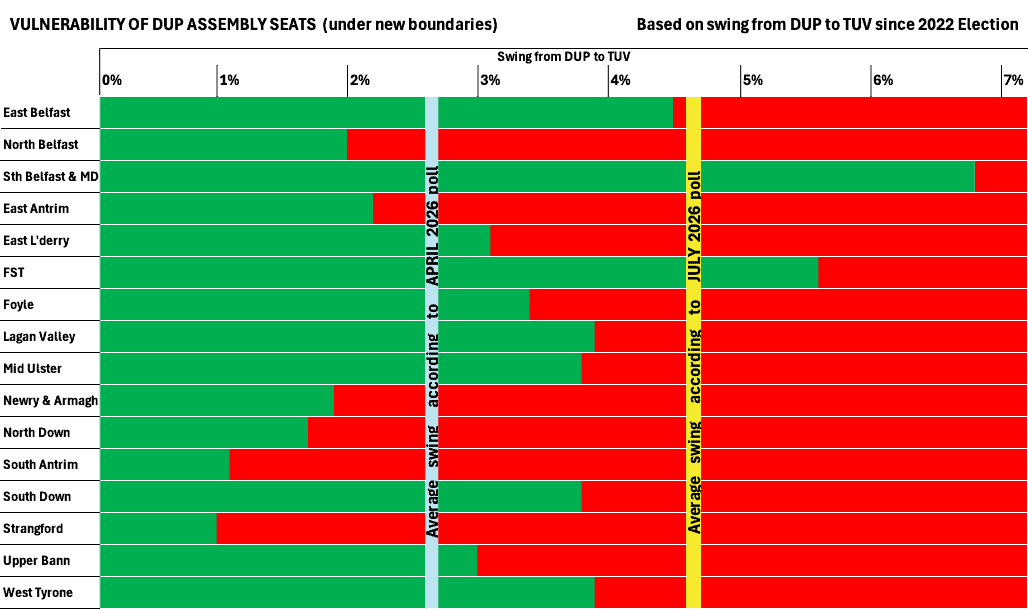
In Foyle, although the swing is shown to the TUV, the pattern of transfers would then almost certainly mean that the UUP would take the seat.

In North Antrim a swing of this size would give the seat to the UUP.
The swing to the UUP since the last poll is a massive 3%. It brings the total swing since the last election to approximately 5%. This has the following impact.

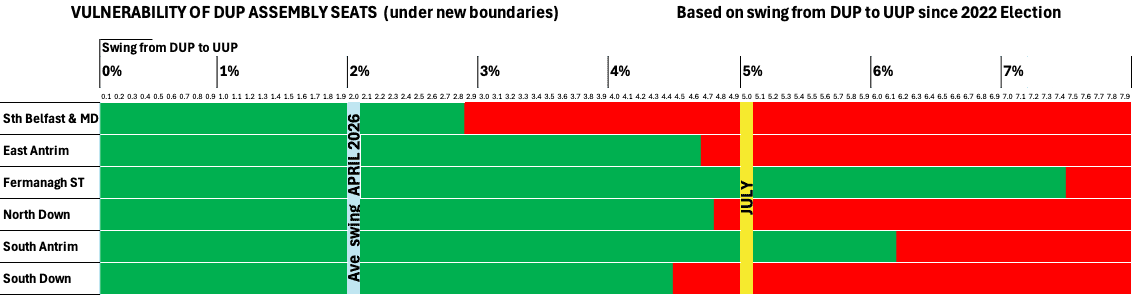

As can be seen there are a number of seats where the TUV and UUP would be competing for a DUP seat.

The TUV has been enjoying a good run at the DUP’s expense. The last two polls raised the possibility that they were coming slightly off the boil – although that could be no more than margin of error variation. As is frequently pointed out, they had enjoyed a similar run before the last Assembly election only to fall short at the end. But what is not so frequently remembered is that their 2022 vote share came in a full 5% points higher than their 2017 score. Yes, they remained stuck on 1 seat – but only 1 or 2 % points below the level at which more DUP seats would start to drop their way. (Their Local Government score can be discounted since they contested fewer areas than their competitors.)
They must be very disappointed that the DUP’s travails have not boosted them back to and beyond the 13% they held at the end of last year. Normally I would say to ignore differences of 1% as being meaningless – but this could have a psychological importance as the poll suggests that the UUP, not the TUV, is picking up the slack from the DUP. At least for now.

The UUP were the steady-Eddies of unionism. The last two polls held the possible promise of a modest uptick, although still within the margin of error. Like the TUV they had enjoyed stronger figures before the last election only to see them fade when the voters reached the polls. But they have not hit 16% in a poll since August 2021 – (possibly boosted by Robin Swann’s popularity as Health Minister during Covid?).
We could be witnessing a contest to replace the DUP as the principle party of unionism.
But today’s poll is unlikely to be the final word on the matter. Although clearly the UUP has won round 1.
Here are some factors we will need to take into account.
- Be prepared for the possibility of a greater degree of volatility in unionist parties’ figures in the months ahead.
- There may be DUP supporters who are yet to finalise their minds. Their current commitment to the DUP may be shallow – especially that 14% who said the party was “completely untruthful” in denying any knowledge of Donaldson’s “double life”.
- Any that have already moved their support to another party are less likely to be fully committed there. They may say TUV or UUP today but be very open to switching if the other can make a better case.
- The DUP might find a way to attract them, or some of them, back.
- If either the TUV or UUP establish a significantly strong momentum, the credibility that brings could bring them victory in the competition for former DUP voters.
- If the gap between the DUP and either the UUP or TUV remains close, the DUP could shed those voters for whom their main attraction has been the party’s overwhelming dominance within unionism.
- Be prepared for the possibility that voter turnout by DUP supporters could be lower than normal. It is possible that polls will correctly measure the proportion of potential voters who would support the DUP if they actually vote. But if an unusually high proportion stay at home, it would reduce the real DUP share. For example, if one in ten failed to vote the DUP would drop about 1.5% points.
If something causes a drop in the motivation of one party’s supporters, there is no reliable way that a poll can take that into account. The pollster can ask each respondent how likely they would be to vote if the election were today – but asking how likely they would be to vote at an election that is weeks or months ahead is too hypothetical to be worthwhile. The voter simply cannot know exactly how they will feel on the day they have to make that final decision.
- It is possible that the DUP could receive fewer transfers from other unionists. While the evidence is limited, it appears that in the last Council and Assembly elections UUP voters preferred the DUP as to the TUV by about 2 to 1. The DUP enjoyed a similar advantage with TUV voters who were more than twice as likely to transfer to the DUP as to the UUP.
To be clear a change in these transfer preferences is unlikely to make a mammoth difference – but it could tip the balance in one or two constituencies where either the TUV or UUP were pressing the DUP hard.
In the case of the UUP it is possible that some more transfers could switch to non-unionist parties. Already in 2022 and 2023 about 20% of UUP transfers went to Alliance, even when one or more unionist alternatives were available, while up to a further 7% went to the SDLP.
- A further factor which could impact the DUP is the motivation of their volunteer activists. These play a vital role in identifying who will vote for the party and then working on election day to encourage those who have not voted to go to the polls. If fewer supporters volunteer to do this vital work DUP turnout will suffer.

If it were not for the post-Donaldson maelstrom within unionism the decline of Sinn Féin would be the key talking point from this poll.
The party has drooped before between elections only to pull back as the election comes into view, but has never fallen to 22% in an opinion poll in the last 10 years. At this level Assembly seats would be at risk and the number of Councillors would tumble.


This chart is still using the old boundaries but gives a fair indication of the levels of risk.

This is the party’s highest score in a poll for the Assembly in five years. They will go into the pre-election period with their tails up – and party morale is an important asset at that point. Gaining seats in the Assembly will still be a stretch – although no longer an unrealistic ambition. But their council base should be protected and increased if they can hold this level – a critical element in rebuilding the party.

This is the lowest Alliance have been since before their breakthrough in the 2019 Euro elections. If there is anything that they can do to turn things around they need to do it now.
With all three leading Executive parties in trouble the whole political landscape is in question.

The Greens are holding their gains. If those are in North Down and South Belfast Mid Down they could return to the Assembly, taking seats from Alliance.

If Sinn Féin and the DUP’s weakness continue the PBP should retain their West Belfast seat.

Aontú are also holding their gain giving them the possibility of winning one or more council seats if they can field good candidates with a strong local campaign.

As mentioned before, polling for an Assembly election cannot capture the greater strength of Independents in Local Government elections. These will take support from the bigger parties.
Fasten your seat belts we are in for a wild political ride.

Michael Hehir is a retired sales and marketing manager. He studied in Northern Ireland but now lives between England and Italy.
Discover more from Slugger O'Toole
Subscribe to get the latest posts sent to your email.


