
Colin Harvey, Queen’s law professor and an authority on human rights law identifies as a prominent member of nationalist civil society. This is his latest call for a proper discussion of a border poll.
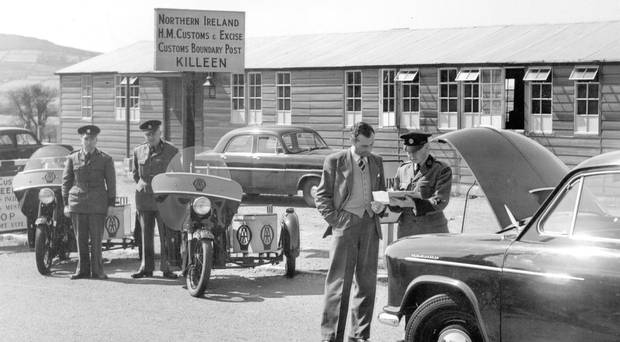
My sole concern here is to suggest that in tackling one of the consequences of Brexit – a hard border on the island of Ireland – a principled way forward is to ask people in this region whether they wish to remain in the UK or not. That does not rule out other arrangements to deal with this problem (as envisaged in the Withdrawal Agreement) it is simply to argue that the existing, and legally endorsed, method for removal of the border is an obvious option.
This is one contribution to the discussion.
Colin Harvey’s pessimism is well appreciated. He can immediately be acquitted of sectarianism. His good faith is not in question. At its heart his argument is blissfully simple. By creating the problem of Brexit the British unwittingly promoted the potential solution of a border poll. Having arguably violated the spirit and perhaps the letter of the GFA they are no longer its reliable co-guarantors. Irish unity would solve the problem of a hard border at a stroke. Why not put it to the test? Middle of the road unionist remainers disgusted by Brexit might vote for nirvana too. Where’s the harm in giving it a go? The harm is in the illusion; the border poll is never going to go away but it will not happen like that. Only the weight of public opinion however measured, will force the British government’s hand. Brexit may yet destroy “the precious Union” but a Conservative government and arguably any other government will never be the willing agent of its destruction: witness the contortions over the backstop and the government’s commitment to averting the domino effect of Northern Ireland today, Scotland tomorrow, or vice versa.
It’s up to the Irish now.
For Colin, Brexit has to be a disaster and the border poll closer than we thought. But what if Brexit preserves the open border and delivers the best of both worlds for the North? Will the bubble burst? Should we not at least wait and see?
Colin’s fallback is to persuade the Irish government to do the heavy lifting. Pressure for a border poll fairly soon is necessary to stiffen the resolve of southern faint hearts and kill off in advance any notion of “whole hearted consent” hardening into a new unionist veto. Good luck with that.
What might be the unionist contribution to the debate? They’re unlikely to go along with the question-begging approach of looking for terms for unity when the decision is at best an open question. It is also remiss of civic nationalists not to canvas improved terms for remaining in the Union on GFA terms, as if the British dimension didn’t exist and the GFA had not delivered the essentials of equality. Determinist assumptions about unity will not make it happen.
Colin doesn’t bother to explore alternatives within the GFA. Does he really believe that a border poll is all that’s left? Elsewhere he argues that unity would provide better human rights guarantees for all after Brexit. But human rights only go so far as a force for unity. They are not easily conflated. In the end unity is territorial.
There are two interlinked questions about human rights after Brexit which fall within Colin Harvey’s expertise. How can the Irish government act politically to guarantee the rights of EU citizens in the North? And how can their rights be preserved when the EU Charter of fundamental rights ceases to apply? An available answer is to enact the Northern Ireland Bill of Rights, long subject to a unionist veto. Here may lie the basis of a deal.
Instead of conflating human rights and unity, the two governments will sooner or later have to return to the field of Northern Ireland’s governance. They need to press Sinn Fein to return to the Assembly and the DUP in particular to abandon the petition of concern as a crude party veto. Stormont is the forum to tackle the sticking points and manage the post- Brexit world, supported by continuous, active British and Irish engagement. In this scenario, a border poll is a distraction at least until re-engagement is fully tested.
If this isn’t the path to follow, Colin’s argument comes into its own. Northern nationalism re-roots in Dublin and the very idea of power sharing is dead.

Former BBC journalist and manager in Belfast, Manchester and London, Editor Spolight; Political Editor BBC NI; Current Affairs Commissioning editor BBC Radio 4; Editor Political and Parliamentary Programmes, BBC Westminster; former London Editor Belfast Telegraph. Hon Senior Research Fellow, The Constitution Unit, Univ Coll. London
Discover more from Slugger O'Toole
Subscribe to get the latest posts sent to your email.


