
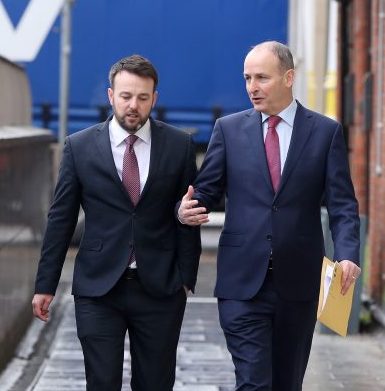
So, finally, it has arrived. What did we learn from yesterday’s launch? Well, it’s to be a civil partnership, not a marriage. Although Micheál Martin refused to be drawn on the matter of elections, the focus seems to be more about policy, than candidates per se.
Policy, as I’ve remarked before, would be nice. But it would also be an oddity in Northern Irish politics. As one political insider remarked yesterday, “Northern Ireland voters don’t give a damn about policy”. In fact neither do her politicians nor, dare I say it, do many in our media.
Evening Extra focused on a misspeak by Martin when he claimed that Sinn Fein’s abstentionist MPs took their salaries, when in fact between them they receive expenses (£132k last year) under the Financial Assistance to Opposition Parties for never turning up at “the office”.
In such a consequence free zone, nothing is too trivial to make the news in Northern Ireland. The underlying case that the value exchange between a non sitting MP and their constituents is a poor one is rarely heard within the Northern Irish media mainstream.
One of Northern Ireland’s most respected (for good reason) political observers, Mark Devenport, compared the slow burn nature of this ‘get together’ with the rather hasty shotgun marriage between David Cameron’s Conservatives and Reg Empey’s Ulster Unionists.
It’s a good call. That debacle had an impact on players in both parties. The cultural incongruences between any two parties in such different spaces are unlikely to be any less challenging this time. The Tory election machine that won the 2010 election, made little impact in NI.
Micheál Martin has earned an (unfair) reputation for indecision. But in this case, the caution is merited. Despite aspirations, the culture gap between north and south is immense (something that may have impressed itself upon the large number of TDs present this morning).
SDLP politicians campaigned bravely for peace, often putting themselves in harm’s way, but largely from outside government. Nationalist experience of unrest has generated an ambivalence towards the law, which is a serous inhibitor on further growth of its cross community support.
In contrast, Fianna Fáil has been synonymous with the government of the Republic for ninety years, to the point their TDs can be restless and capricious out of government. Past FF taoisigh have interned and on occasion executed what’s still sometimes referred to as subversives in the Republic.
Few SDLP MLAs have tasted either the advantages (or the burdens) of incumbency. Fianna Fáil Deputies are deeply experienced in the ebb and flow of political fortunes. Martin himself survived the catastrophic collapse of his party in 2011, and has painstakingly worked them back into contention.
LBJ said that the first rule of politics was to be able to count. To count your own votes and that of your nearest rival and figure out a way to get more than him or her. Who gets the top figure, is the only one who wins. Talk of winning the argument but losing the election is just talk.
To that singular end, the average Fianna Fáiler is not afraid to punch an opponent square on the (metaphoric) nose. By contrast the SDLP has tended to lash out any which way except in the direction of the opponent sitting on the biggest pile of votes they most need to win.
That’s a big culture gap to bridge. Despite the promise of limited southern resources (Eastwood’s last election budget was shoestring), we know from experience that culture eats strategy for breakfast. As it goes into the next election, the burden is almost entirely upon the SDLP to prove it has some kind of future.
Yes, the arrangement is vague. Vague enough, perhaps, to entice eleven out of the party’s twelve MLAs to be counted in its favour. But also vague enough to allow the developmental process itself to determine where it will eventually lead them.
The north, as Chris puts it, may have to wait longer for real politics to return. But that’s only if all that arises from yesterday is a lick of fresh paint and some cash. This is why policy matters. In the real world policies are not symbolic, they’re about what you’re actually going do.
All those years in government has bequeathed Fianna Fáil an ability to write and to sell policy well. For all their recent reversals they do it as well and often better than any other party on the island. But that alone won’t make the difference for the future of the SDLP.
According to Martin the need is to…
…develop a new agenda for Northern Ireland and for Ireland as a whole. There is a desperate need to shift the focus away from an obsession with who holds power and onto the much more important issue of what is done with that power.
I do wonder if the MLAs listening understood just what an oil tanker they have so publicly committed to turn around? That a single misspeak is treated as more scandalous than a clatter of MPs and MLAs refusing to do their public duty by their own constituents shows the power of that obsession in the media and the enormity of the challenge facing the party.
Eggs need cracked, fresh omelettes made and a few sacred cows urgently need led to the (metaphoric) slaughter. Will the SDLP find the nerve and the discipline to do it? Time will surely give us a clear answer.

Mick is founding editor of Slugger. He has written papers on the impacts of the Internet on politics and the wider media and is a regular guest and speaking events across Ireland, the UK and Europe. Twitter: @MickFealty
Discover more from Slugger O'Toole
Subscribe to get the latest posts sent to your email.


