Sleigh Ride over the Red Planet

A short seasonal diversion from JPLnews, using images of the real landscapes of Mars taken by the High Resolution Imaging Science Experiment (HiRISE) camera on NASA’s Mars Reconnaissance Orbiter. Pete Baker
A short seasonal diversion from JPLnews, using images of the real landscapes of Mars taken by the High Resolution Imaging Science Experiment (HiRISE) camera on NASA’s Mars Reconnaissance Orbiter. Pete Baker
Rumours of the demise of Kreutz sungrazing Comet Lovejoy may have been greatly exaggarated. NASA’s Solar Dynamics Observatory caught Comet Lovejoy emerging from its scorching close encounter with the sun. [Video Credit: NASA SDO] As the Science at Nasa press release notes Comet Lovejoy was discovered on Dec. 2, 2011, by amateur astronomer Terry Lovejoy of Australia. Researchers quickly realized that the new find was a member of the Kreutz family of sungrazing comets. Named after the German astronomer Heinrich Kreutz, …
After the hype, “somewhat excited” reporters are straining to sound convincing – the Guardian live-blogged the presentation. And Matt Strassler was at the circus in CERN. I have been chatting with my colleagues, all particle physicists working at or visiting CERN, and finding out how many say that the evidence presented today convinces them that the Higgs has been found. So far — Experimentalists — No: 9, Maybe: 1, and a good one; will explain shortly. Yes: 1 (Tomaso Dorigo, of …
A short BBC report notes that one man has been arrested and a vehicle seized after a shot was fired at a man in the New Lodge area of north Belfast this morning. From the BBC report Detective Chief Inspector Alan Little said the attack was “an extremely reckless act in a heavily populated area”. He added: “We are investigating a number of lines of enquiry and I am keen to hear from anyone who was near the Antrim Road/Stratheden Street …

By the time its last catalogue of exoplanet candidates was released in February, Nasa’s Kepler space observatory, launched in March 2009, first light in April 2009, had identified 1,235 planetary candidates – and 54 candidates within the habitable zone. The Kepler team have now identified 2,326 planet candidates – of those, 207 are approximately Earth-size, 680 are super Earth-size, 1,181 are Neptune-size, 203 are Jupiter-size and 55 are larger than Jupiter. And there are now 48 planet candidates in their star’s habitable zone There …
As the Guardian’s Ian Sample notes from the science desk The runup to Christmas looks exciting for the Large Hadron Collider at Cern near Geneva. Staff at the laboratory have arranged a special seminar on Tuesday 13 December at which the latest results in the search for the Higgs boson will be made public. The presentation is due to happen directly after the lab’s scientific policy committee has convened one of its regular meetings behind closed doors. So what can we …

As Curiosity heads to Mars, and Voyager continues to go boldly further than ever, the BBC reports on some speculative assessments of potentially habitable locations elsewhere in the galaxy. A timely reminder, then, from the Guardian’s GrrlScientist of our pale blue dot in this short video tribute to Carl Sagan. Carl Sagan (1934-1996), Pale Blue Dot: A Vision of the Human Future in Space [1997: Amazon UK; Amazon US]. From this distant vantage point, the Earth might not seem of any …
Nasa’s Mars Science Laboratory (MSL) successfully launched from the Kennedy Space Centre earlier today on an Atlas 5 rocket at the start of its eight and a half month journey to Mars. With its massive 900kg rover, Curiosity, it’s being billed as “the biggest and best Mars mission yet.” Mike Meyer is the lead scientist on Nasa’s Mars exploration effort: “MSL plays a central role in a series of missions of looking at Mars and determining whether or not it has the potential for life. …

And that could be a good thing. [Image credit: Nasa/JPL. Image reprocessed by Ted Stryk]. As a BBC report notes, Nasa scientists have published their latest thinking on the chaos terrains of Jovian satellite Europa. [All hail our friend and lord, Jupiter! – Ed] *ahem*. It suggests that the “chaos terrains form above liquid water lenses perched within the ice shell as shallow as 3 kilometres”. Here’s a cross-section view through the surface of Europa showing the suspected “Great Lake.” [Image credit: Britney Schmidt/Dead Pixel …

If the calculations are correct, the 400m-wide asteroid 2005 YU55 will make a safe, close flyby of Earth at around half past eleven tonight (11.28pm GMT). [If?! – Ed] If not, we’ll have a wondrous new scar to boast about! Radar image of asteroid 2005 YU55 obtained on Nov. 7, 2011, at 11:45 a.m. PST (2:45 p.m. EST/1945 UTC), when the asteroid was at 3.6 lunar distances, which is about 860,000 miles, or 1.38 million kilometers, from Earth. [Image credit: NASA/JPL-Caltech] And with its …
Via Tom Chivers at the Telegraph blog. [Video courtesy of the Image Science & Analysis Laboratory, NASA Johnson Space Center] This video was taken by the crew of Expedition 29 on board the International Space Station. The sequence of shots was taken October 18, 2011 from 07:09:06 to 07:27:42 GMT, on a pass from just south of Alaska to eastern Cuba. The camera used for this imagery was north-facing, so the Aurora Borealis stay visible throughout the video. Lights from …
After a two year trial in Lithuania, suspected Real IRA member Michael Campbell, 39, from County Louth, has been found guilty of supporting a terrorist group, illegal possession of weapons and attempted weapons smuggling and has been sentenced to 12 years in prison. He was arrested in Lithuania in January 2008 as a result of an MI5 sting operation, working alongside Lithuanian authorities, against republican terrorist groups. From the Guardian report Michael Campbell was jailed for 12 years by a judge …
The discovery of an intact Viking boat burial on the Ardnamurchan Peninsula – by the Ardnamurchan Transitions Project, a team led by experts from the universities of Manchester and Leicester, CFA Archaeology Ltd and Archaeology Scotland – has generated plenty of coverage. Believed to be from the 10th Century, it’s the first fully intact Viking boat burial site to be excavated on the British mainland. As the BBC report notes The term “fully-intact”, used to describe the find, means the remains …

[Image credit: NASA/JPL-Caltech/University of Arizona/Texas A&M University.] Having completed what once “seemed like a crazy idea”, Nasa have released a video documenting the journey of Mars Exploration Rover Opportunity from Victoria crater to Endeavour crater. A “three-year trek that totaled about 13 miles (21 kilometers) across a Martian plain pocked with smaller craters.” Opportunity arrived on Mars in January 2004 and completed its three-month prime mission in April that year. The rest have been bonus, extended missions. The video is compiled from 309 images taken at …

As the BBC report, and see here also, the European Southern Observatory (ESO) have released the first image obtained by their new telescope, the Atacama Large Millimetre/Sub-millimetre Array (ALMA) – even though the array isn’t expected to be completed until 2013. It’s the focus of the latest ESOcast 36 – ALMA opens its eyes. And here’s that image, of the colliding spiral Antennae Galaxies (also known as NGC 4038 and 4039). [Image credit: ALMA (ESO/NAOJ/NRAO)] A side-by-side comparison with a Very Large Telescope (VLT) image of …
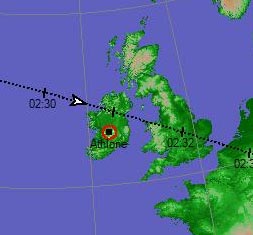
I did warn you… Just about everyone’s now covering the falling UARS satellite – that’s the 5 tonne, 20-year-old UARS satellite. Nasa has further refined their estimate of when it will come down. As of 10:30 a.m. EDT on Sept. 23, 2011, the orbit of UARS was 100 miles by 105 miles (160 km by 170 km). Re-entry is expected late Friday, Sept. 23, or early Saturday, Sept. 24, Eastern Daylight Time. Solar activity is no longer the major factor …
As noted by the BBC, Nasa have released a short video of the Aurora Australis “created from a sequence of still shots taken by astronauts on board the International Space Station. The images were acquired on September 11, 2011 as the ISS orbit pass descended over eastern Australia.” Wondrous. Pete Baker

Nasa’s Dawn spacecraft remains in orbit around the 530km-wide proto-planet Vesta – the second most massive object in the main asteroid belt. And they’ve released this cool video constructed from the images they’ve obtained so far. Via JPLnews Here’s an image of the south pole of Vesta from a distance of about 1,700 miles (2,700 kilometers). [Image credit: NASA/JPL-Caltech/UCLA/MPS/DLR/IDA] And speaking of exo-planets, scientists using the orbiting Kepler observatory have identifed the first circumbinary planet, the first planet known to definitively orbit two …
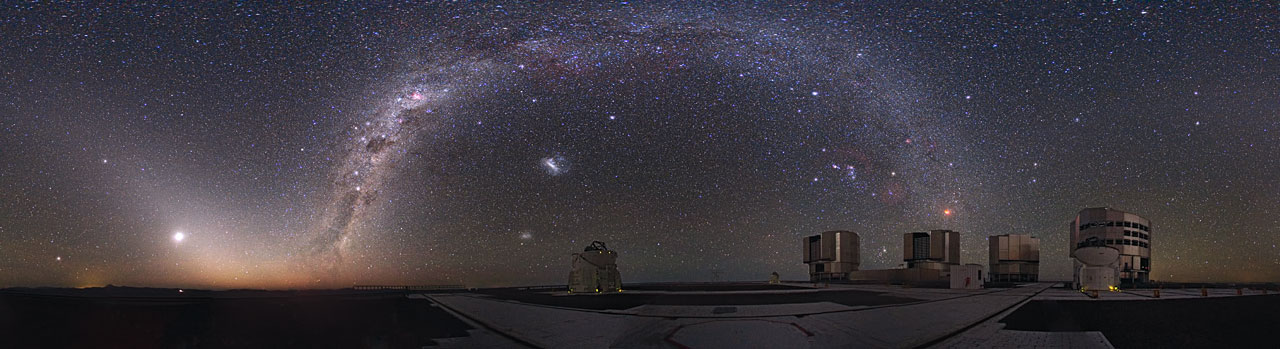
[Image credit: ESO/M. Kornmesser]. As the BBC reported, astronomers using the HARPS spectrograph on the 3.6-metre telescope at the European Southern Observatory [ESO]’s La Silla Observatory in Chile recently announced the discovery of more than 50 new exoplanets orbiting nearby stars, including sixteen super-Earths. It’s the subject of ESOcast 35: 50 New Exoplanets. From the ESO science release In the eight years since it started surveying stars like the Sun using the radial velocity technique HARPS has been used to discover more …
Quantum field theorist Professor Matt Strassler, whom I mentioned previously and who’s been spending a few days at the Perimeter Institute, takes issue with the science in this BBC science report of “hints” of dark matter in his latest post. Meanwhile, a bit more insight into the CRESST dark matter situation (see yesterday’s post). There have already been silly press articles. The BBC article says Researchers at the Cresst experiment in Italy say they have spotted 67 events in their detectors that may be …