“A billion stars revealed”

A stunning image was unveiled last week at the UK-Germany National Astronomy Meeting NAM2012 in Manchester. [All images courtesy of Mike Read (WFAU), UKIDSS/GPS and VVV] The BBC’s Spaceman, Jonathan Amos, helpfully provides this combination image, with a partial zoom-in on the Galactic center. But to really appreciate the scale and detail of the image you need to use the online interactive viewer here. From the University of Edinburgh press release Astronomers have today released a picture containing more than one billion …

Read more…

“…and marvel at the solar system in motion”

Here’s a date to mark in your diary [really? – Ed].  On the 5/6 June this year one of the rarest predictable astronomical events will occur – a transit of Venus.  [Can’t wait… – Ed]  Since the invention of the greatest human innovation, the telescope, at the beginning of the 17th century, not by Galileo, there have been only 7 such transits.  And, although the last one was in 2004, the next will not happen until 11 December 2117. [I’ll catch it then! …

Read more…

The Universe at a glance…

Well, several glances actually…  As spotted by the Guardian blog’s Tom McCarthy, NASA has released a new atlas and catalog of the entire infrared sky “showing more than a half billion stars, galaxies and other objects captured by the Wide-field Infrared Survey Explorer (WISE) mission.”  And an impressive view it is. [Image Credit: NASA/JPL-Caltech/UCLA]   From the Nasa press release The sky can be thought of as a sphere that surrounds us in three dimensions. To make a map of …

Read more…

Stargazing, and [exo]planet hunting…

The last three nights saw the return to BBC2 of popular astronomy show Stargazing Live – presented by Brian Cox and Dara O’Briain.  Hopefully it will become, at least, an annual fixture. [Image credit: ESO/Y. Beletsky] The three hour-long programmes are still available, for now, on the iPlayer.  The entertaining ‘after-show’ shows, Back to Earth, appears to be missing are also available. If you’ve been paying attention you’ll have recognised some of the material – for example, the Lunar Reconnaissance Orbiter’s images …

Read more…

Sleigh Ride over the Red Planet

A short seasonal diversion from JPLnews, using images of the real landscapes of Mars taken by the High Resolution Imaging Science Experiment (HiRISE) camera on NASA’s Mars Reconnaissance Orbiter.   Pete Baker

Kepler-22b: “This is a major milestone on the road to finding Earth’s twin”

By the time its last catalogue of exoplanet candidates was released in February,  Nasa’s Kepler space observatory, launched in March 2009, first light in April 2009, had identified 1,235 planetary candidates – and 54 candidates within the habitable zone. The Kepler team have now identified 2,326 planet candidates – of those, 207 are approximately Earth-size, 680 are super Earth-size, 1,181 are Neptune-size, 203 are Jupiter-size and 55 are larger than Jupiter.  And there are now 48 planet candidates in their star’s habitable zone There …

Read more…

“An aircraft carrier-sized asteroid will make a safe, close flyby of Earth…”

If the calculations are correct, the 400m-wide asteroid 2005 YU55 will make a safe, close flyby of Earth at around half past eleven tonight (11.28pm GMT).  [If?! – Ed]  If not, we’ll have a wondrous new scar to boast about!  Radar image of asteroid 2005 YU55 obtained on Nov. 7, 2011, at 11:45 a.m. PST (2:45 p.m. EST/1945 UTC), when the asteroid was at 3.6 lunar distances, which is about 860,000 miles, or 1.38 million kilometers, from Earth. [Image credit: NASA/JPL-Caltech] And with its …

Read more…

ALMA opens its eyes

As the BBC report, and see here also, the European Southern Observatory (ESO) have released the first image obtained by their new telescope, the Atacama Large Millimetre/Sub-millimetre Array (ALMA) – even though the array isn’t expected to be completed until 2013.  It’s the focus of the latest ESOcast 36 – ALMA opens its eyes. And here’s that image, of the colliding spiral Antennae Galaxies (also known as NGC 4038 and 4039).  [Image credit: ALMA (ESO/NAOJ/NRAO)] A side-by-side comparison with a Very Large Telescope (VLT) image of …

Read more…

Of proto- [and exo-] planets. And falling satellites…

Nasa’s Dawn spacecraft remains in orbit around the 530km-wide proto-planet Vesta – the second most massive object in the main asteroid belt.  And they’ve released this cool video constructed from the images they’ve obtained so far. Via JPLnews Here’s an image of the south pole of Vesta from a distance of about 1,700 miles (2,700 kilometers). [Image credit: NASA/JPL-Caltech/UCLA/MPS/DLR/IDA] And speaking of exo-planets, scientists using the orbiting Kepler observatory have identifed the first circumbinary planet, the first planet known to definitively orbit two …

Read more…

“a special perspective of our role and place in the universe…”

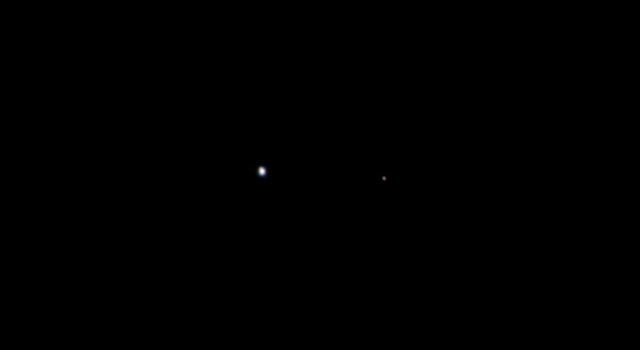
Three weeks into its journey to our friend and lord, Jupiter, Nasa’s Juno spacecraft has taken a look back at its home planet [on the left] and its natural satellite, the Moon.  [Image credit: NASA/JPL-Caltech] From the Nasa press release “This is a remarkable sight people get to see all too rarely,” said Scott Bolton, Juno principal investigator from the Southwest Research Institute in San Antonio. “This view of our planet shows how Earth looks from the outside, illustrating a special …

Read more…

The Galactic Centre Revisited

While waiting, hopefully, for the arrival of the James Webb Space Telescope, here’s a short video of what the current space telescopes, particularly Nasa’s Spitzer and ESA’s Herschel, have seen at the centre of our galaxy.  The above image is a three-color composite, showing infrared observations from two of Spitzer instruments. [Image credit: NASA/JPL-Caltech].  Video from SpitzerSpaceCenter. As well as the twisted ring of very dense and cold gas and dust at the galactic centre, there have been other amazing structures observed.  Then there are the “colossal swathes of …

Read more…

Opportunity at Endeavour

Last seen, on Slugger, at the edge of the football-field sized crater Santa Maria, Nasa’s Mars Exploration Rover Opportunity has arrived at its next destination – the 22km wide crater Endeavour.  3 years and 13 miles from its first destination, Victoria crater. [Image Credit: NASA/JPL-Caltech/Cornell/ASU] A portion of the west rim of Endeavour crater sweeps southward in this color view from NASA’s Mars Exploration Rover Opportunity. This crater — with a diameter of about 14 miles (22 kilometers) — is more …

Read more…

“these could be the first known Martian locations with liquid water”

A BBC report notes the fascinating interpretation being made of some more wondrous images from the HiRISE camera on the Mars Reconnaissance Orbiter.  MRO image gallery here.    From JPLnews Here’s an animated gif showing the features of interest. This series of images shows warm-season features that might be evidence of salty liquid water active on Mars today. Evidence for that possible interpretation is presented in a report by McEwen et al. in the Aug. 5, 2011, edition of Science. These images come …

Read more…

Journey to Jupiter

As the BBC reports, and the Guardian notes, Nasa’s Juno Mission to our friend and lord, Jupiter, is scheduled to launch this afternoon on an Atlas V rocket.  There’s an impressive Juno mission website too.  Lift-off at 15:34 UT [4.34pm BST].  Here’s a short overview of the mission.  Video credit: NASA/JPL-Caltech. And, if you have time, here’s the full science briefing via NasaTV. You can also watch the launch live via NasaTV.  Or, indeed, here! Update2  I’ve replaced the live Ustream video with …

Read more…

Vesta’s dark side [and possibly a colourful one]

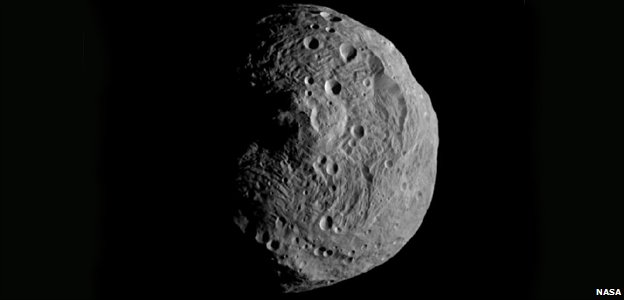
As the BBC spaceman, Jonathon Amos, notes Nasa’s Dawn spacecraft has taken a close look at the 530 km wide giant asteroid Vesta’s northern hemisphere– to add to all those earlier images.  This image was taken on 23 July, at a distance of about 3,200 miles (5,200 kilometers) away from the proto planet Vesta.  Image credit: NASA/JPL-Caltech/UCLA/MPS/DLR/IDA.   And in a short while, 1700 UT [6pm BST], Nasa will be holding a press conference to present the latest findings.  Which may include some colour …

Read more…

Hubble spots fourth moon of Pluto

  The Hubble Space Telescope has been looking at the twin dwarf planet system of Pluto and Charon ahead of Nasa’s New Horizons mission expected arrival in the neighbourhood in 2015.  They’ve already mapped the surface of Pluto, to an extent, and now they’ve spotted a fourth moon in the system– if you count the dwarf planet Charon as a moon of Pluto, that is.  The new moon has been designated “S/2011 P1” or “P4” until a permanent name is chosen.  [All …

Read more…

Vesta: “arguably the oldest extant primordial surface in the Solar System”

With Dawn now safely in orbit around the giant asteroid Vesta, Nasa have released the first close-up image of the ancient protoplanet. [Image credit: NASA/JPL-Caltech/UCLA/MPS/DLR/IDA] From the accompanying text July 18, 2011 – PASADENA, Calif. — NASA’s Dawn spacecraft obtained this image with its framing camera on July 17, 2011. It was taken from a distance of about 9,500 miles (15,000 kilometers) away from the protoplanet Vesta. Each pixel in the image corresponds to roughly 0.88 miles (1.4 kilometers). And from the …

Read more…

Dawn: Up close and personal with Vesta

As I may have mentioned, early tomorrow morning, 9am [BST] 16 July, Nasa’s Dawn spacecraft is expected to be captured into orbit by the 530km-wide giant asteroid Vesta.  They won’t know for sure until a scheduled communications pass at 8.30am [BST] on Sunday 17 July.  Here’s the latest image of Vesta taken by Dawn on 9 July at a distance of about 26,000 miles (41,000 km).    NASA’s Dawn spacecraft obtained this image with its framing camera on July 9, …

Read more…

Spectacular Solar Eruption Close-up

Nasa have released more stunning footage from the Solar Dynamics Observatory of the spectacular solar eruption on June 7.  As LittleSDOHMI notes – “This video uses the full-resolution 4096 x 4096 pixel images at a one minute time cadence to provide the highest quality, finest detail version possible.”  With music! Pete Baker

Most distant “angry monster” brightest in early Universe

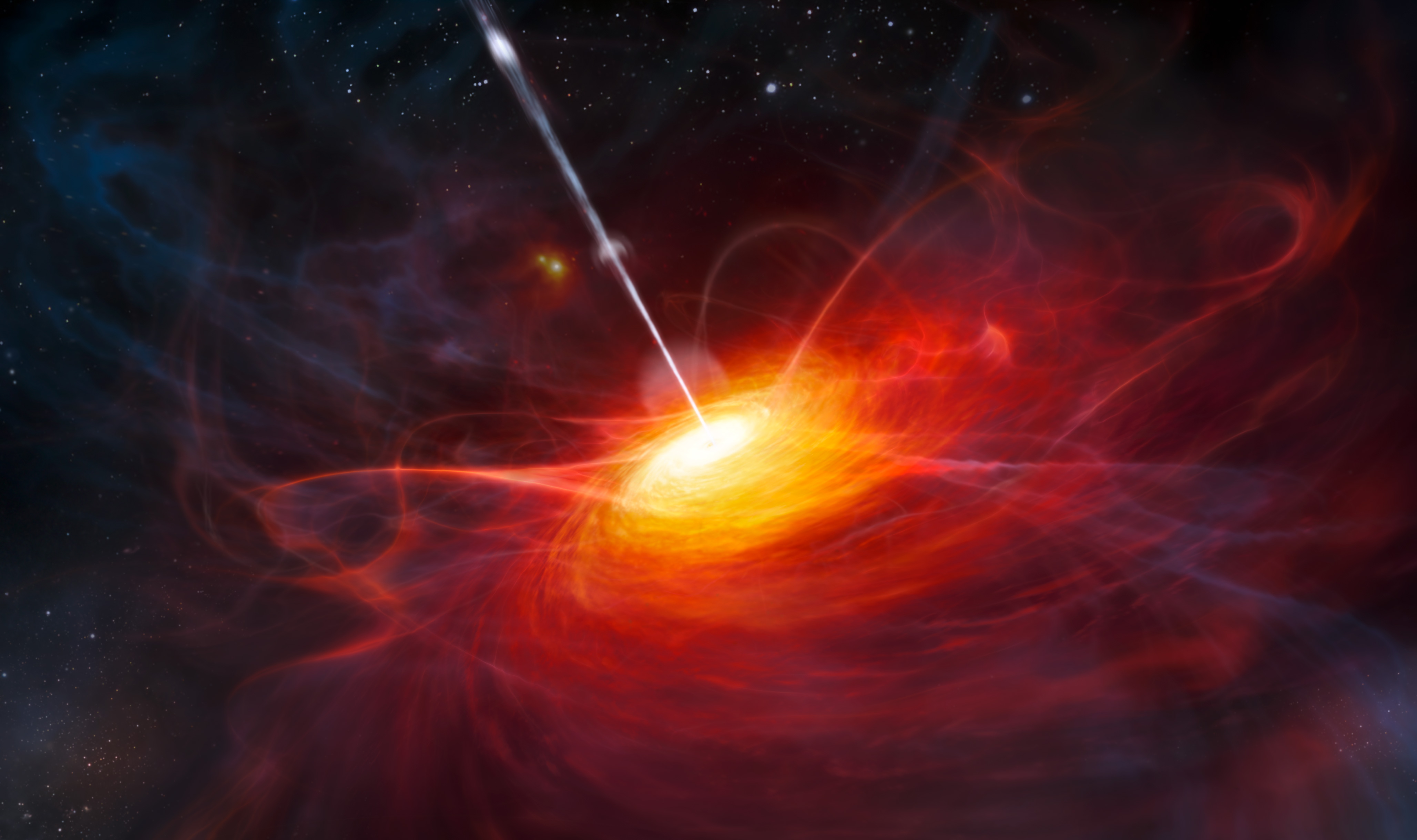
[Image credit: ESO/M. Kornmesser] The BBC reports on the discovery of the most distant quasar yet seen, ULAS J1120+0641.  An “angry monster” 12.9 billion light-years away – a mere 770 million years after the Big Bang.  Before the process of re-ionization was completed.  As the BBC report notes The light from ULAS J1120+0641 displays the characteristic signature of neutral gas, indicating that, at 770 million years after the Big Bang, the process of re-ionization had some way to go before the process was …

Read more…