
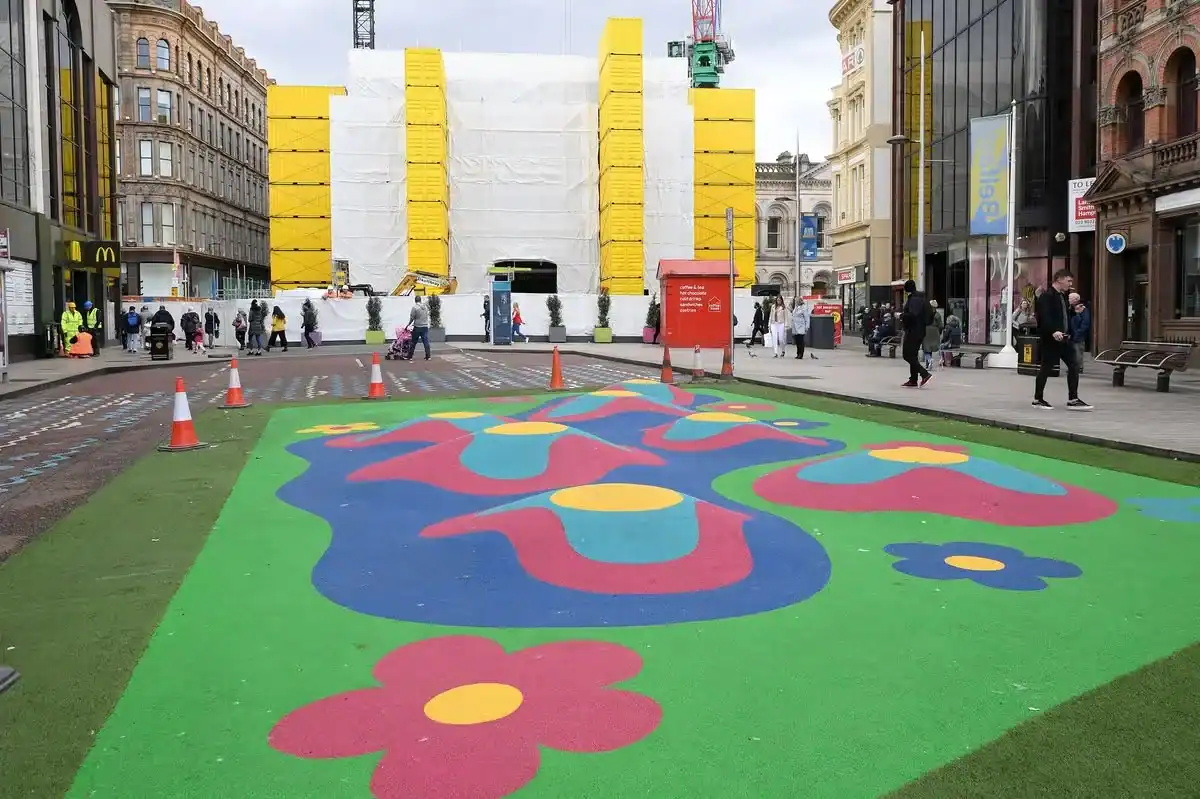
There’s something slightly odd about the reaction to plans to pedestrianise parts of Belfast city centre during the Fleadh.
On the face of it, the proposal is fairly simple. For a period in August, parts of the city centre will be restricted to traffic to safely accommodate what is expected to be one of the largest cultural events Belfast has ever hosted. And yet, even as the consultation process ran and closed, the debate hardened quickly, settling into a familiar groove, the sense that Belfast simply cannot function if traffic is disrupted.
But is this really about the Fleadh, or is it about something deeper, a long-standing reluctance to imagine Belfast city centre any other way?

Real concerns, but the wrong conclusion
Some of the concerns raised during the consultation were entirely valid. Businesses need to know how deliveries will work, taxi access matters, particularly late at night, and accessibility for disabled people is not optional. It has to be built in from the start.
None of that is trivial.
But these are practical problems to solve, not reasons to abandon pedestrianisation altogether. And this is where Belfast often gets stuck, jumping straight from “this will be complicated” to “this cannot be done”, without spending enough time in the space in between.
Consultation means consultation
Part of the frustration in this debate is how quickly the idea of consultation itself seemed to get lost.
Take the contribution from a taxi driver, “Pat”, on The Nolan Show, who suggested that taxi drivers should effectively have been consulted in advance, before the public consultation even began.
It’s hard to know what to do with that.
The entire point of a consultation is to surface concerns like these, from taxi drivers, from businesses, from residents, in a structured way so they can be addressed before anything is finalised. Not beforehand, not behind closed doors, and not for one group ahead of everyone else. If anything, the fact that these concerns came through clearly just shows the process working as intended.

We already close the city, just not on purpose
The truth is, Belfast already shuts down its streets all the time.
Parades, protests and demonstrations regularly make large parts of the city centre inaccessible to traffic, sometimes at relatively short notice, and while it is not always seamless, the system adjusts. Roads close, buses divert, people find their way.
The difference with the Fleadh is intent. This is not disruption as a by-product, it is disruption in service of something – a safer, more welcoming, more usable city centre. And that seems to trigger a different kind of resistance.
This is not a new idea
It is also worth saying that none of this is new.
The idea of pedestrianising parts of Belfast city centre has been around for well over a decade, dating back to the Department for Social Development’s Streets Ahead proposals. This is not a sudden departure. It is something the city has been inching towards, and then away from, for years.
We have even seen a version of it work in practice. In the aftermath of the Primark fire, when large parts of the city centre were closed to traffic, the space didn’t collapse. If anything, it offered a glimpse of a different kind of city centre, one that felt more open, easier to move around, and more pleasant to spend time in.
And even today, pedestrianisation is not some foreign concept. Cornmarket, Ann Street and Rosemary Street already prioritise people over traffic, and the city functions perfectly well around them.
Transport can change, it always has
There’s a tendency to talk about the current transport network as if it’s fixed, but it isn’t.
Bus routes were not carved into stone at the top of Mount Sinai. They have been altered before, rerouted, expanded and cut back depending on need, and they can change again, especially for a major event like this.
We have recent evidence of that flexibility working. During The Open Championship in Portrush, a mix of park and ride, rail capacity and careful planning managed huge visitor numbers. It wasn’t perfect, but it worked, and more importantly, it showed that the system can adapt when it needs to.

A pattern of hesitation
If any of this feels familiar, it is because Belfast has been here before.
Hill Street was finally pedestrianised after years of delay, only for weak enforcement to undermine it almost immediately. Cars still slip through, and the space never quite feels like it belongs to people in the way it was intended.
Meanwhile, proposals to restrict traffic on York Street have been dropped altogether.
The pattern is difficult to ignore. Small steps forward, followed by hesitation, or retreat, when things get difficult.
This is a test, whether we treat it like one or not
The Fleadh offers something slightly different. It is not a permanent change, but it does give the city a chance to see how the centre works when you start to prioritise people over through-traffic.
That means working through the details properly. Delivery windows that actually function, clear taxi access at the edges of the zone, and thought-through provision for blue badge users. It may even mean introducing a shuttle service for those with reduced mobility, something already used in cities like Ljubljana, and in a more modest way at Belfast Zoo.
These are not abstract ideas. They are practical solutions.

The bigger question
There is a deeper irony running through all of this.
Parts of Belfast city centre are already heavily restricted to buses and permitted vehicles, so the shift being proposed is not radical, it is incremental. And it is a shift that cities across Europe have already made, often with clear benefits for footfall, air quality and the overall experience of being in the city.
So the question is not whether Belfast can do this.
It is whether it is willing to.
There is, of course, a reason for the scepticism. Belfast has seen its fair share of disruption that has not been handled well. The traffic management around the closure of Durham Street is a recent example that still lingers. It wasn’t the closure itself that frustrated people as much as how it was managed.
People remember that. It shapes how new proposals are received.
But that cannot become the default setting.
Because if every proposal is met with the assumption that it will fail, that nothing can improve, that every challenge is a reason to stop rather than a problem to solve, then nothing ever will.
The Fleadh will come and go. The question is what Belfast chooses to learn from it.

Aaron Vennard is a Managing Consultant with 15 years in Financial Services across New York, Chicago, Toronto, London and Dublin while locally advocating to improve public transport and active travel across Greater Belfast through the Circle Line Campaign.
Discover more from Slugger O'Toole
Subscribe to get the latest posts sent to your email.


