


While the attendance will have pleased organisers – who followed the SDLP pattern of not streaming the conference online – and the morning’s smorgasbord of speakers were greeted with buoyant applause, a postprandial somnolence infected much of the audience after lunch and reaction to the leader’s somewhat meandering speech was often muted.
Much was made of the UUP and, in particular, David Trimble’s role in the 1998 Belfast Agreement. A time of ‘hope’ that they wanted to recreate. References to how the party had treated Trimble were less forthcoming. English nationalism was identified as the greatest threat the union: a warning to other unionist parties who the UUP see as cosying up to dangerous figures and campaigns.
Leader Mike Nesbitt says he is sticking to his promise to decide next January whether he’ll stand for election again at May 2027’s Assembly election. No matter what, his intention is to serve out the term as Health Minster … but a chance of leadership could put that at risk.
The single greatest – yet unspoken – existential crisis facing the UUP is whether they’ll remain the second largest unionist party after the next set of elections.
Deputy leader Robbie Butler suggested that if his party was to achieve future electoral success, it would be a result of “outworking every other party” in serving their constituencies. Together with two speakers who called out the need to work hard on engagement and service in working class communities, there’s plenty of work for the UUP to do over the next 18 months if they’re to seriously tackle the risk of being overtaken by the TUV.
– – –
After opening prayers, party president Lady Trimble welcomed delegates and new party chair Lord Elliott (and former leader) gave his ‘state of the nation’ address. In a section looking at the Union’s future, he emphasised the number of people living in Great Britain who have Irish grandparents and suggested the whole of Ireland would have been better off to have stayed in the United Kingdom. He touched on Michelle Gildernew’s recent podcast comments: “One thing Northern Ireland is not, it is not a (cough) shithole. It’s absolutely disgraceful [for a former minister] to describe it as such. It’s abominable.”
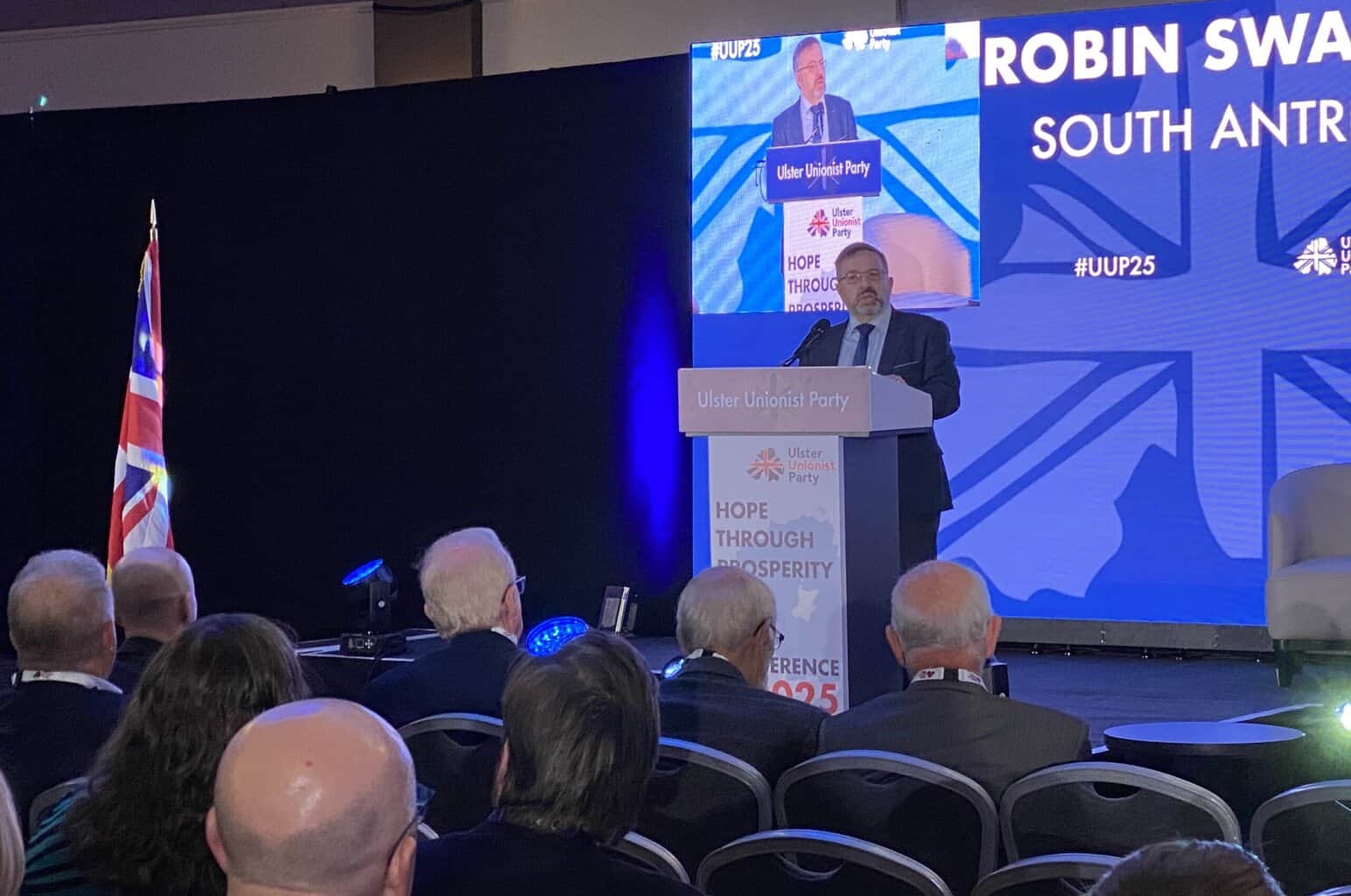
“For too long the voice of unionism in Westminster has been dominated by a perpetually negative Party, a Party that has not delivered for Northern Ireland, a party that has instead created more and more obstacles to prosperity, mis-sold shoddy deals on the Windsor Framework, and consistently failed to sell the benefits of both Northern Ireland and the Union in Westminster … Our sights are well set on the council and Assembly elections of 2027, but I would quite like some company on those green benches as well!”
* By the time the conference programme began, I’d bumped into and said hello to all the living former leaders, one of whom was also the current leader!
New UUP MLA Jon Burrows (potentially a future former leader) was next up to the podium. He spoke off the cuff with no autocue, one hand in his pocket, the other waving around. It felt like a rehearsal for the leadership election speech he might give if Mike Nesbitt decides to step down in January – though Burrows categorically denies that it was! – commenting on a variety of policy areas, critiquing other parties, and talked up the UUP’s heritage and approach.
Burrows suggested that “the case for the Union is compelling … we just have to make it.” He commented on radio traffic from smugglers who try to “stay in Irish waters: the Irish have radios, the British have ships”. He compared the unfavourable price of chicken, the size of utility bills, and the number of hospital patients on trolleys south of the border.
He said that “Sinn Féin hope that Northern Ireland fails and Unionism give them own goals while they rewrite history and legacy”. Up at the Assembly, he observed that Sinn Féin had “a well-oiled but very mediocre team” with “speeches written by Connolly House”. He quipped that Gerry Kelly was “still very light on his toes … there’s still a few on the runs in that party!”
The SDLP’s Claire Hanna was asking for the “Monty Python Ministry of Silly Walks, a Ministry of Irish Unity that the Irish government don’t even want”. On Alliance, he joked that “rumours of my defection to the Alliance Party are false flag operations”. He said that “the protest outside Naomi Long’s home was wrong and I condemn it outright. (Audience applauded.) But the Alliance Party are desperate, they are folding under scrutiny.”
Burrows suggested that Naomi Long’s dream ministry would be a “Ministry of Operational Independence, answerable to no one, responsible for nothing, and everything is someone else’s fault”. The TUV and People Before Profit escaped his comment and criticism.
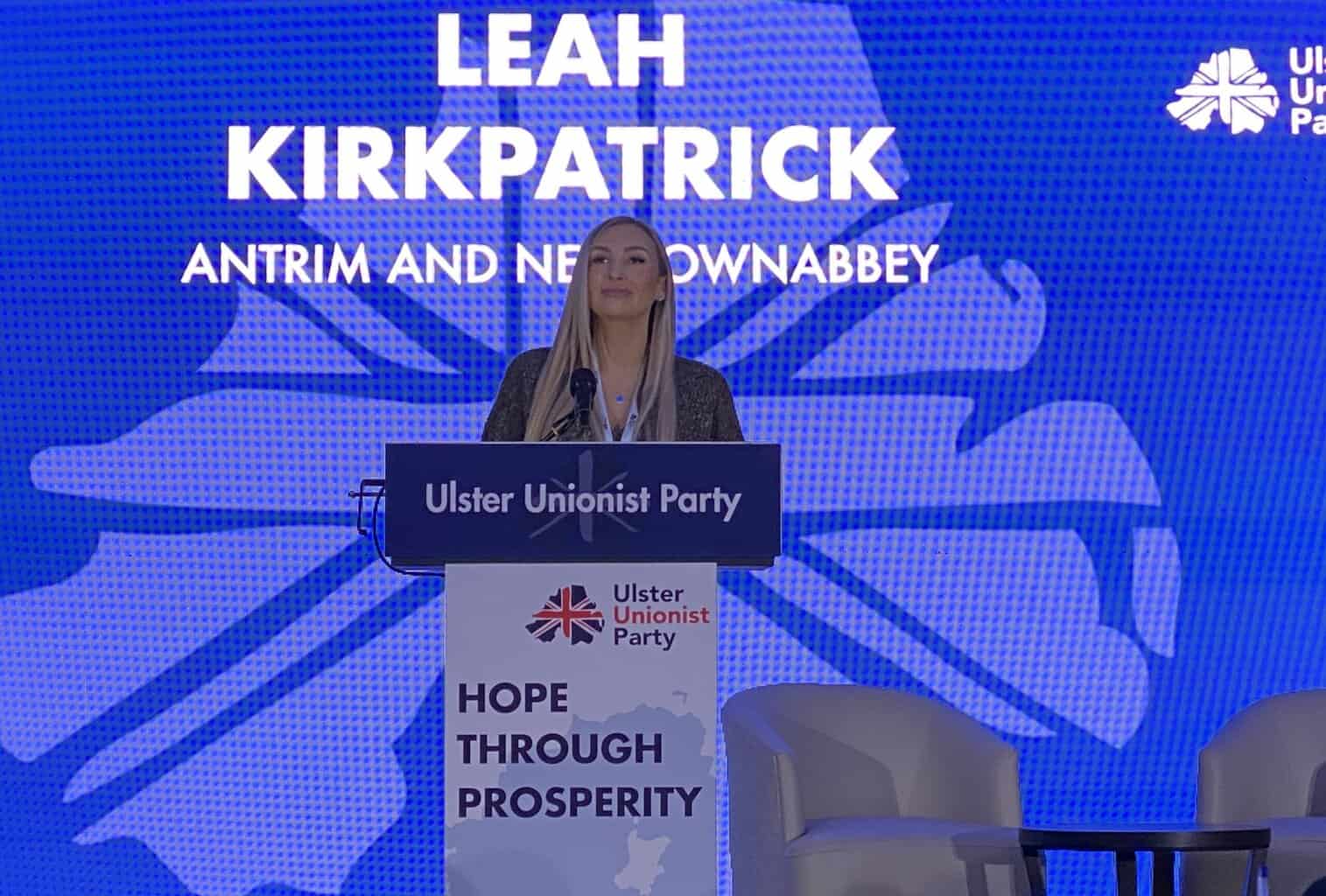
“I still see comments about my hair, how I dress – things that have nothing to do with my work, my ability or my impact. And I know I’m not alone in this. Too often, women in public life are judged on their appearance instead of their achievements.
“Society still expects mothers to work like they don’t have children, and parent like they don’t have a job … meetings and events are often scheduled in ways that are completely unrealistic for working parents. That’s not just inconvenient – it’s exclusionary. It is time for people to realise that those 8.30am business breakfasts directly clash with the school run and those late-night meetings mean missing bedtime routines … We need to reshape this political landscape so it works for families, especially for mothers. I want to raise my children with joy, being present for their childhoods – but I also want to keep growing in my own career. I don’t believe I should have to choose between those two identities.”
Ards and North Down Councillor Pete Wray wanted his speech to start a conversation asking “What is a loyalist? What does it mean to be a Unionist? Are they not the same, and if not, why not?” He highlighted that while “loyalist communities want to maintain the union, … there is a problem with apathy. There is a lack of confidence in and support for unionist political parties. We don’t see this mirrored in republican communities … there’s a problem we must fix, and a relationship we must repair.”
Wray listed the challenges to unionism and recommendations identified by the Lets Talk Loyalism group in their recent paper What Next? An Overview of Loyalist responses to Key Challenges facing Unionism Today (if anyone has an online link to the paper, let me know in the comments and I’ll add a link here). “If we can build that trust, we can rebuild the relationship and heal the disconnect that exists. Loyalism and Unionism aren’t the same but we do have one massive thing in common, and that is that we want to protect the union. We should do so as a family.”
He highlighted how elected representatives need to connect with communities on the ground and be present (physically and in their phones’ messaging apps): “Policies and messaging must be right, but never forget about or underestimate the importance of relationships.”
Former councillor Dr John Kyle picked up Pete Wray’s themes about working class communities. He reminded the UUP delegates how he had got into politics. (David Ervine was his route into the PUP and ultimately becoming deputy leader until he resigned and joined the UUP in March 2022.) He highlighted the prevalence of mental health issues, alcohol and drug related deaths, the danger of vaping, problem gambling, educational underachievement.
“Working class communities, while demonstrating great resilience, loyalty and pride in their community, face hardships and hazards which lead to a much greater sense of vulnerability, and they have limited resources at their disposal to resolve the problems that they face. Politicians have a responsibility to tackle these issues, and what’s more, it is in everyone’s interests that we do, otherwise we will have generations of young people languishing in disadvantage and deprivation , suffering physical and mental health difficulties, failing to fulfil their potential and unable to make a proper and fitting contribution to the future of Northern Ireland.”
“So, in order to tackle disadvantage, economic inactivity and the perception of many within Loyalist communities, that they have been ignored or forgotten, we need to demonstrate that we take their concerns seriously, that we are actively addressing their problems such as the ones I have highlighted; mental ill health, addictions, educational failure and unemployment. If we do this, we will reduce alienation, bring about a social and economic levelling up, demonstrate our relevance as a political party and set individuals and Northern Ireland as a whole on a course for stability, economic success and social and cultural enrichment. This is what politics should be about, and this is what we as a Party are committed to.”

“As we look to the future of Unionism, we must also recognise something crucial: our movement is strongest when every voice within it is heard and that includes the voices of our women. Women in Unionism have always played a vital role, though too often their contributions have gone uncelebrated.”
Reid spoke highly of Fermanagh and South Tyrone MLA Diana Armstrong who had inspired her to become politically involved. “If Unionism is to be vibrant, inclusive, and forward looking, it must reflect the society it seeks to serve. That means encouraging more women into politics, ensuring they are not just present, but prominent, and giving them the platforms to lead. This is not simply about equality for equality’s sake. It is about strength. A movement that silences half of its people is only half a movement.”
She was followed on stage by another Fermanagh and South Tyrone unionist. The latest UUP press officer Lewis McVitty made his conference debut with a speech that looked not at the media but focussed instead on agri-food, labelling DAERA minister Andrew Muir as “so completely out of his depth”.
“[Farmers] are being hammered by an ever-escalating crisis of TB right across the province, with no credible plan of action in place … And then there’s Minister Muir’s Nutrient Action Programme – a policy so disastrous, so ill thought out that it’s united the entire Agri-food sector against him. Conference let’s be clear, no one disputes the need to protect our waterways. Lough Neagh and our rivers are vital to our ecosystem, our communities and our economy, but the proposals that are on the table risk doing more harm than good, especially to the very people who have been the stewards of our land for generations.”
Later in his speech McVitty returned to Lough Neagh: “… as a party we have to make clear that we want clean water. We want environmental responsibility. But we will not allow our farmers to be scapegoated. We will not allow their livelihoods to be sacrificed, to be blamed for the institutional failures of NI Water, a company that dumps 20 million tons of untreated sewage and waste-water spill into our waterways annually. Blaming farmers is too simple, farming is only but one spoke on a very large wheel impacting the Lough.”
Former MEP Jim Nicholson (never got a chance to be a former party leader) chaired some of the sessions and leaned on his European experience on agriculture issues when he ad-libbed that while Minister Andrew Muir “leaves a lot to be desired … until you separate agriculture from environment” and give each their own minister “you will go nowhere… and I hope the Ulster Unionist Party will adopt that position”.
For a conference running under the future-facing title of “Hope Through Prosperity”, it was unexpected to see half an hour before lunch devoted to a series of politicians and commentators sharing their analysis around “Dealing with the Past”.
Deputy leader Robbie Butler (who so far hasn’t been interested in being leader) finally appeared on stage after lunch with a short session about Motor Neuron Disease, with one young man explaining how slow his diagnosis had been, and his struggle to get financial help for simple but essential accessibility improvements. A worthy reminder of the real life difficulties faced by many voters, but an uncomfortable one given the leader’s role as Health Minister.

He quipped that NI has “too many schools, too many hospitals, too many civil servants, and too many politicians. Politicians wouldn’t close a post box if they thought they’d lose a vote.”
Wolsey is very conscious of poverty and suggests the UUP would do well to put “the economy at the centre of everything they do”. He volunteers some of his time working with prisoners.
“My advice to the Ulster Unionist Party is the TUV are doing to the DUP what the DUP did to the UUP. We have a Province where our best and brightest leave … and never come back. There’s an opportunity for any party to be modern in their thinking, look forward, and put out their hand of friendship.”
– – –

“I’ve turned up in person this year. You may remember, I contracted Covid-19 in the run up to Conference ‘24. And with your indulgence, I’ll start by looking back before I give you my vision of a very bright future for Northern Ireland.
“Given the recent focus on legacy issues, I think a moment of reflection on our past is appropriate. I grew up in east Belfast, born just in time to live through what we so euphemistically call The Troubles. Troubles which came to my family’s door one day when the IRA blew up my father’s business. Had that not happened, I probably wouldn’t be standing here today. It’s unlikely you would have ever even have heard of me. And I’d be retired. Funny how random acts beyond our control can shape our lives.
“But we can also plan. We can have a vision and a strategy to achieve the plan. My vision is of a Northern Ireland that’s getting better – and better. A Northern Ireland finally and fully at peace with itself – peaceful, prosperous, hopeful. Comfortable in its own skin.
“In my 15 years in politics, I have never felt more positive about the future. Why? Because for the first time in Northern Ireland’s history, every mainstream political party has a reason to make Northern Ireland work. Clearly, we have different motivations. Ours is because it’s the right thing to do. It’s the best way to secure the Union of Great Britain and Northern Ireland.
“Making this place work means delivering good politics, measured by the number of people who are happy with their lot. I want people to feel financially secure, see their children and grandchildren well educated, have appropriate and timely access to quality public services, particularly health and social care – and through all that, have a standard of living and quality of life that pleases. I want a society where people wake up feeling good about life. Where they get up to do something they consider worthwhile. Where any obstacles in their lives are manageable and they know any hurdle they may have to jump is no higher or more difficult than the next person’s. In other words, a society based on fairness and equity. Where the government delivers on your needs – not on the basis of your religion or party political or constitutional preference, or gender or any other discrimination.
“I said every mainstream party has a reason to make Northern Ireland work. Even Republicans. When was the last time you heard a leading republican politician describe this place as ‘a failed, ungovernable statelet’?”
[Many in the audience – and party chair Lord Elliott – may have been thinking about Michelle Gildernew and ‘shithole’ … but not Mike.]
“It’s a little difficult when you hold the positions of First Minister, Finance Minister, Economy Minister and Minister for Infrastructure, is it not? Plus, come a Border Poll, and you’re voting in Dublin, or Galway or Limerick, what’s attractive about being asked to adopt a failed, ungovernable statelet? A place you may never have visited. A place you barely know. A place apart. I say to those calling the loudest for a Border Boll – careful what you wish for.
“No, for the first time, there a genuine opportunity to agree to work together, for the benefit of all our people. It’s time to recreate the hope this party injected into society in 1998 with the Agreement – an Agreement unionists reject or abandon at their peril. There is simply no viable alternative to working together, to respecting every party’s legitimate, democratic mandate, to stretch ourselves when necessary to find accommodation and compromise.
“Compromise. Let’s be clear. Compromise is not a dirty word. And it should never be confused with appeasement. Appeasement is when only one side moves to close a gap. Compromise requires all sides to move. As was the case so remarkably in 1998.
I want at this point to pause to pay renewed tribute to David Trimble.
“Earlier this year, I joined Lady Daphne and the Trimble family at Westminster for the unveiling of a bust of Lord Trimble, which sits at the midpoint between the Houses of Commons and Lords. reflecting his time and influence in both Houses of Parliament. It is a truly remarkable tribute to his brand of unionism that there are now busts of David Trimble in both the British and Irish parliaments. A tribute as fitting as the Nobel Peace Prize he was awarded jointly with John Hume. But, you know, reflecting on the negotiations that led to that historic deal 27 years ago, it has to be said, it was relatively easy for John Hume. Embracing diversity was his thing. Uniting minds and people rather than fixating on borders and lines on maps. 1998 was much, much harder for David – and yet he did it. This Party did it and people are alive because of it!
“Given the daily diet of criticism of politicians these days focuses on the claim we don’t make the difficult decisions, let’s remember David did. The Ulster Unionist Party did and we did it in the face of those who preferred to stand on the other side of the crush barriers and shout ‘Judas’ and ‘Traitor’ and ‘Lundy’ at the unionists who delivered.
“And I look at my team today and see politicians who are prepared to deliver – at Westminster, at Stormont and at all 11 Council Chambers.
“And I have made difficult decisions as Minister of Health. Difficult and unpopular decisions. But I did so because it was the right thing to do and I shall continue to do the right thing – for Northern Ireland and for its people.
“The Ulster Unionist Party has ambitions, ambitions to tackle some of the deepest, stickiest, hardest to shift problems that hold our people back from enjoying Hope through Prosperity.
“So in health, it is a shocking fact that health inequalities have a devastating impact on many people’s healthy life expectancy. Two babies, born the same day in the same maternity unit in this City could grow up a mile apart – one in an area of the greatest deprivation, the other in an area of the least – and their healthy life expectancy will vary by up to 14 years! Fourteen years. We’re a quarter of the way into the 21st century. We are a first world country. How do we even tolerate that inequality?
“I am not prepared to turn a blind eye and I have started an initiative to turn that tide. But I’ll need help, because those inequalities arise through other factors – including the socio- economic and environmental circumstances people endure. So it requires a whole system – a whole of government approach.
“So does ending educational underachievement, a phenomenon most prevalent in areas of deprivation. It’s obvious. Children in good health will do better at school. As will children living in good housing, with decent transport links. It’s another whole of government issue. As is economic inactivity. Today more than one in four people of working age are neither in employment nor seeking a job. In other words, not waking up with that sense of purpose that got me and every elected Ulster Unionist representative out of bed this morning.
“Another barrier for many of our people is the criminality and community coercive control exercised by criminal gangs. You know, when I served on the Policing Board, I had an interesting conversation with some senior officers about the so-called ‘transition’ of the loyalist groups – UDA, UVF, Red Hand Commando. They told me that the scale of the problem was so big, if you wanted to arrest on the grounds of membership, you would need to build two new prisons.
“But then they sub-divided each group into three parts, not of equal size. Those who were members but not active. There were people who wanted to direct their energy and commitment to help their communities. And then thirdly, the criminals. They said that if we could separate out the first two groups then we would have shrunk the problem to a size and a consistency that the police could and would move against.
“I thought the 30th anniversary of the loyalist ceasefires last year was a moment when they could have finally exited the stage, not least as they have now been on ceasefire longer than they were fully active. The question, of course, being Why are you still around? To what purpose? And for whose benefit?
“Some time ago, the Independent Reporting Commission, established with input from the British, Irish and American administrations, and they recommended appointing an Independent Expert to scope out whether there are grounds to think of a process to facilitate the transition of these groups. An individual has been appointed. Be clear, Fleur Ravensbergen is not in charge of a process. She is assessing whether a process is worth looking at. I just hope she has the skill and experience to eyeball the right people and make a judgement about their sincerity when they say they are willing to disband.
“I know transition, if it happens, might prove hard, particularly for the victims and survivors of The Troubles. But there are fresh victims of criminality and community coercive control every day in 2025. As a party of law and order, we must support the police and the justice system to act. We must also offer the young people who are drawn into supporting these groups an attractive alternative – a better reason to get out of bed with purpose.
“And for the sake of completeness, I have not, do not and never will support giving these groups money to go away. A pathway, yes – money, no. (applause) So why do it? Because the communities they operate in need more Hope, more Prosperity.
“So to talk of a border poll. When I was first elected to Stormont in 2011, I don’t recall any talk of border polls, or the constitutional question – not in the debating chamber, not in the tea rooms, not in the corridors. That’s because David Trimble and this great party secured an agreement in 1998 that put the constitutional question to bed … until Brexit – the most destabilising event of my political lifetime – and I do not forget the Anglo Irish Agreement of 1985.
“For fans of the movie, Four Weddings and a Funeral, Brexit put me in mind of what I call Four Ironies and a Paradox.
“Irony One is that the biggest obstacle to Irish Unification for people like us was the IRA. Because their bombs and bullets were an attempt to coerce us into something we did not want. It was never, ever going to work, not least because of the bravery and the sacrifice of our people, some of whom are in this room today.
“Irony Two: the organisation doing most to put the constitutional question back on the agenda is the DUP, not least with that full throated support for Brexit.
“Irony Three: unionists don’t always recognise that one of the people who understands best that no one is ready for a Border Poll is the Taoiseach, Micheál Martin. Hence his focus on the Shared Island Fund rather than a referendum.
“And irony Four is that while unionists have always looked over their shoulder at Irish Nationalists as the biggest threat to Northern Ireland’s place in the Union, Irish Nationalists have been knocked off the gold medal spot on the rostrum by English Nationalism.
“Last time I joined our team at Westminster, I was struck by the number of MPs sporting lapel badges, not with the flag of the United Kingdom, but the flag of St George. Since then, of course, waving the flag of England has become a campaign for many English people. Like Brexit, they see it as another campaign to ‘take back control’.
“At the same time, I read of one English Nationalist MP’s attacking Scotland for its annual Block Grant – and therein lies the danger. Our annual Subvention, £19 billion is a very significant sum of money. It could build hospitals in the constituencies of English Nationalist MPs. It could put bobbies on the beats of their towns and villages. It could put classroom assistants for the children of the people who voted them into power. That’s the real danger of supporting the sort of right-wing parties other unionists currently find so appealing.
“For a long time, Treasury in London has made a simple point about our membership of the United Kingdom. How come we spend more tax per head of the population than any other nation or region of the Kingdom, but generate fewer tax pounds than anybody else? That was Prime Minister David Cameron’s opening gambit over a decade ago at the Stormont House Talks and the only thing that has changed since then is the RHI scandal.
“You will recall the Renewable Heat Incentive? Treasury certainly does. It was so perversely warped that its incentive to switch from conventional heating, for every bag of wood pellets you burned, you were reimbursed at a higher rate than the sum you paid for the pellets in the first place. Cash for Ash! It was a debacle – and in a way it was a gift for Treasury, because it gave them permission to tell their political masters than we are not to be trusted with money. That is the true, lasting and potentially devastating legacy of the DUP’s RHI scandal.
“I mentioned my four ironies and a paradox, and here’s the paradox. Any sensible unionist looking at Brexit for clues that could be applied come a Border Poll will conclude you should never put it to the people until you have thought through the consequences of change to the nth degree. So what happens to state pensions, to state benefits, to the civil service, to the Health Service?
“But it’s not just the big ticket issues. What about your nearest post box. Is it still red, or is it now green, and do you care either way? But paradoxically, the same people who understand all that, accuse any unionist in engaging in the debate of being a Lundy. When there is a problem the first thing you should do is name it. Then deal with it, openly, transparently and honestly. The problem with constitutional change like Brexit is that it’s destabilising, it’s confusing and it’s disappointing. I think one constitutional leap of faith is enough for any generation to endure.

“What I think is really important in this debate is defence. At a time when geo-political tensions are so great, analysts have concluded that while a Third World War is not inevitable, it is also more likely than it has been for a very long time. So the question is this: is this the time to leave NATO? We pride ourselves on initiatives like Project Kelvin, a fibre optic link with cables running across the Atlantic Ocean which means we can transmit financial information to the New York Stock Exchange faster that California can. Our defence against those cables being cut by a hostile power depends on our membership of the United Kingdom and by extension, NATO. Ask Steve Aiken.
“The UK is committed to upping our percentage spend on defence to 5% of GDP. The Republic doesn’t spend half of one percent. With an American administration hostile to Europe and – crudely – the accusation European nations are freeloading on the USA’s military, are we really going to divorce ourselves from our greatest protection? No, we should increase the capacity of the Royal Navy and the air force to use Northern Ireland to defend our shores and our international interests.
“A final thought on the constitutional question. If you do the maths, then if there was a new Ireland there could be maybe 60 new, additional TDs representing what was Northern Ireland in the Irish Parliament. Around half of them could be unionist, or representing people who identify as British. So unionists could hold the balance of power in Leinster House. Why would a proud Irish person want me, or Gavin Robinson or Jim Allister choosing their next Taoiseach?
“As I grew up, I was well used to the republican cry of ‘Brits Out!’ And of course I took that very personally, particularly after the IRA bombed the family business. Now it appears to be ‘Brits In!’ in a new Ireland. But why? What changed? It’s not for you or me to explain. But does it not affirm our belief that no-one needed to die to get where society is today.
“Given the outrageous attempts – outrageous – by some this week to justify murder, let me say it again – no one needed to die to get Northern Ireland to where it is today. (applause)
“Those murders, those needless deaths have created a highly toxic legacy which we still struggle with today. Instead of promoting the absurd notion that republicans and the loyalists had no choice, can Republicans in particular accept that ‘Brits In’ was the only proper strategy from Day 1. And can we all accept what David Trimble said in his Nobel Lecture in 1998 when he said ‘Ulster Unionists, fearful of being isolated on the island, built a solid house, but it was a cold house for Catholics. And northern nationalists, although they had a roof over their heads, seemed to us as if they meant to burn the house down.’
“Another thought that everyone in the room will be very familiar with: Forgive us our sins
As we forgive those who sin against us.
“We all recognise those words from the Lord’s Prayer, but what do they mean to you. What does Reconciliation mean? There’s no agreed political definition of reconciliation, yet the concept is at the heart of daily political discourse. For me, reconciliation means giving up all hope of creating a better past – of trying to re-write history. So, let us commit to building a better future, with warm homes and fire resistant roofs. And no re-writing of history – no ducking responsibility. I note the criticism of the Government of Ireland in the debate earlier.
“Let me say a few words about Health. I hear people condemn the Health Service as broken. I think that’s a terrible insult to the magnificent HSC workforce! I disagree with the proposition it’s broken.
“Every single day, many thousands of encounters are delivered successfully by Health and Social Care in Northern Ireland. What needs fixed is some of the pathways through which you access that care. Our capacity to meet demand is a mis-match and that’s been a problem for well over a decade.
“But under the Ulster Unionist Party the dial is beginning to turn. The numbers waiting unacceptably long times are falling and they’re falling quickly. No one should have to wait 4, 5 or 6 years. Some lists – especially paediatric or children’s – are being cleared entirely.
“Of course, there is more to do, but my ambition is to set a direction of travel that the next Minister feels compelled to follow.
“Because we need to do things differently – very differently. I brough Professor Bengoa back last year to reboot his report from 2016, because it seemed to me people had forgotten what was in that report. In three words, Rafa said ‘Do things differently!’
“So despite having to deal with a global pandemic, Robin Swann did his bit, not least in mental health. He appointed a Mental Health Champion, something a previous minister by the way refused to do. He delivered a ten year mental health strategy and beyond that, he brought leadership to a difficult role in the most testing of circumstances. Can that be said of every Health Minister? Thank you Robin.”
There was no mention of the mental health strategy funding issues that were in the news on Friday.
“I often say to deliver healthcare you need buildings, you need beds, you need equipment and you need medicines. But all that is nothing, if you do not have the right workforce. Without people, the system does not function.
“Every week I am out and about, visiting health and social care settings, and what I see is a workforce combining the most inspiring and energising mix of professionalism based on their training and experience, and compassion based on their empathy and humanity.
“Day and daily, Health and Social Care is delivered on goodwill. I love that goodwill, but it’s no way to run a health service. So, I have another idea. Let’s pay the workforce what they deserve. (applause) Let’s honour the recommendations of the independent pay bodies. Let’s stop making our nurses and healthcare workers feel they are the only ones, right across the United Kingdom, who have to threaten strike action to get what’s theirs. Frankly, it would be bad faith for the Executive not to maintain pay parity.
“I’ve done my bit as Minister. Conference, lets send a message to the Executive – this message – Do the Right Thing! Pay the nurses. Pay the doctors. Pay the workforce! (more applause)
“So when I think about the state of politics, we need to be more sensitive about our words and actions. We need to put the human cost of what we do and say front and centre of what we do. We need to be honest, because we always have choices, whether it’s about today or whether it’s about yesterday.
“Justifying anything with a claim that ‘we had no choice’ just doesn’t cut it. If you pick up a gun, you choose to pick it up. If you detonate a bomb, you choose to set the timer, or press the detonator. And you know I used to have that debate with the late Martin McGuinness. His response was ‘ahhhh, you didn’t grow up Derry the way he did’. I’d say that’s true, but John Hume did (applause) and John chose a different path and, I would argue, John achieved much more with his peaceful strategy.
“In 1998 that peaceful strategy met David Trimble’s outstanding courage and as Seamus Heaney so famously put it ‘hope and history rhymed’.
“Hope. Hope peaked in 1998. We need to restore some more hope in 2025.
“Success is within reach – politically.
“We’re on our way – economically.
“We are developing – culturally. There is a growing sense that Northern Irishness is a thing, distinct from, but at the same time embracing, Britishness and Irishness for those who need it. It’s more than a brand. It’s a feeling. A sense of belonging. A sense of unique identity in which we can all take pride.
“It also makes those who steadfastly refer to this place only as ‘the North’ appear very old-fashioned and out of touch – because they’re denying people their sense of Northern Irishness. If I can refer to the government in Dublin as The Government of Ireland – even though it’s a bit of a stretch – is it too much for nationalists to embrace the term ‘Northern Ireland’? Or do they still want to cherry pick the bits of the 1998 Agreement they like?
“You know I stand for delivering a prosperity agenda, an agenda that delivers on health inequalities, educational underachievement, economic inactivity. If we collectively begin that journey, we will start delivering more hope, and prosperity will spread.
“Let me I finish with thanks to our team. To you our supporters. To our team in the Lords, Tom Elliott, Reg Empey and Denis Rogan. To Robin Swann. Jon Burrows has hit the ground running, big time like Usain Bolt. To Diana Armstrong, who has had a fantastic first year. To Doug Beattie, so focused on the justice issues that matter. To Alan Chambers, not least for his scrutiny on the Policy Board. To Steve Aiken, not least for his attention to detail. Same for Andy Allen in Communities – do not challenge Andy on benefits! To John Stewart on all things Infrastructure. And to Robbie Bulter, the party’s deputy leader, who does so much out front and behind the scenes.
“I’d love to tell you about each and every one of our local government Councillors, but there are so many of them, we’d be here to teatime! Suffice to say, they give us a presence right across the country and for that, many thanks.
To deliver Hope through Prosperity. That’s the ticket.
Conference, thanks for listening. Thanks for your company. Thanks for your support.”
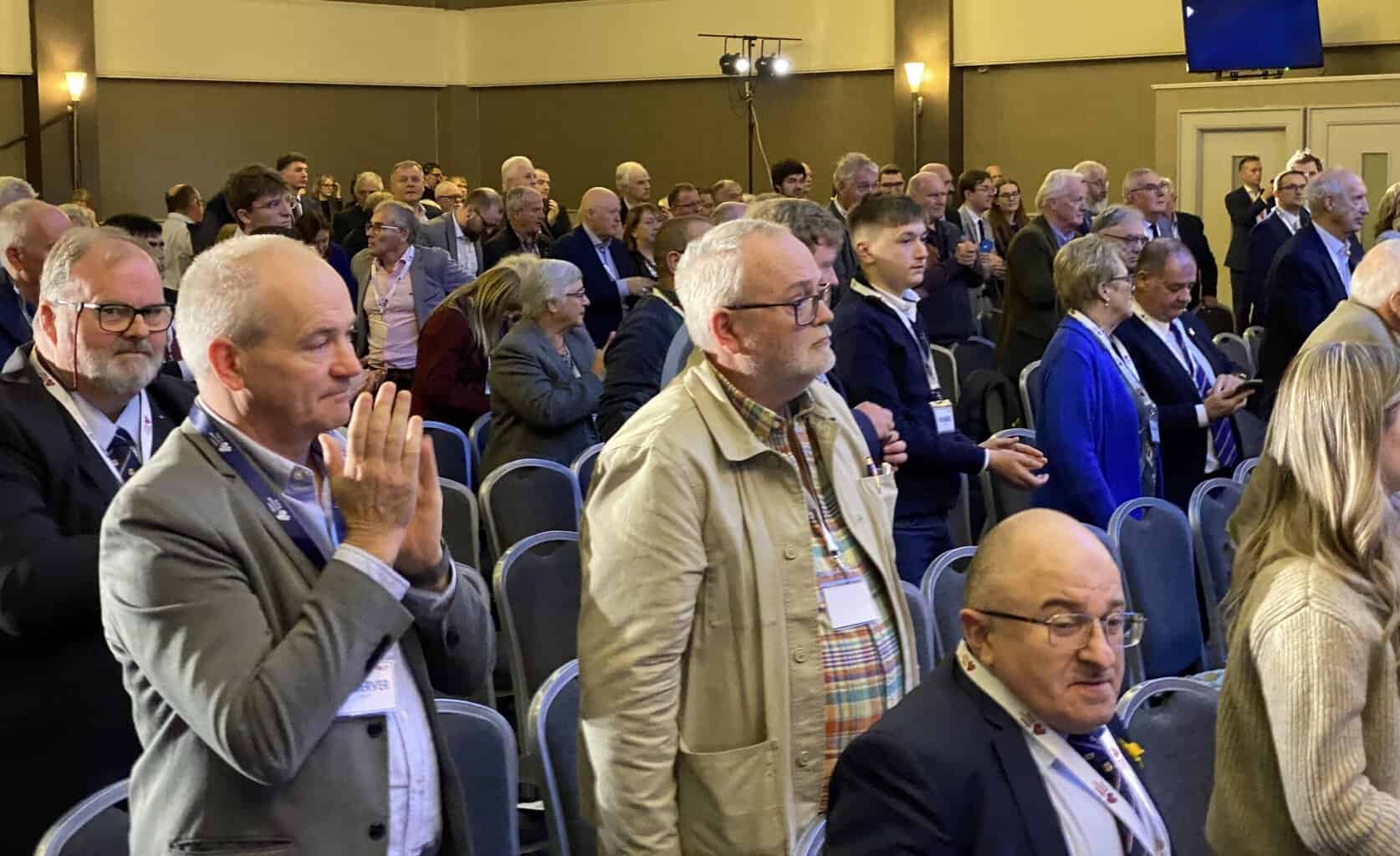
Delegates rose to give the leader a standing ovation, though he remained a lone figure on the stage, with no colleagues joining him for a celebratory moment and photo opportunity in the bright lights, before he quietly walked off. The national anthem (an unusual ceremonial brass band version that has tripped up the UUP members two years in a row) concluded the conference. The UUP need to practice their conference endings.

Alan Meban. Tweets as @alaninbelfast. Blogs about cinema and theatre over at Alan in Belfast. A freelancer who writes about, reports from, live-tweets and live-streams civic, academic and political events and conferences. He delivers social media training/coaching; produces podcasts and radio programmes; is a FactCheckNI director; a member of Ofcom’s Advisory Committee for Northern Ireland; and a member of the Corrymeela Community.
Discover more from Slugger O'Toole
Subscribe to get the latest posts sent to your email.


