
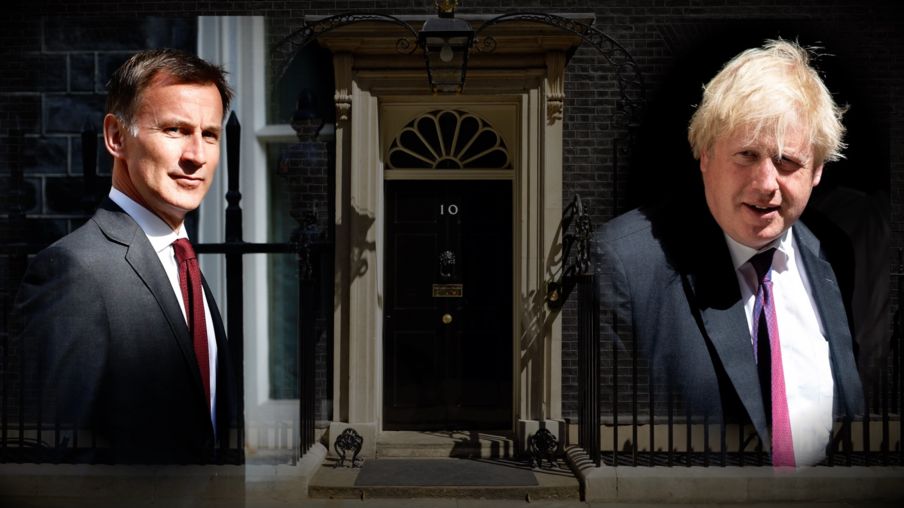
As the Tory leadership contest passes to the party’s version of the people, we may expect Boris Johnson’s approach to Brexit to come under scrutiny for the first time. We only know from the last vacuous TV debate that he like Gove and Hunt cannot “guarantee “ leaving on 31 October. However EU sources are saying they would only grant a deadline extension for a general election which would compel a halt to proceedings . The whole pretence of a firm deadline, ” no ifs, no buts” is falling apart just as the leadership election process enters its next phase. Katy Balls the Spectators’ poll corr who’s close to all Tory factions writes:
There’s a joke going around the various warring tribes in the Tory leadership contest. They might not win this time, they tell each other, but not to worry: ‘We’ll all meet again in November.’ The point is that whoever succeeds Theresa May is doomed: the 31 October deadline will pass not with Britain leaving the European Union but with a political crisis and a general election that will be won by Jeremy Corbyn. After that, the Tories will in a few months go through the whole process again — this time to pick a leader of the opposition. ‘We’re using this leadership campaign as a test run for when the whole thing collapses in the autumn,’ says one aide.
Some MPs are more optimistic and think the next prime minister will survive until Christmas — but generally, no one is at all sure how this will be resolved. The European Union is refusing point blank to change its Brexit deal, and parliament is full of MPs who suggest they’ll sooner vote down the government than allow a no-deal Brexit. Add to the mix a new leader ruling out any delay to Brexit and you get either a last-minute breakthrough or a collapse. Many Tories predict the latter. As one MP puts it: ‘Despite all the noise about moderate Tories coming out for Brexiteers, the parliamentary arithmetic [for a Brexit solution] has not changed.’ Only an election could change it.
Boris Johnson remains clear favourite to succeed May, in part because of his uncompromising Brexit position. Staying in the EU beyond 31 October, he says, could lead to the extinction of the party. With the exception of Esther McVey, all the candidates have promised to seek a new deal with the EU, but May is telling MPs that is a fantasy.
Taoiseach Leo Varadkar believes only an election would persuade the EU to grant an extension.
“There is very much a strong view across the European Union that there shouldn’t be any more extensions,” Mr Varadkar said in Brussels on Thursday.
“While I have endless patience, some of my colleagues have lost patience quite frankly with the UK and there is enormous hostility to any further extension.
“So I think an extension could really only happen to facilitate something like a General Election in the UK or perhaps something like a second referendum if they decided to have one,” Mr Varadkar said.
“What won’t be entertained is an extension for further negotiations or further indicative votes – the time for that is long since past
In a lengthy interview on the Today programme the anglophile Dutch PM Mark Rutte dismissed hard Brexiteer claims that a deal could be struck by 31 October. For the EU to engage, the new PM would a have to outline his plans in which a general election would have to figure.
Mr Rutte replied “no” when asked if there was any realistic prospect of a renegotiation of the deal before the Brexit deadline of 31 October. “What we could do is look together, collectively again at the political agreement which is below the withdrawal agreement – the political declaration,” he said. Any extension, he told BBC Radio 4’s Today programme, would require the future prime minister to outline his plan, “in terms of new elections, new referendums, making changes to the red lines” the UK currently has.
“If nothing is happening, it would mean after 31 October again going through the rounds – then there is no point in having an extension,” he said.
On the suggestion of negotiating a time-limit to the backstop, he went on: “Let’s go through that idea – you have a time limit on the backstop. That means in four, five, six years time if there is no other solution for the border issue, and I don’t think we’ll be able to have anything in place in four, fix, six years. Purely technically, and logistically.
“It will be a hard border in your scenario in four, five years. And do we want that? I don’t think so because this is the end of the Good Friday Agreement.
And he also made clear that there could not be a transition period if the UK leaves the bloc without a deal, saying: “As Boris Johnson would say, Brexit is Brexit. I would say a hard Brexit is a hard Brexit. I don’t see how you can sweeten it.”
Pressed whether he is prepared to have a no-deal Brexit, he continued: “No, I hate it. I hate Brexit from every angle, I hate a no-deal Brexit from every angle.
“With a hard Brexit – even with a normal Brexit – the UK will be a different country, it will be a diminished country.
To emphasise reality a new EU commissioning working paper has emphasised the integration of north-south cooperation, leading with agriculture.
According to the paper, the mapping exercise, conducted jointly by the EU and UK, showed “that virtually all areas of north-south cooperation are predicated on the avoidance of a hard border, including related customs or regulatory checks and controls”….. Strong North-South cooperation has contributed to ensuring that the island of Ireland is free from certain plant pests/diseases which exist elsewhere in Europe, including Great Britain.”
The paper repeatedly emphasises the link between the success of such programmes and the need to avoid a hard border, not least in regard to agricultural/food product checks which would be hugely disruptive. In the wake of BSE, the EU instituted rigorous border controls on its external borders on the passage of food and agricultural goods which would need to be imposed by the Irish Government in a no-deal situation unless the UK agreed to maintain, at least in Northern Ireland, an alignment of regulatory standards and procedures equivalent to the EU’s.
The mapping exercise demonstrated the link between environmental issues and commitments to avoid a hard border…
The commission has insisted that while it remains open to discussing elements of the Brexit deal – the political declaration – with the UK, it will not discuss no-deal scenario arrangements until after Brexit. Each side has set out in unilateral declarations some of the temporary emergency measures that will be necessary to avoid a cliff-edge departure.
On the island of Ireland that leaves considerable uncertainty, however, and arguably there may need for bilateral discussions with the UK to clarify what it accepts to be its continuing obligations under the Belfast Agreement.
The paper has the potential to strongly undermine the arguments that the Irish border dilemma can be solved by technology alone, as it points to a broad range of cross-border activity that goes well beyond the technical and fiscal aspects of customs and single market regulations.

Former BBC journalist and manager in Belfast, Manchester and London, Editor Spolight; Political Editor BBC NI; Current Affairs Commissioning editor BBC Radio 4; Editor Political and Parliamentary Programmes, BBC Westminster; former London Editor Belfast Telegraph. Hon Senior Research Fellow, The Constitution Unit, Univ Coll. London
Discover more from Slugger O'Toole
Subscribe to get the latest posts sent to your email.


