
Update.. May appears to back amnesty for former security forces
At Prime Ministers Questions on Wednesday, Mrs May said the issue of a statute of limitations was “very important”.
“At its heart, is the support and gratitude that we owe all those who have served in our armed forces,” she said.
“The situation we have at the moment is that the only people being investigated for these issues are those in our armed forces or those who served in law enforcement in Northern Ireland.
In February 2017, PSNI figures showed that investigations into killings by the Army accounted for about 30% of its legacy workload.
The police legacy branch is re-investigating 1,118 deaths not previously reviewed or completed by the now defunct Historical Enquiries Team (HET).
Of those killings, 530 were carried out by republicans, 271 by loyalists and 354 by the security forces.
Earlier during Northern Ireland Questions, the Secretary of State said the status quo regarding the legacy of the Troubles “sees a disproportionate emphasis on the actions of the military and law enforcement”.
Karen Bradley added there is “very little emphasis on the actions of paramilitary terrorists”.
She said she wants to see a consultation on creating new institutions so those concerns can be addressed.
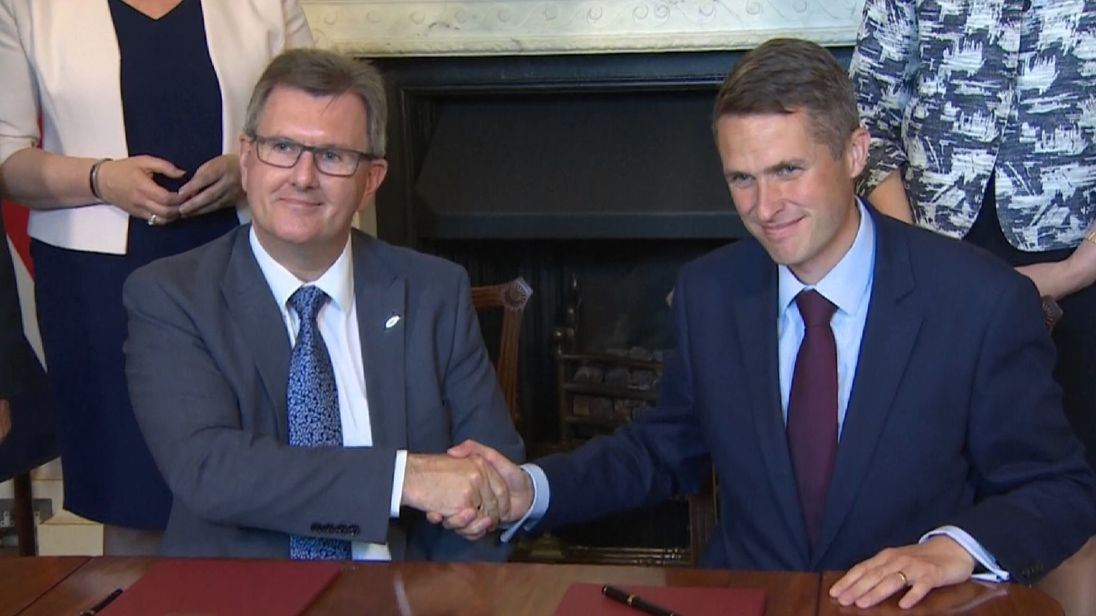
The latest cabinet “spat” leaked to the BBC seems to have delayed at the last minute, proposals in a Legacy Bill for the long awaited independent Historical Investigations Unit to take charge of evidence gathering for Troubles prosecutions. Although put forward in the Stormont House Agreement the plan has run into trouble from Conservative ministers including Gavin Williamson, the ambitious Defence Secretary (pictured), who as Conservative chief whip signed the confidence and supply agreement with the DUP’s Jeffrey Donaldson. The two are in lockstep with objections
that military veterans might not have enough protections under the proposed system.
Another minister who expressed worries said there had not been a huge argument, but that it had been made clear to the government that it had to do more to make sure that former military personnel weren’t unfairly targeted, or dragged through the courts.
This point of view is based on the popular misconception that former soldiers including the part time UDR /RIR may incur similar legal handicaps as troops who served in Iraq or Afghanistan where their human rights protection was unclear. The Daily Telegraph fought a campaign against ambulance chasing human rights lawyers on behalf of terrorists on legal aid bent on suing soldiers involved in operations. .
In so many words, some ministers and MPs are worried about the same thing happening here, with lawyers exploiting the fact that records were kept by the security forces unlike paramilitary organisations. ( But they kept records on terrorists too). ,
The big factor missing is the A word – amnesty. The last to opine on this was a group of civic unionists convened by Jeff Dudgeon who recommended a time limit for the HIU to complete the trawl through official records of thousands of outstanding cases, after which a line should drawn on prosecutions in the hope of encouraging voluntary “truth recovery”. The Conservatives and the DUP adamantly oppose an amnesty; now they seem to be opposed to even handed justice.
Jeffrey Donaldson turns the basic argument on its head. He says an amnesty must extend to Iraq and Afghanistan and cannot be confined to former security forces in NI to prevent the former IRA claiming an amnesty.
The Commons Defence select committee floated a selective amnesty for soldiers, only to realise on further examination that it might have to cover all sides.
The whole matter would be better left to the independent justice system to deal with. But now the superpatriotic ministerial objections may throw a spanner into the efforts of judges to speed up cases and inquests.
So confusion reigns and with it, the inevitable prospect of a new almighty and unenlightening row about equality before the law and no hierarchy of victims versus exploiting legal process to serve the republican narrative.
Will the Conservative right wing and the DUP manage to frustrate the sensible approach to dealing with the past? We wait and see how the government will jump.

Former BBC journalist and manager in Belfast, Manchester and London, Editor Spolight; Political Editor BBC NI; Current Affairs Commissioning editor BBC Radio 4; Editor Political and Parliamentary Programmes, BBC Westminster; former London Editor Belfast Telegraph. Hon Senior Research Fellow, The Constitution Unit, Univ Coll. London
Discover more from Slugger O'Toole
Subscribe to get the latest posts sent to your email.


